Tag Archives: Vietnam

Warship Wednesday, Nov. 27, 2024: Ron Three

Here at LSOZI, we take off every Wednesday for a look at the old steam/diesel navies of the 1833-1954 period and will profile a different ship each week. These ships have a life, a tale all their own, which sometimes takes them to the strangest places.- Christopher Eger

If you enjoy my always ad-free Warship Wednesday content, you can support it by buying me a cup of joe at https://buymeacoffee.com/lsozi

Warship Wednesday, Nov. 27, 2024: Ron Three

French Navy image

Above we see the white-hulled U.S. Coast Guard Reliance-class cutter Valiant (WMEC 621), steaming alongside the French Navy’s surveillance frigate FS Ventose (F733) on 29 Sept. 2024, while underway in the Windward Passage. Valiant, built in the 1960s, originally carried a 3″/50 DP gun of the same sort they used to put on submarines in WWII, but since the 1990s has only carried a 25mm chain gun forward. Ventose, which is only marginally larger than the cutter, totes a 3.9″/55 DP gun in a CADAM turret recycled from the old carrier Clemenceau.

The French, in their design concept behind Ventose and her sisters, intended them for solo overseas constabulary service, roughly akin to what the USCG’s large cutters have done for over a century Sadly, the Coast Guard long ago landed their big guns and today just have 57mm pop guns on even their largest cutters.

It wasn’t always like that.

Coast Guard Squadron Three

Immediately after the Gulf of Tonkin Incident in 1964, the Navy got heavily involved in Southeast Asia. One rub of the situation was that road-poor Vietnam had a river and stream-dotted 12,000-mile coastline and a myriad of some 60,000 small craft in its littoral. That meant the only way you could halt and screen this shallow-water maritime traffic was by getting your own shallow-water assets and the saga of the “Brown Water Navy” and Operation Market Time was born.

At first, the Navy tried to grow its own force from local vessels, the Junk Force, augmented by old destroyers, mine warfare vessels, and some 82-foot Coast Guard patrol boats, the latter the start of a decade-long multifaceted involvement by the Guard in Vietnam.

By August 1965, TF 115 comprised eight large U.S. Navy vessels (primarily DERs augmented by MSOs and MSCs), 11 Coast Guard WPBs, 15 VNN Sea Force ships, and 215 junks. These were soon augmented by hundreds of the new 50-foot PCFs (Swiftboats), and the Navy sent more and more old destroyers and escorts into the near-shore zone for interdiction and naval gunfire support.

ADM Roy Johnson, Commander Pacific Fleet, forced in March 1967 to reassign Market Time DERs to a new interdiction campaign, known as Operation Sea Dragon, against lines of communication in North Vietnam, requested five Coast Guard high endurance cutters (WHECs) to replace the DERs in the Market Time barrier. Thus was born Commander, Task Unit (CTU) 70.8.6 (Coast Guard Squadron Three).

The Ships

In early 1967, the Coast Guard had 37 of what they termed at the time “high endurance cutters,” larger ocean-going vessels that were expected to be pressed into service as destroyer escorts/patrol frigates should WWIII start.

Between 4 May 1967 and 31 January 1972, no less than 31 HECs completed lengthy deployments to Vietnam, one of them twice. These weren’t short cruises. All were at least six months long while many were well past that to nine or ten months. Keep in mind this was while the agency was still part of the civilian U.S. Transportation Department (they have been part of Homeland Security since 2003) and not transferred wholesale to the Navy as in WWI and WWII.

These 31 ships included six of six 327-foot Treasury-class cutters that had seen convoy escort and amphibious landing operations in WWII; nine of 18 smaller and almost as well-traveled 311-foot Casco-class cutters (former WWII Navy Barnegat-class small seaplane tenders); nine of 13 stubby 255-foot Owasco-class cutters which entered service just after WWII, and the seven of nine brand-new 378-foot Hamilton-class cutters which included such modern features as helicopter hangars and gas turbine powerplants.

Nine of the 18 311-foot Casco class cutters would serve in CGRON3 off Vietnam– and two of them would transfer to the RVNN at the end of their U.S. service (listing via the 1960 ed of Janes)

A big reason these were sent to Vietnam was that they had a relatively shallow draft (12.5 feet on the 311s and 327s, 17 on the 255s, and 15 on the 378s), allowing them to operate close to shore, surface search radar (SPS-23, augmented by SPS-29 air search), had a decent commo suite that allowed interfacing with Big Navy C4I assets, had crews familiar with sometimes sketchy coastwise interdiction in a littoral, and, most importantly, all carried a simple and easily supportable Mark 12 DP 5-inch gun (in enclosed Mk 30 single mountings with local Mk. 26 Fire Control) and knew how to use it.

The Deployments

In all, the 31 cutters sent to Vietnam steamed 1,292,094 combined miles on station, spending some 62.6 percent of their time underway conducting 205 Market Time patrols.

Five Casco class Barnegat class cutters 311 USCG Squadron Three, probably taken in Subic Bay on the way to Vietnam in 1967

CGRON3 headed to Vietnam in a column from Subic Bay

This was enabled by 1,153 underway replenishments and a smaller number of vertical replenishments.

At sea off Vietnam. Australian destroyer HMAS Hobart approaching a Mispillion class replenishment oiler USS Passumpsic (AO-107) as it is tanking a Coast Guard 311-foot HEC, likely CGC Pontchartrain. AWM Photo P01904.005 by Peter Michael Oleson.

The Coast Guard sent eight deployments of HECs to support CGRON3 with the first five each comprised of five high-endurance cutters. The sixth deployment included three high-endurance cutters, with two of the three turned over to the Vietnamese Navy at the end of the tour. The seventh and eighth deployments each consisted of just two cutters.

First Deployment

USCGC Barataria (WHEC 381) 4 May 67 — 25 Dec 67 (Casco)
USCGC Half Moon (WHEC 378) 4 May 67 — 29 Dec 67 (Casco)
USCGC Yakutat (WHEC 380) 4 May 67 — 1 Jan 68 (Casco)
USCGC Gresham (WHEC 387) 4 May 67 — 28 Jan 68 (Casco)
USCGC Bering Strait (WHEC 382) 4 May 67 — 18 Feb 68 (Casco)

Naval Base Subic Bay – USCG Squadron 3, first deployment, showing five freshly-painted Casco-class cutters alongside the repair ship USS Jason (AR-8) in late April before heading to Vietnam. Note this is before the Coast Guard adopting their now famous bow “racing stripe” 221206-G-G0000-120

A rusty and hard-serving USCGC Barataria (WHEC 381) off Vietnam in late 1967 showed a less than gleaming appearance. Note she doesn’t have a racing stripe yet and her 26-foot Monomoy is away. 230807-G-M0101-2004

From Barataria’s history: 

Barataria set a fast pace of effectiveness during her deployment in Vietnam waters. Underway 83 percent of the time, the cutter cruised over 67,000 miles without a major mechanical or electrical failure. Keeping a close watch on all moving craft in her surveillance area, Barataria detected, inspected, or boarded nearly 1,000 steel-hulled vessels traversing her area, any one of which could have been a trawler trying to sneak supplies to the enemy. Barataria was called upon many times to use her main battery against shore-based enemy troops who were aggressively engaged with Allied forces. Representative of the high state of readiness and training of the cutter’s men is the fact that U.S. Army spotter planes reported all rounds on target, never once falling out of the target area. On one mission three direct hits were scored on point targets that had been spotted by aircraft. She returned to the US on 12 January 1968 and was reassigned to San Francisco.

Second Deployment

USCGC Androscoggin (WHEC 68) 4 Dec 67 — 4 Aug 68 (Owasco)
USCGC Duane (WHEC 33) 4 Dec 67 — 28 Jul 68 (Treasury)
USCGC Campbell (WHEC 32) 14 Dec 67 — 12 Aug 68 (Treasury)
USCGC Minnetonka (WHEC 67) 5 Jan 68 — 29 Sep 68 (Owasco)
USCGC Winona (WHEC 65) 25 Jan 68 — 17 Oct 68 (Owasco)

255-foot Owasco class USCGC Minnetonka (WHEC 67), Vietnam

Of the above, Winona noted in her history that:

She steamed 50,727 miles, spent 203 days at sea, treated 437 Vietnamese, sunk one enemy trawler, destroyed 50 sampans and damaged 44 more, destroyed 137 structures and damaged 254, destroyed 39 bunkers and damaged 27, destroyed two bridges and damaged another, destroyed 3 gun positions and killed 128 enemy personnel, expending a total of 3,291 five-inch shells.

All in a day’s work.

Third Deployment

USCGC Bibb (WHEC 31) 4 Jul 68 — 28 Feb 69 (Treasury)
USCGC Ingham (WHEC 35) 16 Jul 68 — 3 Apr 69 (Treasury)
USCGC Owasco (WHEC 39) 23 Jul 68 — 21 Mar 69 (Owasco)
USCGC Wachusett (WHEC 44) 10 Sep — 1 Jun 69 (Owasco)
USCGC Winnebago (WHEC 40) 20 Sep 68 — 19 Jul 69 (Owasco)

USCGC Wachusett (WHEC-44) in the Vietnam era

“W O W . . . . . .The initials of these three high endurance cutters spell out that expression of surprise as they nest alongside Riviera Pier at the U.S. Naval Base, Subic Bay, R.P. The three, Winnebago, Owasco, and Winona, along with a fourth unit of Coast Guard Squadron Three, the Bibb, was in Subic Bay for inchop, outchop, and upkeep, marking the first time that this many ships of the five-cutter squadron had visited there since it was formed 18 months ago. The squadron is a part of the Seventh Fleet’s Cruiser Destroyer Group and the cutters serve on the Coastal Surveillance Force’s Operation Market Time in Vietnam.” COMCOGARDRONTHREE PHOTO NO. 101068-01; 18 October 1968; Dale Cross, JOC, USCG, photographer

Owasco’s history notes that on her Vietnam deployment:

By the end of her tour overseas, she had supplied logistical support to 86 Navy Swift boats and 47 Coast Guard 82-foot patrol boats. She had detected 2,596 junks and conducted 178 “actual boardings and 2,341 inspections,” exceeding the “results of any Squadron Three cutter thus far.” She conducted 17 Naval Gunfire Support Missions, firing 1,330 rounds of 5-inch ammunition.” She was officially credited with killing four enemy soldiers, destroying 18 bunkers, and damaging 10, destroying 11 “military structures” and damaging 17, destroying 550 meters of “Enemy Supply Trails,” destroying 1 sampan, 1 loading pier, and interdicting 3 “Enemy Troop Movements.” She carried out 49 underway replenishments while in theatre and her medical personnel carried out 7 medical and civil action programs (MEDCAP), treating 432 Vietnamese civilians.

Fourth Deployment

USCGC Spencer (WHEC 36) 11 Feb 69 — 30 Sep 69 (Treasury)
USCGC Mendota (WHEC 69) 28 Feb 69 — 3 Nov 69 (Owasco)
USCGC Sebago (WHEC 42) 2 Mar 69 — 16 Nov 69 (Owasco)
USCGC Taney (WHEC 37) 14 May 69 — 31 Jan 70 (Treasury)
USCGC Klamath (WHEC 66) 7 Jul 69 — 3 Apr 70 (Owasco)

Both Taney and Spencer had already seen much WWII service, with the former being at Pearl Harbor and the latter a bona fide U-boat slayer. Here, on April 17, 1943, USCGC Spencer sinks U-327. National Archives Identifier: 205574168 https://catalog.archives.gov/id/205574168

Fifth Deployment

USCGC Hamilton (WHEC 715) 1 Nov 69 — 25 May 70 (Hamilton)
USCGC Dallas (WHEC 716) 3 Nov 69 — 19 Jun 70 (Hamilton)
USCGC Chase (WHEC 718) 6 Dec 69 — 28 May 70 (Hamilton)
USCGC Mellon (WHEC 717) 31 Mar 70 — 2 Jul 70 (Hamilton)
USCGC Pontchartrain (WHEC 70) 2 Apr 1970 — 25 Oct 1970 (Owasco)

Sixth Deployment

USCGC Sherman (WHEC 720) 22 Apr 70 — 25 Dec 70 (Hamilton)
USCGC Bering Strait (WHEC 382) 17 May 70 — 31 Dec 70 (Casco)
USCGC Yakutat (WHEC 380) 17 May 70 — 31 Dec 70 (Casco)

Seventh Deployment

USCGC Rush (WHEC 723) 28 Oct 70 — 15 Jul 71 (Hamilton)
USCGC Morgenthau (WHEC 722) 6 Dec 70 — 31 Jul 71 (Hamilton)

Eight Deployment

USCGC Castle Rock (WHEC 383) 9 Jul 71 — 21 Dec 71 (Casco)
USCGC Cook Inlet (WHEC 384) 2 Jul 71 — 21 Dec 71 (Casco)

Interdiction

The primary reason for these big cutters to be in Vietnamese waters was to sanitize them by combing out vessel traffic smuggling contraband, primarily small arms and munitions, to Viet Cong guerillas in the south. They did this in spades, closing with some 69,517 vessels in the five years that CGRON3 was part of Market Time. Of these, no less than 50,000 were inspected alongside, while 1,094 were boarded and searched.

At Sea – USCG Squadron 3, Vietnam. Note the 26-foot Mark V Motor Surf Boat, YAK2, likely from CGC Yakutat, dating the photo to 1970. The nine-man crew includes at least two M16s and five flak jackets, hinting at a five-man boarding team. 221206-G-G0000-119

CGC Winona on Market Time Patrol by JOC Dale E. Cross, USCG. Note the M16-armed Coastie on the lookout to the right while the flak-vest-equipped junior officer goes over a mariner’s papers. 231220-G-G0000-107

CGC Winona on Market Time Patrol by JOC Dale E. Cross, May 16, 1968. Release No. 36-68 231220-G-G0000-106

New armaments were fitted to assist with this type of seagoing asymmetric warfare. Cutters typically picked up at least two (later cutters carried as many as six) .50 caliber air-cooled M2 Brownings on pintel mounts.

Also new were pintel-mounted 81mm mortars which could be used either for launching illumination parachute rounds, in counter-ship operations, or in suppressing fire near-shore (out to 4,500 yards).

At Sea – USCG in Vietnam – Market Time – Squadron Three with a detainee on deck, one of at least 128 detained and handed over to local ARVN assets. Note the loaded M2 .50 cal to the left and the sidearm-equipped CPO on watch. 221206-G-G0000-121

CGC Klamath on Market Time, showing off her new 50 cal and mortar emplacement

The 81mm mortar was mounted on either side of the No. 1 (5-inch) mount

311-foot Casco (Barnegat) class cutter Half Moon firing the 5″/38 on NGFS in Vietnam. Note the two mortars on the base of the superstructure between the ship’s Hedgehog ASW device

Campbell’s mortar team

Campbell’s mortar team “hanging an 81” ashore

The circa early 1960s small arms lockers for HECs included 40 M1 rifles, five M1 carbines, 17 .45 caliber M1911s, two Thompson SMGs, and two M1919 .30-caliber LMGs. With Vietnam on the schedule, this was updated.

Clark’s Commandos: CGC Klamath’s Market Time boarding team. Note the M16s, flak vests, .45s, and shotguns

Campbell’s boarding team, casual in flak vests and cut-off dungaree shorts, complete with M16s

From Shots that Hit, a Study of USCG Marksmanship, 1790-1985 by William Wells:

The cutters exchanged their M1 rifles and Thompson SMGs for the M16 rifle. However, many Coast Guardsmen were exceptionally adept at procuring arms of any nature. The use of revolvers in many calibers and models was common, as were communist weapons of which the AK-47 was the favorite. In addition to the M16, the M79 grenade launcher and the M60 machine gun were added. As far as weapons on board the cutters, it was an anything-goes allowance.

Naval Gunfire Support

The large cutters of CGRON3 conducted no less than 1,368 combined NGFS missions, firing a staggering 77,036 5-inch shells ashore. Keep in mind that most of these cutters only carried about 300 rounds in their magazines, so you can look at that amount of ordnance expended being something like 250 ship-loads.

Minnetonka (WHEC-67) providing fire support during the Vietnam War. Note the loose uniform of the day

Minnetonka’s 5-inch “Iron Hoss” blistered after all-night fires

USCGC Wachusett (WHEC-44) NGFS Vietnam

CGC Waschusett At Sea with USCG Vietnam Squadron 3, logging gunfire missions, with the spades due to “digging dirt.” 221206-G-G0000-118

USCGC Cook Inlet conducts a fire support mission off the coast of Vietnam, in 1971

Color photograph of Cutter Duane performing gunfire support mission with its forward 5-inch gun off the coast of Vietnam. U.S. Coast Guard photo.

PONTCHARTRAIN NGFS Vietnam 1970 Photo by LeRoy Reinburg

5/”38 from USCG Hamilton-class cutter providing NGFS off Vietnam

Powder and shell consumption was so high that some cutters would have to underway replenish or VERTREP 2-3 times a week while doing gun ops.

“Crewmen cart high explosive projectiles across the deck of the 311-foot U.S. Coast Guard Cutter Half Moon for the ship’s five-inch gun to hurl at a Viet Cong emplacement near a U.S. Special Forces Camp in the Song on Doc area, South Vietnam.” Coast Guard Photo Rel. No. 6215; 12/67;

PONTCHARTRAIN receiving 5-inch powder cases UNREP Vietnam 1970 Photo by LeRoy Reinburg

As described by John Darrell Sherwood in his War in the Shallows: U.S. Navy Coastal and Riverine Warfare in Vietnam:

To the casual observer, the all-white hulls of Market Time’s high-endurance cutters looked like angels of mercy, but the 5-inch 38-caliber gun mounts on these ships could let loose significant destructive power upon an unsuspecting enemy up to nine miles away. Nine men worked in the cramped confines of these turrets, enduring extreme heat and the ever-present smell of gun grease and cordite, to place ordnance on targets.

In built-up areas like Song On Doc, where the Viet Cong often sheltered in structures, the methodology for dislodging defenders was to set the initial rounds to burst in the air to kill anyone exposed outdoors. Assuming troops will then run for bunkers and slit trenches soon after a bombardment begins, the next shots would be set to hit the ground and explode. Gunners would then walk the rounds across a target area like a checkerboard so as to cover as much of the kill zone as possible. White phosphorus represented the grand finale. Since many Vietnamese structures were made of bamboo, it did not take many well-placed WP rounds to transform a small village or small settlement into smoldering ashes. Shards of white phosphorus extending outwards from an airburst shot literally created a rain of fire, igniting everything in a wide dispersal area.

Commander Herbert J. Lynch, who commanded Winona (WHEC-65) in early 1968, claims it was “nothing to fire 50 rounds of shoreside support. We did so much shooting we had to re-barrell the gun.”

The shallow draft of the cutters was key.

Again, Sherwood:

Although many of these rounds consisted of unspotted harassment and interdiction missions that did little more than tear up ground and knock down palm trees, when Coast Guard vessels were allowed to fire at actual targets, the results could be devastating. For instance, on 27 August, Half Moon conducted a gunfire mission against Viet Cong troops operating on the Ca Mau Peninsula in An Xuyen Province. Subsequent intelligence reports stated that 5-inch fire destroyed three enemy buildings and killed 11 Viet Cong.

On 26 September 1967, Yakutat (WHEC-380) destroyed or damaged 27 fortified enemy positions, four sampans, and an enemy canal blockade in a single gunfire support mission off the coast of An Xuyen Province.

The high endurance cutters, with their relatively shallow 22-foot draft, were the only ships with 5-inch guns capable of operating in the shallow waters of An Xuyen Province and much of the rest of the IV Corps area.

“Sometimes we would go into areas with only one or two feet clearance between the hull and sea floor,” recalled Captain Robert W. Durfey, who commanded Rush (WHEC-723) in 1970, but “fortunately the bottom was mostly mud.”

Another anecdote from the USCG Historian’s office:

The Cutter Rush, working with an Australian destroyer, brought its guns to the aid of a small Special Forces camp in the village of Song Ong Doc. The village, located in the middle of Viet Cong-held territory, was being overrun. Gunfire from the two ships drove off the attackers and left 64 Viet Cong dead.

The results, as reported back by ground and air observers, included 2,612 structures destroyed, another 2,676 damaged, and body counts (Vietnam was big on body counts) including 529 enemy KIA and 243 enemy WIA.

Surface engagements

When it came to fighting often heavily-armed enemy cargo trawlers, several pitched sea fights, typically at night, are all but lost to history.

One such fight in March 1968, as told by Sherwood:

The Coast Guard cutter Androscoggin (WHEC-68) made radar contact with the infiltrator at 2047 local time and began maintaining covert surveillance. Early in the morning of 1 March, the trawler crossed into the 12-mile contiguous zone 22 miles from Cape Batangan, and Androscoggin soon challenged it by firing an illumination round. The trawler responded with machine gun fire, and Androscoggin returned fire with her 5-inch 38-caliber guns, hitting the trawler in the starboard quarter. Army helicopter gunships, Point Welcome, Point Grey, and PCFs -18 and -20 joined the attack as the trawler headed toward the beach. At 0210, the trawler beached itself and blew itself up in two attempts. During the battle, machine-gun rounds hit Androscoggin and other units but caused no casualties. Salvage crews later recovered a variety of military cargo from the scene, including 600 rifles, 41 submachine guns, and 11 light machine guns along with ammunition. Of the North Vietnamese crew, all that was recovered was a head and a full set of teeth.

Another fight on the same night saw Winona close to within 550 yards of an armed trawler that lit up the cutter with a mix of .50 caliber and .30 caliber machine guns, hitting the little 255-foot cutter at least 13 times and wounding three of her crew. Once Winona got her 5-incher into play, however, the trawler “disintegrated” with the entire fight lasting just two minutes.

From her history:

“We shadowed the trawler for six long hours into the night before it finally turned for the beach, our cue to intercept. Closing to 700 yards we illuminated and challenged them to stop when a running gun battle ensued. The effect in the night outfourthed the 4th of July. .50 cal. tracers, fiery red in the black, streaked both ways, punctuated by 5″ gun flashes, white with the intensity of burning magnesium. The ricochets whined off into the distance, or metal piercing rounds thwacked through steel. For seven minutes we fought until a 5” round found home at the base of the trawler’s deckhouse, and the night was day, and our ship rocked from the explosion that rained debris on our decks. For meritorious achievement that night, Captain Lynch was awarded the Bronze Star. Lt. Commander [J.A.] Atkinson, conning officer, Lt. [M.J.] Bujarski, gunnery officer, and BM3 “Audie” Slawson, director operator were awarded Navy Accommodation Medals. All four were authorized a Combat “V”.”

There were no enemy survivors. Enemy fire pierced Winona’s hull and deckhouse six times and also left several dents but she sustained no personnel casualties.

Capt. Paul Lutz describing the battle between the cutter Sherman and the large armed trawler SL3 at the mouth of the Mekong on the night of 21 November 1970:

“Sherman sinks armed enemy vessel, SL3, at Mekong River mouth, 21 November 1970” by John Wilinski

After the first round in direct fire with point detonating rounds, I saw an explosion and a bright illumination of the enemy vessel. I knew that prior enemy vessels had usually destroyed themselves when caught by allied forces and accordingly I thought it must be a self-destruct explosion. However, as our succeeding rounds showed as they hit there was the same marked explosion and a vivid illumination of the enemy vessel. Sherman was firing her forward 5″ 38 caliber gun at a maximum rate of fire (as I remember 18 rounds/minute) and every round hit and brilliantly illuminated the enemy. The rhythmic hit, hit, hit, etc. were synchronized with the firing of Sherman’s 5-inch gun and were awesome to observe. After about 8 to 10 rounds (and hits), taking about one half a minute the enemy ship was stopped and brightly burning.

Navy divers later found the trawler full of .60 caliber machine guns and recoilless rifles along “with enough ammunition and weapons to arm a division.”

Motherships

Operating between two and 20 miles offshore, these big cutters were often the closest thing to “The Fleet” that was available to the truly small boats that were running missions inshore.

They proved a home away from home for the growing fleet of CGRON1’s 82-foot patrol boats, of which ultimately 26 were deployed to Vietnam.

Point class cutter refueling from USCGC Dallas in Vietnam

Point class refueling from USCGC Dallas in Vietnam.

USCGC Point Lomas (WPB-82321) alongside the 327-foot USCGC Duane WHEC 33 1968 Vietnam

They also proved of vital support to Navy PCFs, with the small 50-foot Swiftboats typically having to swap out crews every 24 hours to remain on station. This meant lots of hot meals provided for these Brown Water sailors in the cutters’ mess, cold seawater showers, and a place to drop off mail and grab an (often warm) bunk. Then of course the boats would top off their fuel and water, and grab some snacks and ammo as a parting gift before motoring off with a rotated crew.

CGC Bibb in Vietnamese waters with a six-pack of nursing Swiftboats 200227-G-G0000-1003

The cutters also served as a floating hospital, with the ship’s corpsmen and public health service doctors ready to do what they could.

Wounded Swiftboat personnel being transferred to USCGC Campbell

As told by Mendota, who was only a 255-footer herself, a good 30 feet smaller than any cramped destroyer escort fielded in WWII!:

Mendota was not only home to the 160 men who were permanently assigned as her crew. She also served as a mother ship to U.S. Navy Swift boats and their crews, and to a lesser degree the Coast Guard 82-foot patrol boats, which operated in the inner barrier closer to shore. Mendota serviced the 82-footers 40 times during her stay while the Swift boats received logistic support daily, and the crews alternated being on board Mendota every other day. The medical staff also aided 51 men who had been wounded in action.

In all, CGRON3 logged 1,516 small craft replenishments over its five-year history.

Medcaps

As part of the “winning hearts and minds” concept, these big cutters were also active in humanitarian initiatives during lulls in combat. Ongoing Medical Civil Action Program, or MEDCAP, services saw the cutters land their medical personnel ashore to provide public health aid to locals.

This is well-told by Chief Hospital Corpsman Joseph “Doc” White, who served on CGC Bering Strait in 1970 and had to race ashore to respond to an attack on Song Ong Doc village.

Chief Joe White providing medical care to local Vietnamese and their children during a visit to a village in South Vietnam. (Via Mrs. Misa White, USCG photo 201218-G-G0000-1003)

“Doc” White providing medical care to wounded Vietnamese villagers. (Via Mrs. Misa White, USCG photo 201218-G-G0000-1005)

Besides the MEDCAPs, the cutter’s crews were also involved in assorted Civic Action Projects that ranged from installing playground equipment at a village school to passing the hat for enough donations for a refrigerator for the Saigon School for Blind Girls.

As detailed by Sebago’s history:

She was assigned to Coast Guard Squadron Three, Vietnam, serving in theatre from 2 March to 16 November 1969, while under the command of CDR Dudley C. Goodwin, USCG. She was assigned to support Operation Market Time, including the interdiction of enemy supplies heading south by water and naval gunfire support [NGS] of units ashore. By July 1968, she had conducted 12 NGS missions, destroying 31 structures, 15 bunkers, 2 sampans, and 3 enemy “huts.”

Combat duties were not all the cutter did. The Sebago’s medical staff, including the cutter’s doctor, Public Health Service LT Lewis J. Wyatt, conducted humanitarian missions in Vietnam, treating over 400 villagers “for a variety of ills.” The crew visited the village of Co Luy, 80 miles south of Da Nang, and built an 18-foot extension to a waterfront pier for the villagers. She also served as a supply ship for Coast Guard and Navy patrol boats serving in Vietnamese coastal waters.

This from sistership Mendota:

The crew of Mendota also participated in humanitarian missions while serving in Vietnam. These missions were concentrated on the village of Song Ong Doc, on the Gulf of Thailand. The medical team conducted MEDCAPS (Medical Care of the Civilian Population), treating over 800 Vietnamese for every variety of medical malady during 14 visits to the village. The crew also helped rebuild a small dispensary. In addition, assistance was rendered to Vietnamese and Thai fishermen who were injured while fishing. U.S. and South Vietnamese forces were also treated by the medical personnel.

Being the Coast Guard, the big cutters took a break from walking their Market Time beat to respond to numerous calls for assistance from mariners in distress.

This included Bibb responding to the Thai M/V Daktachi and her shop crafting her a new drive shaft for her broken fuel pump, Campbell aiding the Filipino vessel Carmelita which had a broken propeller shaft and was drifting in the San Bernadino Strait, Morgenthau rescuing 23 survivors from the sinking merchant ship Joy Taylor, and Owasco pulling off the crew of the SS Foh Hong and towing the flooded vessel to safety. One cutter, Winnebago, chalked up three different maritime rescues, going to the assistance of the swamped Vietnamese coastal freighter Thuan Hing, pulling 35 people from the distressed M/V Fair Philippine Anchorage, and responding to an SOS from SS Aginar.

Endgame

As part of Vietnamization, the Coast Guard did a lot of out-building for the South Vietnamese Navy. The 26 Point class cutters of CGRON1 were all handed over in warm transfers by 1971. Of the 18 311-foot Casco-class cutters operated by the USCG, seven– Absecon, Chincoteague, Castle Rock, Cook Inlet, Yakutat, and Bering Strait — were transferred to South Vietnam in 1971 and 1972.

The last two, Bering Strait and Yakutat, were selected to be used by the Vietnamese Navy as offshore patrol units and operated hybrid mixed crews for the last half of 1970. This earned Bering Strait a haze-grey scheme.

Profile photograph of High-Endurance Cutter Bering Strait in a rare paint scheme of haze gray with Coast Guard “Racing Stripe.” Mackinaw. (Mrs. Misa White)

As detailed by Tulich:

They arrived in Subic Bay in June 1970 with a small cadre of Vietnamese on board, which was supplemented by another contingent at Subic. The VNN personnel were taught the operations of the ship and soon took over important positions in CIC boarding parties, NGFS details, and repair crews. The VNN also performed the external functions of the ship, especially boardings. The VNN officers soon became underway and in-port OODs. Teams assumed engineering watches, navigated, piloted, and provided all the control and most other positions in the NGFS teams. Their training became apparent when a combined USCG/VNN rescue and assistance party from Yakutat extinguished a serious fire and performed damage control on a USN landing ship.

The transfer of Bering Strait and Yakutat at the end of their 1970 deployment, in full color (but silent):

CGRON3 was formally disestablished on 31 January 1972, leaving three shore establishments– the Con Son and Tan My LORAN stations and the USCG Merchant Marine Detachment in Saigon– as the last remnants of the service’s efforts in Vietnam. Even those would be gone by 5 May 1973 when the final Coast Guard personnel departed the country.

Ingham returning from Vietnam in 1969

USCGC Duane (WHEC-33) returning from Vietnam, 1968

Between 1965 and 1973, the USCG sent some 8,000 men to Vietnam– nearly a quarter of its active force– with the bulk of these, more than 6,000, being those afloat with CGRON3.

Seven Coast Guardsmen were killed in action, all with the smaller patrol boats of CGRON1, and their names are listed on the Vietnam Veterans Memorial in Washington, DC. Another 59 were seriously wounded in combat.

Epilogue

Of the seven large cutters handed over to the VNN in 1971-72, six escaped to the Philippines after the fall of Saigon in 1975 and went on to be used to varying degrees by the Filipino Navy for another decade. The seventh ship, the former CGC Absecon, was captured and bore a red flag as part of the Vietnam People’s Navy into the 1990s.

The Coast Guard eventually whittled down its remaining Vietnam Veteran cutters with two, Taney and Ingham, preserved as floating museums in Maryland and Florida, respectively.

USCGC Ingham, both a WWII and Vietnam Vet, retired in 1988, is well-preserved in Key West (Photo: Chris Eger)

The last cutter in service that had fired shots into Vietnam in anger, CGC Mellon, only decommissioned on 20 August 2020, capping a 54-year career.

Ironically, Mellon is slated to be transferred to the Vietnam People’s Coast Guard at some point in the future, where she will join former CGRON3 sister Morgenthau, which has been flying a red flag since 2017.

Vietnamese Coast Guard’s patrol ship CSB-8020, formerly the Hamilton-class cutter USCGC Morgenthau (WHEC-722)

Meminisse est ad Vivificandum – To Remember is to Keep Alive


Ships are more than steel
and wood
And heart of burning coal,
For those who sail upon
them know
That some ships have a
soul.


If you liked this column, please consider joining the International Naval Research Organization (INRO), Publishers of Warship International

They are possibly one of the best sources of naval study, images, and fellowship you can find. http://www.warship.org/membership.htm

The International Naval Research Organization is a non-profit corporation dedicated to the encouragement of the study of naval vessels and their histories, principally in the era of iron and steel warships (about 1860 to date). Its purpose is to provide information and a means of contact for those interested in warships.

With more than 50 years of scholarship, Warship International, the written tome of the INRO has published hundreds of articles, most of which are unique in their sweep and subject.

PRINT still has its place. If you LOVE warships you should belong.

I’m a member, so should you be!

Welcome, Hannah!

80 years ago today:

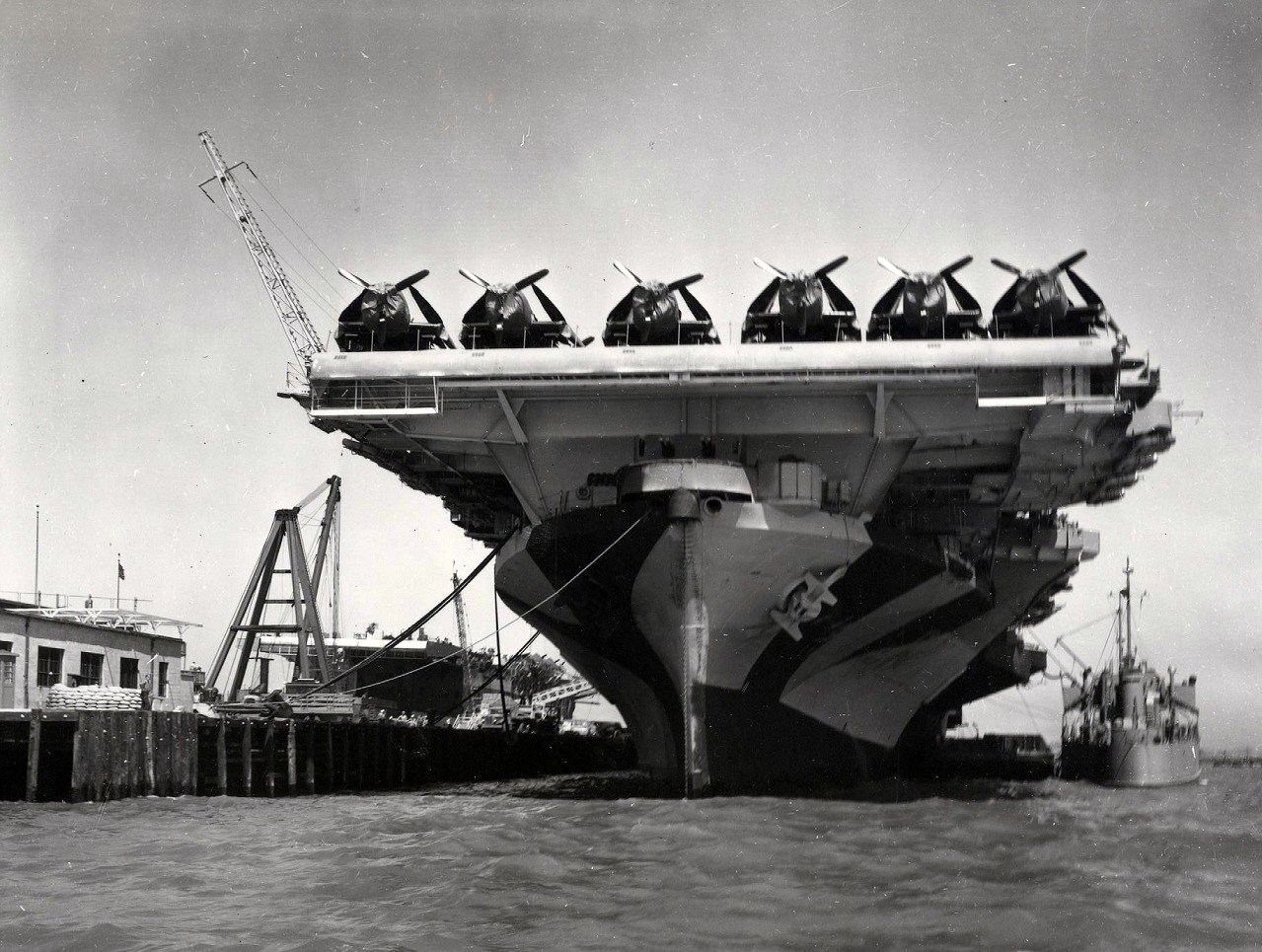
A great shot of the brand new Essex-class fleet carrier USS Hancock (CV-19) underway in Boston harbor on 15 April 1944, the day of her commissioning from the Fore River Shipyard at Quincy, Massachusetts. The paint scheme is Measure 32, Design 3A; note the small hull number on the Dull Black bow area.

Official US Navy photograph from the collections of the Naval History and Heritage Command (NH&HC), # NH 91546.

As noted of this image by Wolfgang Hechler at Navsource:

Hancock was the only “long bow” Essex to wear Design 3A. Since all the Pattern Design Sheets had been prepared for “short bow” Essexes, there were several noticeable differences in the bow area for Intrepid (CV-11), Hornet (CV-12), and Franklin (CV-13)—compare, for example, to this photo of Intrepid. Two 40-mm quad AA mounts were fitted on the extended forecastle of the “long hull” ships. Hancock had two more 40-mm mounts on the fantail but none on the starboard side, amidships. There were four deck-edge masts.

Just six months after the above image was snapped, the new carrier had completed shakedowns and air group quals then joined the Pacific Third Fleet in time for the brutal Philippines Campaign in October 1944.

Hannah earned four battle stars in her short but hectic WWII service. Reconstructed twice during the Cold War (SCB-27C then later SCB-125), she was dubbed an attack carrier (CVA-19) and went on to complete nine deployments to Vietnam– eight with Carrier Air Wing 21 (CVG/CVW-21), and one with CVW-5.

She would earn 13 Vietnam battle stars along with five Navy Unit Commendations and was present for the endgame in April 1975 when Saigon fell, saving 2,500 souls.

USS HANCOCK (CVA-19) With men of VA-55 and crew members information of “44-74” in honor of the ship’s thirty years of service. Photo taken 3 January 1974 by PH1 Cook. NH 84727

Of her sisters, the wooden-decked Hancock outlived all in the fleet except the training carrier USS Lexington and 1950s latecomer USS Oriskany. Even with that, the newer (and steel-decked!) Oriskany was laid up just eight months after Hannah.

Decommissioned for the last time on 30 January 1976 and struck from the Navy list the following day, Hannah was sold for scrap that same September.

Warship Wednesday, March 27, 2024: That Time a Jeep Carrier Airshipped an Indian Army Brigade

Here at LSOZI, we take off every Wednesday for a look at the old steam/diesel navies of the 1833-1954 period and will profile a different ship each week. These ships have a life, a tale all their own, which sometimes takes them to the strangest places.- Christopher Eger

Warship Wednesday, March 27, 2024: That Time a Jeep Carrier Airshipped an Indian Army Brigade

U.S. Defense Imagery VIRIN: 111-C-9093 by Van Scoyk (US Army), via the U.S. National Archives 111-C-9093

Above we see, on the center-line forward elevator of the Commencement Bay-class escort carrier USS Point Cruz (CVE-119), a great original Kodachrome showing a 25-man stick of Enfield-armed Indian Army troops ready to be airlifted ashore by five waiting H-19s to Panmunjom, Korea during Operation Platform on 7 September 1953. It was a remarkable achievement: vertically inserting 6,061 combat-ready Indian troops some 30 miles inshore in 1,261 helicopter sorties without losing a single man or bird.

You’ve never heard of Operation Platform? Well, stand by for the rundown.

The Commencement Bays

Of the 130 U.S./RN escort carriers– merchant ships hulls given a hangar, magazine, and flight deck– built during WWII, the late-war Commencement Bay class was by far the Cadillac of the design slope. Using lessons learned from the earlier Long Island, Avenger, Sangamon, Bogue, and Casablanca-class ships. Like the hard-hitting Sangamon class, they were based on Maritime Commission T3 class tanker hulls (which they shared with the roomy replenishment oilers of the Chiwawa, Cimarron, and Ashtabula-classes), from the keel-up, these were made into flattops.

Pushing some 25,000 tons at full load, they could make 19 knots which was faster than a lot of submarines looking to plug them. A decent suite of about 60 AAA guns spread across 5-inch, 40mm, and 20mm fittings could put as much flying lead in the air as a light cruiser of the day when enemy aircraft came calling. Finally, they could carry a 30-40 aircraft airwing of single-engine fighter bombers and torpedo planes ready for a fight or about twice that many planes if being used as a delivery ship.

Sounds good, right? Of course, had the war run into 1946-47, the 33 planned vessels of the Commencement Bay class would have no doubt fought kamikazes, midget subs, and suicide boats tooth and nail just off the coast of the Japanese Home Islands.

However, the war ended in Sept. 1945 with only nine of the class barely in commission– most of those still on shake-down cruises. Just two, Block Island and Gilbert Islands, saw significant combat, at Okinawa and Balikpapan, winning two and three battle stars, respectively. Kula Gulf and Cape Gloucester picked up a single battle star.

With the war over, some of the class, such as USS Rabaul and USS Tinian, though complete were never commissioned and simply laid up in mothballs, never being brought to life. Four other ships were canceled before launching just after the bomb on Nagasaki was dropped. In all, just 19 of the planned 33 were commissioned.

But we are getting ahead of ourselves.

Meet Point Cruz

Our boat was initially named Trocadero Bay— for a strait in the eastern part of Bucareli Bay in the Prince of Wales archipelago of Alaska– in line with the “Bay” naming convention at the time for escort carriers. Laid down at Todd Pacific Shipyards in Tacoma on 4 December 1944, she was subsequently renamed Point Cruz to honor the decisive three-day battle in November 1942 on Guadalcanal.

Point Cruz (CVE-119) was launched on Friday, 18 May 1945, NARA 80-G-345301.

Launched a week after VE Day, her construction ended just after VJ Day and she was commissioned on 16 October 1945, a war baby completed too late for her war.

Flight deck of the USS Point Cruz with Avengers and Corsairs, off of San Diego, November 1945

Following trials and shakedowns off the West Coast, Point Cruz spent about a year shuttling aircraft to forward bases around the Western Pacific before reporting to Puget Sound Naval Shipyard in March 1947 for inactivation. Decommissioned three months later, she was laid up in the Pacific Reserve Fleet at Bremerton without firing a shot in WWII.

Bremerton, Washington, aerial view of the reserve fleet berthing area at Puget Sound. 25 October 1951. Ships present include USS Indiana (BB-58); USS Alabama (BB-60); USS Maryland (BB-46); USS Colorado (BB-47); and USS West Virginia (BB-48). Four Essex (CV-9) class CVs one Commencement Bay (CVE-105) class CVE in the foreground– possibly Point Cruz– one Independence (CVL-22) class CVL, as well as numerous CA, CL, DD, DE, and auxiliary-type ships are also visible. 80-G-435494

Headed to Korea

With the sleepy early Cold War peace shattered when the Norks crossed the 38th Parallel in 1950, the Navy was soon reactivating gently used ships from mothballs to sustain the high tempo carrier, fire support, and amphibious warfare operations off the Korean coast. Point Cruz was dusted off and recommissioned on paper on 26 July 1951 but would spend the next 18 months in an extensive overhaul modifying her for use as an ASW Hunter-Killer Group carrier.

Our girl only got underway for Sasebo in January 1953. There, on 11 April, she would embark the scratch air group consisting of F4U-4B Corsairs of VMF-332 and TBM-3W/3E Avengers of VS-23, along with a HO3S-1 helicopter det from HU-1 for C-SAR, and would go on to patrol the Korean coast for the last four months of the conflict.

Vought F4U-4 Corsair fighters assigned to U.S. Marine Corps attack squadron VMA-332 Polka-dots aboard the escort carrier USS Point Cruz (CVE-119) on 27 July 1953 during a deployment to Korea. “Replacing the VMF-312 Checkerboards, which had a red and white checkerboard painted around the engine cowlings, VMA-332, somewhat mockingly, adopted the red polka dots on white background. The design was reminiscent of Captain Eddie Rickenbacker’s ‘Hat in the Ring’ Squadron of World War I. The addition of the hat and cane was derived from the squadron tail letters (MR), being the abbreviation of ‘mister’, and feeling they were gentlemen in every regard, the hat and cane were adopted as accouterments every gentleman has. It was then that the squadron picked up the nickname VMA-332 Polkadots.” Photo by Cpl. G.R. Corseri, USMC

USS Point Cruz (CVE 119) at sea, east of Japan, 23 July 1953. She has anti-submarine aircraft on her flight deck including seven TBM-3S and TBM-3W Avengers and one HO4S helicopter. 80-G-630786

Op Platform

When the Korean War Armistice came about, our little flattop was tasked with her role in Operation Platform (Operation Byway by the U.S. Army and Operation Patang/Kite by the Indian Army), airlifting Indian troops to the Panmunjom neutral buffer zone– without touching South Korea– to supervise the neutral repatriation of some 22,959 North Korean and Chinese POWs, many of which didn’t want to return to their home countries. It would take nine months for these men to either be sent back to their homeland or a neutral country under the agreement that halted the war.

The “hop, skip, and a jump” logistics of Platform/Byway/Patang began with the “hop” of six Allied transports (two Indian, two American, and two British) carrying 6,061 men of the hand-picked five-battalion 190th Indian Brigade from Japan under Brigadier Rajinder Singh Paintal, a formation that would become the post-war Custodian Force India (CFI).

Consisting of some of the most storied units of the Indian Army, many of these men had seen combat in WWII and were professional soldiers. The force was under the overall command of Maj. Gen. Shankarrao Pandurang Patil Thorat, KC, DSO, a long-serving Sandhust-educated gentleman officer who had picked up his well-deserved DSO as c/o of 2/2 Punjab in the hell of Kangaw on the Arakan coast of Burma, against the Japanese in 1945, and subsequently earned his brigadier’s straps while under British service. Singh, the brigade commander, had likewise been through Sandhurst and, as a captain with the 4/19 Hyderabad Regiment, was captured at Singapore in 1942 and endured four years as a POW in Japanese camps.

Most had to be brought to Korea via a USAF airbridge from India to Japan via Calcutta and Saigon.

315th Air Division, Far East–One hundred paratroopers of the Indian Paratroop Battalion board a U.S. Air Force 374th Troop Carrier Wing C-124 “Globemaster” at Dum Dum Airport, Calcutta, en route to Korea to serve with other Indian Custodial Forces in the demilitarized zone. Five hundred and seventy-five Indian troops were airlifted from Calcutta to southern Japan in the three-decked planes in 20 flying hours, with only two stops for refueling. It was the first Globemaster landing at either Calcutta or Saigon, Indo-China, where a refueling stop was made. The Indian paratroopers were brought to southern Japan, where they were scheduled to transfer to a surface vessel. NARA – 542320

The “skip” would see the troops transferred from their troopships to an anchored Point Cruz without landing in South Korea proper– as Rhee thought they were basically co-opted by the Communists– via U.S. Navy LCUs from Inchon.

Then came the final “jump” which was the movement ashore to Panmunjom from Point Cruz’s flight deck via Sikorsky S-55 Chickasaw H-19/HRS-2 helicopters, five aircraft at a time, each carrying five man sticks (each stick limited to 2,000 pounds including men and gear). The choppers came from the Army’s 1st Transportation Army Aviation Battalion (Provisional), which consisted of the 6th and the 13th Helicopter Companies; and the “Greyhawks” of Marine Helicopter Transport Squadron 161 (HMR-161), with an Army colonel as the overall “air boss.”

August 27 saw Point Cruz arrive at Inchon and fly off her fixed-wing aircraft that afternoon. The 28th and 29th saw the Army and Marine helicopter pilots come aboard for orientation.

It was decided that the five-helicopter blocks would form up, land, and take off as a unit for safety, then deliver their charges ashore. Lifejackets would be issued to the troops from a pool just before loading, then collected at the landing zone ashore for reissue to the next group.

The airlift started on 1 September with the first Indian troops shipped over to Point Cruz from the British troopship HMT Empire Pride. Some 437 men were airlifted that afternoon in 89 sorties. The next day 907 men in 186 flights– including deputy brigade commander Brig Gen. Gurbuksh Lingh and the entire 6th Bn Jat Regiment– followed by 73 sorties on 3 September carrying 360 men for a composite total of 1,704 troops carried ashore in 348 flights.

Indian troops Korea Inchon, Sept 1953

Point Cruz: Indian troops loading up during Operation Platform Sept 1953 LIFE

The British steamer HMT Dilwara arrived off Inchon on 6 September from Japan and started transferring men via LCU to Point Cruz, with the airlift starting up again on the 7th with 979 Indian troops, primarily of the 3rd Bn Dogra Regiment, carried inshore in 196 flights.

When the Indian ship Jaladurga steamed into Inchon a few days later, followed by the American MSTS troopship USNS General Edgar T. Collins (T-AP-147), 1,555 Indian troops were transferred aboard Point Cruz and then carried into the DMZ in 328 flights. These were primarily from the 5th Bn Rajputana Rifles and of the brigade’s HHC.

The final phase saw the Indian ship Jalagopal and the transport USS Menifee (APA-202) transfer 1,823 Indian troops to Point Cruz via boat, which were then carried into the DMZ in 389 sorties between the 28th and the 30th. These troops included the whole of the 3rd Bn Garhwal Rifles and the 2nd Bn Parachute Regiment (Maratha), along with support personnel.

Platform was a tremendous success in terms of moving the 190th ashore, especially considering the military use of the helicopter was in its infancy and the first U.S. military rotary wing shipboard trials had only been conducted a decade prior.

Twilight

Wrapping up her involvement in moving the Indians to the Panmunjom buffer zone, Point Cruz reembarked her Corsairs and Avengers and resumed patrols in the tense waters around Korea. Headed back to San Diego, she landed her aircraft on 18 December 1953 and began an overhaul there that would last until April 1954.

A West Pac cruise from 27 April to 23 November saw her embark the short-lived 11-ton Grumman AF-2W/2S Guardians of VS-21– the first purpose-built ASW aircraft system to enter service in the U.S. Navy aircraft, along with a HO4S-3 helicopter det of HS-2.

A follow-on West Pac cruise (24 August 1955- February 1956), as the flagship of Carrier Division 15, would see Point Cruz with another new ASW platform, the twin-engined 12-ton S2F-1 Tracker, the largest Navy aircraft to operate from CVEs. This cruise would also see one of the final carrier deployments of Corsairs, with a det of radar-equipped F4U-5N night fighters of Composite Squadron 3 (VC-3) “Blue Nemesis” embarked to give the flattop some limited air-to-air capability.

USS Point Cruz (CVE-119) underway with a Sikorsky HO4S-3S of Helicopter Antisubmarine Squadron HS-4 and Grumman S2F-1 Trackers of Antisubmarine Squadron VS-25 on board, 1955. U.S. Navy photo USN 688159

USS Point Cruz (CVE-119) is underway with a Sikorsky HO4S-3S of HS-4 and four S2F-1 Trackers of VS-25 aboard, 1955. Note she still has her 40mm twin Bofors installed including at least one that is radar-guided. U.S. Navy National Museum of Naval Aviation photo No. 1996.488.035.048

Point Cruz departed Yokosuka on 31 January 1956 and arrived in Long Beach in early February for inactivation at Puget Sound Naval Shipyard. Decommissioned on 31 August 1956, CVE-119 was placed in the Bremerton Group of the Pacific Reserve Fleet.

Vietnam

While in a reserve status, Point Cruz was redesignated as an Aircraft Ferry (AKV-19), on 17 May 1957.

With the massive build-up of forces in Southeast Asia, Point Cruz was taken out of mothballs, reactivated, on 23 August 1965, and placed under the operational control of the Military Sea Transportation Service (MSTS) as T-AKV 19 in September of that year. By the end of that year, MSTS had over 300 freighters and tankers supplying Vietnam, with an average of 75 ships and over 3,000 merchant mariners in Vietnamese ports at any time.

Crewed by civilian mariners, USNS Point Cruz spent the next four years in regular aircraft ferry service from the West Coast to the Republic of Vietnam and other points Far East, typically loaded with Army helicopters– something she was quite familiar with. In this tasking, she joined at least five fellow CVEs taken out of mothballs– USNS Kula Gulf, Core, Card, Croatan, and Breton.

Men of the 271st Aviation Company, 13th Battalion, 164th Group, 1st Aviation Brigade, remove the protective cocoon from the first of the 16 CH 47B Chinook helicopters sitting on the deck of the USS Point Cruz 23 February 1968 NARA photo 111-CCV-105-CC47174 by SP4 Richard Durrance

A CH-47B of the 271st, Point Cruz, same date and place as above. NARA photo 111-CCV-638-CC47180 by SP4 Richard Durrance.

She also carried a number of jets that she could never have operated.

USNS Point Cruz delivered aircraft to Yokosuka, Japan in the mid-1960s. Types onboard appear to be A-1 Skyraiders, a T-33 Tweet, an F-104 Starfighter, and F-4 Phantom IIs. The F-104 and F-4s were possibly bound for the JASDF, the other aircraft for use in Vietnam.

Tug Smohalla (YTM-371) alongside the Aircraft Transport USNS Point Cruz (T-AKV 19) at Yokosuka, Japan, 11 June 1966. Via Navsource

Placed out of service on 6 October 1969, the ex-Point Cruz was advertised in a scrap auction in February 1971 that was secured by the Southern Scrap Material Co. New Orleans for a high bid of $108,888.88.

Removed from Naval custody on 18 June 1971, her scrapping was completed sometime in 1972.

Epilogue

The plans and some images for Point Cruz are in the National Archives.

Of the rest of the Commencement Bay class, most saw a mixed bag of post-WWII service as Helicopter Carriers (CVHE) or Cargo Ships and Aircraft Ferries (AKV). Most were sold for scrap by the early 1970s with the last of the class, Gilbert Islands, converted to a communication relay ship, AGMR-1, enduring on active service until 1969 and going to the breakers in 1979. Their more than 30 “sisters below the waist” the other T3 tankers were used by the Navy through the Cold War with the last of the breed, USS Mispillion (AO-105), headed to the breakers in 2011.

As for Operation Platform, one of the Army H-19C Hogs involved (51-14272/MSN 55225), one of the four known surviving aircraft of the type in the world, is preserved at the U.S. Army Aviation Museum in Alabama. Likewise, a Marine HRS-2, marked as 127834, is in the main atrium of the National Museum of the Marine Corps, portrayed disembarking a machine gun unit onto a Korean War position.

The CFI, on completion of their mission in May 1954, returned to India by sea and all five battalions of the 190th Brigade are still in existence in today’s Indian Army. As a testament to their success in safeguarding the controversial Chinese and North Korean POWs, some 86 of the latter as well as two South Koreans elected to immigrate to India with their protectors when the latter sailed for home.

The Marine unit that took them ashore, HMR-161, still exists as VMM-161.


Ships are more than steel
and wood
And heart of burning coal,
For those who sail upon
them know
That some ships have a
soul.


If you liked this column, please consider joining the International Naval Research Organization (INRO), Publishers of Warship International

They are possibly one of the best sources of naval study, images, and fellowship you can find. http://www.warship.org/membership.htm

The International Naval Research Organization is a non-profit corporation dedicated to the encouragement of the study of naval vessels and their histories, principally in the era of iron and steel warships (about 1860 to date). Its purpose is to provide information and a means of contact for those interested in warships.

With more than 50 years of scholarship, Warship International, the written tome of the INRO has published hundreds of articles, most of which are unique in their sweep and subject.

PRINT still has its place. If you LOVE warships you should belong.

I’m a member, so should you be!

Chuck has hung up his rifle for the final time

Marine Sgt. Charles “Chuck” Mawhinney in Vietnam, left, and in 2013 while at Marine Corps Logistics Base, Barstow, California. (Photos: USMC)

Charles Benjamin “Chuck” Mawhinney was born in Lakeview, Oregon in February 1949, and, the son of a Marine Corps WWII vet, volunteered for service in October 1967 during the height of the Vietnam War. Assigned as a rifleman in the 5th Marine Regiment in Vietnam, he was later reassigned to the regiment’s scout sniper section and, in 16 months while working with not only his Regiment but also in support of ROK Marines and U.S. Army units, was credited with 103 confirmed NVA-VC kills and 216 “probable.”

This left him with the legacy of being the most successful sniper in the service’s history. 

After rotating back CONUS and serving as a marksmanship instructor at Camp Pendleton, Mawhinney left the Corps in 1970 as a sergeant and returned home to Oregon. There, he worked for the U.S. Forest Service until he retired in the 1990s.

Mawhinney, as reported by local media in Oregon, passed in Baker City on Feb. 12, aged 74.

Ironically, Mawhinney outlived the scout sniper program he was associated with, as Marine Corps brass recently moved to terminate the program, seen as unneeded in an age of drones.

Warship Wednesday, Sept. 7, 2022: Come Hell or Low Water

Here at LSOZI, we take off every Wednesday for a look at the old steam/diesel navies of the 1833-1954 period and will profile a different ship each week. These ships have a life, a tale all their own, which sometimes takes them to the strangest places. – Christopher Eger

Warship Wednesday, Sept. 07, 2022: Come Hell or Low Water

U.S. Army Photo 111-CCV-113-CC43650. National Archives Identifier: 100310246

Above we see the Benewah-class self-propelled barracks ship USS Colleton (APB-36), some 55 years ago this month on 24 September 1967, moored in South Vietnam’s My Tho River. A collection of floating piers and docks sister the big, armored converted LST, to her small craft brood of the Mobile Riverine Force. Alongside her are at least 10 LCM-6 landing craft converted to Armored Troop Carriers (aka “Tango” boats), four CCB (aka “Charlie” boats) communication/control monitors, and a helicopter-pad equipped Aid Boat. Note the quad 40mm Bofors fore and aft on Colleton along with two 3″/50s flanking her helicopter pad as well as her location near shore.

Colleton had to be one of the most formidable vessels to even be labeled a “barracks ship” and these days would pull down the designation of an Expeditionary Sea Base, although she was much better armed.

About those APBs…

The Old Navy’s primary receiving ship/barracks ships, based at naval stations and shipyards to house blue jackets between homes, were usually just hulked warships, their topsides covered over by dormitories. 

U.S. Navy frigate, USS Constitution, photographed while serving as a receiving/barracks ship in Boston, circa 1905. Detroit Photographic Company, circa 1891-1912. Courtesy of the Library of Congress.

USS Chicago (IX-5) at Pearl Harbor, Territory of Hawaii, October 20, 1926. Chicago was originally commissioned in 1889 as a protected cruiser was classified as CA-14 in 1920 and became a barracks ship at Pearl Harbor after decommissioning in 1923. Official U.S. Navy Photograph, now in the collections of the National Archives. 80-G-1010827

With the U.S. military swelling to a multi-million man force in WWII– much of it to be sent far overseas into often remote areas such as isolated Pacific islands with no infrastructure– the Navy quickly realized that barracks ships would be needed. Soon, starting in FY 1942, a class of 40 non-self-propelled Barracks Ships (APL hull numbers) were begun. Dubbed the APL-2 and APL-17 types, they were simple 2,000-ton, 260-foot, covered barges with a two-story barracks built on top.

APL-17, under tow to her next location, 8 October 1944. Able to accommodate 500 or so troops or sailors, these barracks barges had three generators for lights, cooling, and amenities but no engines and a 71-man crew made up primarily of Ship’s Servicemen– Barber (SSMB), Laundryman (SSML), Cobbler (SSMC), and Tailor (SSMT)– rates along with a few engineering rates and GMs. For defense, as they were to be forward deployed, was a battery of 20mm Oerlikons on the roof and some M1919 mounts to cover the water. 

Midway into the numbering sequence for the APLs, starting with APL-35 and running through APL-40, it was decided to create a run of larger, self-propelled barracks ships. These would become the Benewah-class authorized as APL-35 (soon morphed to APB-35) and 15 sisters soon following.

To avoid reinventing the wheel, the Benewahs were all 4,000-ton, 328-foot, LST-542-class landing ship tanks, or AKS-16 class general stores issue ships (which used the same hull and machinery). They were able to steam at 12 knots and had a decent self-defense capability including two twins and four single 40mm/60 Bofors as well as a mix of smaller cannon and machine gun mounts. Gone was the landing and beaching gear and added was a double-deck troop accommodation for 28 officers and 275 enlisted as well as galley and recreation facilities for those embarked as well as the 137-man crew.

For a time still termed APLs then “LST (Modified)” they eventually became APBs by the time they joined the Navy List.

Ten of the class were quickly converted to APBs post-commissioning while still at their builders including USS Wythe (APB-41) (ex-LST-575), Yavapai (APB-42)(ex LST-676), Yolo (APB-43)(ex LST-677), Presque Isle (APB-44)(ex LST-678), Accomac (APB-49)(ex LST-710), Cameron (APB-50)(ex LST-928), Blackford (APB-45)(ex AKS-16), Dorchester (APB-46)(ex AKS-17), Kingman (APB-47)(ex AKS-18), and Vanderburgh (APB-48)(ex AKS-19). These ships made it to the fleet first and some were sent into the thick of the action by 1944.

USS Yavapai (APB-42) at anchor off the coast of Okinawa in the summer of 1945. Note the magnificent view of a DUKW six-wheel amphibian in the foreground. Photo from the NARA US Army Air Force photo collection.

This left Benewah, Colleton, Marlboro (APB-38), Mercer (APB-39), and Nueces (APB-40) to be built as barracks ships from the keel up rather than converted.

USS Mercer (APB-39) and USS Marlboro (APB-38) under construction at Boston Navy Yard, 3 January 1945. Note the two-level superstructure running nearly the entire length of the ship with the pilot house onthe  top forward. The destroyer at the top is USS Babbitt (AG-102) and across the channel, there is probably a British battleship. NARA Identifier NA 38329801

However, this meant that the five-pack of fresh-built Benewahs, Colleton included, were only completed post-VJ-Day.

Speaking of which, Colleton, authorized, on 17 December 1943 as Barracks Ship (non-self-propelled) APL-36 and later reclassified to APB-36 on 8 August 1944, was laid down, on 9 June 1945 at Boston Naval Shipyard and “completed” in September 1945. As she wasn’t needed, she was never commissioned and was placed immediately in reserve at Boston, her bunks never slept in, an ensign never flown from her. She would slumber for 22 years, just in case.

She earned her name from the county and river in South Carolina, near the vital entrance to Port Royal.

Preliminary chart of Port Royal entrance. Beaufort, Chechessee, and Colleton Rivers, South Carolina From a trigonometrical survey under the direction of A. D. Bache, Superintendent of the survey of the coast of the United States. Triangulation by C. O. Boutelle, Assist. Hydrography by the parties under the command of Lieuts. Commdg. J. N. Maffit and C. M. Fauntleroy, U.S.N, Assists. Courtesy of the Library of Congress Geography and Map Division: G3912.P62 1862. U5 CW 389.2

Good Morning, Rat Sung Special Zone!

On 1 April 1966, Naval Forces, Vietnam, was established to control the Navy’s units in the Army’s II, III, and IV Corps Tactical Zones. This eventually included the Coastal Surveillance Force (Task Force 115), River Patrol Force (Task Force 116), and Riverine Assault Force (Task Force 117). The latter unit formed the naval component of the joint Army-Navy Mobile Riverine Force.

Patterned after the French naval assault divisions, or Dinassauts, which performed well in the Indochina War from 1946 to 1954, the MRF consisted of an Army element– 2d Brigade, 9th Infantry Division (augmented by the 3rd Brigade after mid-1968), and a Navy element– River Assault Squadrons 9 and 11 along with River Support Squadron 7– under COMUSMACV’s overall direction.

The “Old Reliables” of the 9th Infantry Division were reactivated on 1 February 1966 and arrived in Vietnam on 16 December 1966 from Fort Riley, Kansas, and would spend most of their time “in-country” with wet boots, motored around the Vietnamese river complex via the Navy.

Original Caption: 26 September 1967, My Tho River, Republic of Vietnam: “Soldiers from the 9th Infantry Division’s ‘Riverines’ assault a heavily wooded area. The Soldiers were brought to the beach head by an Armored Troop Carrier landing craft.” Note the CAR-15 (XM-177) in the hands of the platoon leader, the Marlboros and bug juice in the bands of their M1 helmets, and the general lack of shirts/blouses. U.S. Army photo 111-CCV-113-CC43676, NARA 100310250

As detailed in By Sea, Air, and Land » Chapter 3: The Years of Combat, 1965-1968 from The Navy Department Library:

Each 400-man assault squadron, divided further into two river assault divisions, marshaled a powerful fleet of five monitors. Each monitor was protected with armor and equipped with .50 caliber, 40-millimeter, and 20-millimeter gun mounts, two 40- millimeter grenade launchers, and an 81-millimeter mortar. Another two or three similarly armed and armored craft served as command and control boats. A total of 26 Armored Troop Carriers that mounted .50-caliber machine guns, rapid-fire grenade launchers, and 20-millimeter cannons transported the Army troops. Also installed on the former amphibious landing craft were helicopter landing platforms. A number of craft mounted flame throwers [dubbed “Zippo” boats] or water cannons [dubbed “Douche” boats] to destroy enemy bunkers. A modified armored troop carrier functioned as a refueler for the river force. Beginning in September 1967, to augment the firepower of these converted landing crafts, each squadron was provided with 8 to 16 newly designed Assault Support Patrol Boats for minesweeping and escort duties.

By the end of 1967, each river assault squadron contained 26 ATCs, 16 ASPBs, five Monitors, two CCBs, one Aid Boat, and one refueller (a modified LCM).

An Assault Support Patrol Boat (ASPB) of Task Force 117 moves slowly up the outboard side of an Armored Troop Carrier (ATC). The ATC is sweeping for Vietcong command detonated mines during a Mobile Riverine Force search and destroy mission. The boats are assigned to River Assault Flotilla One, 16 December 1967. USN 1132289

Army infantrymen of the Second Brigade, Ninth Infantry Division return to a U.S. Navy Armored Troop Carrier (ATC) of River Assault Flotilla One, Task Force 117, after conducting a reconnaissance in force mission in the Rung Sat Special Zone in October 1967. USN 1132292

A group of riverine craft consisting of ASPB and Armored ATCS makes a firing run on a suspected enemy position. The craft is part of Commander Task Force 117. K-74760

However, the MRF needed mother ships, and the first, USS Whitfield County (LST 1169), clocked in to support River Assault Squadron 9 at Vung Tau in January 1967. The utility of this put the Navy on a course that would bring its APBs out of mothballs and sent them  to Southeast Asia

Converted to provide a mobile operating base for river patrol squadrons and serve as a command ship in support of Amy infantry battalions, Colleton was finally commissioned on 28 January 1967, at the Philadelphia Naval Shipyard.

Colleton’s ultimate conversion included upgraded habitation amenities, a large amidship helicopter pad for supporting aircraft (primarily Army and Navy UH-1s), expanded 18-bed sick bay facilities, and some quickly installed electronics and commo gear. Her WWII-era guns, well-greased but never fired, were put back in service as threats from Viet Cong sappers and NVA PT boats were a real thing.

From the Mobile Riverine Force Association:

After a complete paint job (green Army olive drab), several hundred square feet of bar armor was fabricated to cover the bridge and operations area. This had to be constructed entirely by ship’s company from angle iron and ½-inch steel bars. The month of May [1967] also saw the installation of 8-50 caliber and 12 7.62mm machine guns to the armament of the ship. She also acquired three ammo pontoons to be used as a mooring place for the small boats of the River Assault Squadrons and as assembling points for troops about to be embarked in the Armored Troop Carriers (Tango’s).

She was soon joined by Benewah who had been laid up at Green Cove Springs, Florida since 1956, and the ship was recommissioned, on 26 February 1967 and sent to Vietnam.

USS Benewah (APB-35). In the Soi Rap River, the BENEWAH lies at anchor with her assault ships nesting alongside, 24 October 1967. K-41574

USS Colleton (APB-36) with a full dozen Armored Troop Carrier LCM-6 conversions– including one outfitted as an Aid Boat– alongside while in the Mekong Delta. L45-55.02.01

Mekong Delta, Republic of Vietnam. Soldiers of the joint U.S. Army-Navy mobile riverine force get a “hosing down” to remove Mekong Delta mud as they return to their floating home base, a self-propelled barracks ship, after completing a mission during Operation Coronado Nine. Photographed by PH1 L.R. Robinson, December 1967. 428-GX-K42765

“Mother Ship: the USS Colleton’s bow, quad 40mm gun mount, loaded and fully manned during the ship’s movements up and down the Delta. It was also partially manned from 6 PM to 6AM every night at anchor. Three different crews taking shifts. We slept in the gun mount when we were able. Most nights we were usually awake and firing, off and on, in support of Army infantry. Sleep was not an option then.”– Dennis Noward

As detailed in Riverine Warfare, The U.S. Navy’s Operations on Inland Waters:

By late May 1967, the five ships that formed the initial Mobile Riverine Base had arrived in the Delta. These include two self-propelled barracks ships, the USS Benewah (APB 35) and USS Colleton (APB 30); a landing craft repair ship, USS Askari (ARL 30); the barracks craft APL 26; and a logistics support LST assigned on a 2-month rotational basis by Commander Seventh Fleet.

These five ships provided repair and logistic support, including messing, berthing, and working spaces for the 1,900 embarked troops of the 2d Brigade, and the 1,600 Navy men then assigned to TF-117. Benewah served as the Mobile Riverine Force flagship. By mid-June, 68 boats had joined the force and others arrived every few days (the full complement of 180 river assault craft was reached in 1968).

Thus, beginning June 1967, it was possible to conduct six to eight search and destroy missions per month, each lasting 2 or 3 days. (A number were joint United States-South Vietnamese.) On each of eight separate operations during the year, more than 100 Viet Cong were killed.

Sisters Mercer (also laid up in Green Cove Springs) and Nueces (laid up in Orange, Texas since 1955) would soon follow by 1968.

USS NUECES (APB-40) commissioning ceremony at the Puget Sound Naval Shipyard, 3 May 1968. Note the 40mm Bofors mount. USN 1132322

PBR alongside USS Colleton APB-36, near Dong Tam, 1969

USS Colleton -APB-36 and her cluster of river boats. Mekong Delta-1969. Note, that the photo has been reversed.

PBRs alongside USS Colleton APB-36 Near Dong Tam 1969

The four barracks ships, augmented by a rotating force of LSTs (Caroline County, Kemper County, Vernon County, Washtenaw County, Windham County, Sedgwick County, and the aforementioned Whitfield County), and supported by the landing craft repair ships USS Askari (ARL-30) and Satyr (ARL 23) and a couple of yard tugs, would form the hard nucleus that the MRF would operate from throughout 1967 through 1969.

Notably, Colleton was the only one of her sisters outfitted as a pseudo-hospital ship. Arriving in the theater just days before the Tet Offensive, she managed 890 combat casualties from 29 January 1968 to May 1968 alone. Of these patients, 134 were admitted to the ship’s ward, and 411 evac’ed after stabilization.

Seaman Arthur Melling, the coxswain of Monitor 92-1, is loaded onto a “dust off” medevac Huey from an Aid Boat LCM after he was wounded. Helicopters could evacuate wounded MRF Sailors and Soldiers to medical care in a matter of minutes. Melling was evacuated to USS Colleton (APB 36) which had an operating room and medical facilities. Putting flight decks onto Armored Troop Carriers to turn them into Aid Boats was another example of adapting equipment to the demands of the battlefield. Official U.S. Navy photo (XFV-2530-B-6-68)

Then came the policy of Vietnamization, which aimed to reduce American involvement in the country by transferring all military assets and responsibilities to South Vietnam. With that, the MRF soon changed hands, and, with “the locals” taking over its tasks, the MRF faded away and its support ships went home.

The riverine craft of commander Task Force 117 is moored alongside the self-propelled barracks ship USS Colleton (APB-36) pending the ceremony in which the craft will be turned over to the Republic of Vietnam at Dong Tam. The photo was taken on June 14, 1969. K-74723

Armored Troop Carrier (ATC) with the current U.S. crewmen and the Vietnamese future crewmen aboard await the word to lower the U.S. Flag and raise The Republic of Vietnam Flag during ceremonies in which the Riverine task force 117 craft are to be turned over to the RVN at Dong Tam.The photoo was taken on June 14, 1969. K-74731

OG-107 clad Navy personnel of Commander, Task Force 117, stand in formation during ceremonies in which their riverine craft was turned over to the Republic of Vietnam Forces, in July 1969. Taken at Dong Tam, Republic of Vietnam. Note the insignia patch of River Assault Division 111, on the shoulder of the nearest man with the motto “Come Hell or Low Water” and the rocker “Mekong Marauders.” K-74726

The four barracks ships earned no less than a combined total of 27 campaign stars for Vietnam War service in addition to seven Combat Action Ribbons, a Presidential Unit Citation, seven Navy Unit Commendations, and one Navy Meritorious Unit Commendation. To this were added a host of RVN awards and decorations including multiple Gallantry Crosses and Civil Action Medals. Not bad for floating hotels.

Colleton transited back home, arriving at Puget Sound Naval Shipyard for decommissioning in December 1969. Back in mothballs at Bremerton for a few years, she was struck from the NVR in 1973 when it became apparent that she would not have to return to Vietnam, and was sold for $172.226.62, to American Ship Dismantler’s Inc. of Portland, Oregon, for scrapping.

As for the 9th ID, they incurred 2,624 causalities in Vietnam and were brought home and inactivated in 1970 with the Vietnamization of the MRF, then reactivated in 1972 then served as a state-side equipment testing unit at Ft. Lewis, Washington until 1991. There are 10 Soldiers of the 9th ID or its component units in Vietnam still listed as missing in action, some vanished during MRF operations.
 
For more on the arrival and first year of the 9th ID in Vietnam, see George L. MacGarrigle’s Combat Operations: Taking the Offensive, October 1966–October 1967, The United States Army in Vietnam (Washington, D.C.: Center of Military History, United States Army, 1998), 14–15, 117. 

Epilogue

The U.S. Navy has only had a single USS Colleton on its list and as far as I can tell there is little in way of relics around from her life.

As noted by the MRF Assoc, “She was a good ship and will always be remembered by all who served and lived on her in Vietnam, Navy and Army alike.”

Of her sisters, they would prove to be extremely hard to kill indeed. The pair of APBs that arrived in Vietnam to support the MRF in 1968, Nueces and Mercer, once they left Southeast Asia, they only made it as far as Japan and are still there. Nueces is still in Yokosuka while Mercer is in Sasebo, providing berthing and messing assistance to U.S. Forces Japan. Of course, they long ago landed their guns and were officially decommissioned in 1970, redesignated APLs as they are no longer self-propelled.

APL-39, ex-Mercer, moored at SRF Det., Sasebo Japan, 13 December 2012. (By Bob Gregory, Dep Requirements & Special Programs Officer, COMPACFLT N43, via Navsource) and APL-40, ex-Nueces, moored pier side, at Ship Repair Facility Yokosuka, Japan, date unknown. US Navy photo.

Specs:

Displacement 2,189 t., 4,080 t.(fl)
Length 328 feet
Beam 50 feet
Draft 11′ 2″
Fuel Capacity: Diesel 2,975 Bbls
Propulsion: 
two General Motors 12-567A Diesel engines
double Falk Main Reduction Gears
five Diesel-drive 100Kw 120V/240V D.C. Ship’s Service Generators
two propellers, 1,800shp
twin rudders
Speed: 12 kts.
Complement: 
Officers 12
Enlisted 129
Berthing Capacity:
Officers 26
Enlisted 275
Armament (1945)
four single 40mm AA gun mounts
two twin 40mm AA gun mounts
twenty .50 and .30 cal machine guns


If you liked this column, please consider joining the International Naval Research Organization (INRO), Publishers of Warship International

They are possibly one of the best sources of naval study, images, and fellowship you can find. http://www.warship.org/membership.htm

The International Naval Research Organization is a non-profit corporation dedicated to the encouragement of the study of naval vessels and their histories, principally in the era of iron and steel warships (about 1860 to date). Its purpose is to provide information and a means of contact for those interested in warships.

With more than 50 years of scholarship, Warship International, the written tome of the INRO has published hundreds of articles, most of which are unique in their sweep and subject.

PRINT still has its place. If you LOVE warships, you should belong.

I’m a member, so should you be!

Warship Wednesday, Jan. 19, 2022: It’s Easy As 1-2-3

Here at LSOZI, we take off every Wednesday for a look at the old steam/diesel navies of the 1833-1954 time period and will profile a different ship each week. These ships have a life, a tale all their own, which sometimes takes them to the strangest places.- Christopher Eger

Warship Wednesday, Jan. 19, 2022: It’s Easy As 1-2-3

(Shorter WW this week as I am traveling to Vegas for SHOT. We’ll be back to our regular programming next week).

Naval History and Heritage Command NH 94372

Here we see the Oregon-City class heavy (gun) cruiser USS Albany (CA-123), in her original condition, just off her birthplace as seen in an aerial beam view from the Boston Lightship, 19 January 1947– some 75 years ago today.

And a following three-quarter stern view shot, taken the same day as the above. Note the advanced Curtiss SC Seahawk floatplanes, the last of the Navy’s “slingshot planes.” They were retired in 1949. NH 94373

Albany, the fourth such U.S. Navy warship to carry the name of that Empire State capital city– the fifth is a Los Angeles-class attack submarine (SSN-753) commissioned in 1990 and still in active service– was laid down during WWII at Bethlehem Steel’s Quincy, Massachusetts yard. However, she only commissioned nine months after VJ-Day, joining the fleet on 15 June 1946 in a ceremony at the Boston Navy Yard.

The brand new 13,000-ton warship became something of a Cold War-ear “peace cruiser,” and as far as I can tell, she never fired her mighty 8″/55 (20.3 cm) Mark 12s in anger.

Although in commission during Korea, she spent the 1950s alternating “assignments to the 6th Fleet with operations along the east coast of the United States and in the West Indies and made three cruises to South American ports.”

Decommissioned in 1958 after 12 years of service, she was sent back to the Boston Navy Yard for an extensive reconstruction and conversion to a guided-missile cruiser, landing her 8-inchers for MK 11 (Tartar) and MK 12 (Talos) GMLS missile launchers, only retaining a couple of 5″/38s for special occasions.

In 1962, she emerged with her hull number rightfully changed to CG-10.

She looked dramatically different.

A great period Kodachrome of USS Albany (CG-10), conducting sea trials on October 18, 1962. Official U.S. Navy Photograph, now in the collections of the National Archives. Image: 428-GX-KN-4076.

USS Albany (CG-10) became the first ship to fire three guided missiles simultaneously when she launched Tartar and Talos surface-to-air missiles from the forward, aft, and one side of the ship while in an exercise off the Virginia Capes, 20 January 1963. U.S. Navy photo, Boston NHP Collection, NPS Cat. No. 15927

Missing Vietnam, she would continue to make cruises to the Mediterranean, later operating from Gaeta, Italy, where she served as flagship for the Commander, 6th Fleet, for almost four years.

Decommissioned for the last time on 29 August 1980, she was stricken five years later and, when efforts to turn her into a museum never came to fruition, Albany was sold in 1980 for her value in scrap metal.

The USS Albany Association has an extensive amount of relics from the vessel and the NHHC has a nice sampling of photos curated on the lucky warship.


If you liked this column, please consider joining the International Naval Research Organization (INRO), Publishers of Warship International

They are possibly one of the best sources of naval study, images, and fellowship you can find. http://www.warship.org/membership.htm

The International Naval Research Organization is a non-profit corporation dedicated to the encouragement of the study of naval vessels and their histories, principally in the era of iron and steel warships (about 1860 to date). Its purpose is to provide information and a means of contact for those interested in warships.

With more than 50 years of scholarship, Warship International, the written tome of the INRO has published hundreds of articles, most of which are unique in their sweep and subject.

PRINT still has its place. If you LOVE warships you should belong.

I’m a member, so should you be!

The 175mm God of War, or at least Southeast Asia

Official Caption: Ready for Firing – The 30-foot tube of the 175mm gun points the direction. Its 150-pound projectile will travel up to 20 miles. Date: 1969.

That year, the Marine Corps retired the aging M53 gun and converted all the 155mm Fires batteries to 175mm Gun Batteries after the 12th Marines had enjoyed the support of Army 175s in Vietnam in 1967-68.

Note the flak vests and M1 helmets without blouses, and the on-gun rack for the M16A1s. Source: 1stMarDiv [1st Marine Division] Photog: LCpl A. C. Prentiss Defense Dept. Photo (Marine Corps)

The M107 175 mm self-propelled gun was a 28-ton beast that could move over roads at up to 50mph (in theory) and was able to hurtle 147-pound shells to 25 miles, far outclassing 155mm and 105mm pieces and rivaling the impractically large 203mm guns and naval gunfire support from 6- and 8-inch guns on cruisers and 5-inch guns from destroyers/frigates.

SGT Max Cones (gunner) fires an M107, 175mm self-propelled gun, Btry C, 1st Bn, 83rd Arty, 54th Arty Group, Vietnam, January 1968. (U.S. Army photo)

The guns could lay lots of warheads on foreheads so to speak. In 1968’s six-day Operation Thor, Marine artillery averaged 4,000 rounds per day into the target area from 155, 175, and 203mm guns, in addition to 3,300 daily naval gunfire support shells and 2,400 tons of ordnance dropped by aircraft every 24 hours.

Post-Vietnam, the Army updated their remaining M107s to 8-inch guns for use in Europe for another decade along the Fulda Gap, dubbing the new vehicle M110A2s, while the Marines went back to lighter, towed 155mm guns.

Other than use by the IDF against various neighbors and by the Iranians against the Iraqis in the 1980s, the only combat saw by the M107 was by the Army and Marines in Vietnam– where several captured in 1975 are still in arsenal storage.

Warship Wednesday, Sept. 1st, 2021: Fortunate Son, the Army Flat Top Edition

Here at LSOZI, we take off every Wednesday for a look at the old steam/diesel navies of the 1833-1954 period and will profile a different ship each week. These ships have a life, a tale all their own, which sometimes takes them to the strangest places. – Christopher Eger

Warship Wednesday, Sept. 1st, 2021: Fortunate Son, the Army Flat Top Edition

Photo by SP4 Ingimar DeRidder, 69th Sig Bn, via U.S. Army CMH files.

Here we see USNS Corpus Christi Bay (T-ARVN-1), a 14,000-ton floating aircraft maintenance depot, anchored in Cam Ranh Bay, 12 November 66. Note at least three Army UH-1 Hueys on her deck. The Veteran WWII-era Curtiss-class seaplane tender, disarmed and manned by civilian mariners, was the closest thing the Army had to an aircraft carrier during the Vietnam War.

The two Curtiss-class tenders, which include class leader USS Curtiss (AV-4) and her sistership USS Albemarle (AV-5) — the latter would become the above-shown Army flattop– were the first purpose-built seaplane tenders constructed for the Navy, with the previous vessels being repurposed minesweepers and destroyers. Ordered in 1938, they were laid down side-by-side at New York Shipbuilding Corporation, Camden, New Jersey, and were commissioned in November and December 1940.

USS ALBEMARLE (AV-5) (Foreground) and sistership USS CURTISS (AV-4), fitting out at the Philadelphia Navy Yard. CURTISS departed Philadelphia on 2 January 1941 for shakedown, ALBEMARLE on 28 January. Both ships had been commissioned there in November/December 1940. USS TRIPPE (DD-403) and a sistership are at right; OLYMPIA (IX-40) is visible in the reserve basin at the top, along with an EAGLE boat. Note NEW JERSEY (BB-62) is under construction in the slipway at the far left; two motor torpedo boats are visible just to the left of ALBEMARLE’s bow. NH 96539

USS ALBEMARLE (AV-5) passing south yard, Sun shipyard, Chester, PA., c 1941. NH 57783

The newly-commissioned USS ALBEMARLE (AV-5) on her shakedown cruise, anchored at Havana Harbor, Cuba, on 22 February 1941, “dressed” for Washington’s birthday. Note Vought OS2U Kingfisher floatplanes on the flight deck, aft. NH 96538

Some 527 feet long (keep in mind destroyers of the age were in the 300-foot range), they had a very wide 69-foot beam and drew over three fathoms under their hull when fully loaded. Packed with four high-pressure boilers that pushed a pair of geared turbines, they could make a respectable 19.7 knots, which was faster than most auxiliaries of the era, and steam for 12,000 miles at 12 knots– enough to halfway around the globe. Equipped with CXAM-1 radar from the time they joined the fleet, at a time when many of the world’s best cruisers and battleships didn’t have such luxury gear, they were well-armed with four 5″/38 singles and an array of Bofors and Oerlikons.

One of Albemarle’s four 5″/38 DP mounts notes the 40mm Bofors tub in the distance. By the end of WWII, they would carry 20 40mm and 12 20mm guns for self-defense against enemy aircraft, more than most destroyers. Not bad for a “tender”

But of course, their main purpose was to support a couple squadrons of patrol bombers, such as PBY Catalina or PBM Mariner flying boats, with a large seaplane deck over the stern and extensive maintenance shops in the superstructure forward.

A U.S. Navy Martin PBM-1 Mariner of Patrol Squadron 55 (VP-55) is hoisted on board the seaplane tender USS Albemarle (AV-5, in 1941. Note the Neutrality Patrol paint scheme on the aircraft and the sailors manning the handling lines. U.S. Navy National Naval Aviation Museum photo NNAM.1986.014.022

The third (and last) such U.S. Navy ship named Albemarle— after the sound in North Carolina, a traditional naming structure for seaplane tenders– she commissioned at the Philadelphia Navy Yard on 20 December 1940, CDR Henry Maston Mullinnix in command.

Graduating first in the USNA Class of 1916, Mullinnix was a destroyerman until he switched to Naval Aviation in the 1920s. Leaving Albemarle in early 1941 to be the skipper of Patrol Wing Seven, he would go on to command the carrier Saratoga in the Pacific before making RADM. He was killed aboard USS Liscombe Bay (CVE-56) as Task Force Commander off Makin Island on 24 November 1943 when the escort carrier was sent to the bottom by Japanese submarine I-175.

With the Americans and British becoming increasingly cooperative despite U.S. neutrality, Albemarle was dispatched soon after her shakedown to patrol Greenland and the western Atlantic, arriving on 18 May 1941 with the PBYs of patrol squadron VP-52 at Argentia, Newfoundland. It should be noted that, just two days later, the Royal Navy was bird-dogging the German battleship Bismarck and heavy cruiser Prinz Eugen across the North Atlantic. Soon, VP-71, VP-72, and VP-73 would join the tender.

Little Placentia Harbor, Argentia, Newfoundland. USS Albemarle (AV-5), with an AVD alongside, in the harbor, circa 1941. Note PBY Catalinas in the foreground. NARA 80-G-7448

Greenland Expedition by USS Albemarle (AV 5) May-September 1941. East Coast of Greenland with PBY Catalina making observations, May 25, 1941. The PBYs performed long reconnaissance missions to provide data for convoy protection. Caption: Greenland – A Mysterious Land of Mountain and Ice. Majestic fjords indent the coast, serrated by rocky buttes, some of which are precipitous cliffs attaining elevations of two to three thousand feet. 80-CF-73186-6 Box 126.

Her crew earned the American Defense Service Medal for the ship’s peacetime actions in the Atlantic, 23 Jun 41 – 22 Jul 41, 15 Aug 41 – 1 Nov 41.

She was one of the unsung Brotherhood of the F.B.I. “The Forgotten Bastards of Iceland” and survived a strong (hurricane-force) storm there in January 1942.

WAR!

After a refit on the East Coast, she would spend most of the rest of 1942 and the first half of 1943 running around much warmer climes, delivering aeronautical material and men to naval air bases in the Caribbean and the Pacific coast of South America, as well as in the northern South Atlantic.

OS2U Kingfishers aboard USS Albemarle AV-5, 14 May 1942

Her relatively fast speed enabled her to keep ahead of U-boats, and she, ironically, would carry back captured German submariners from sunken boats– killed by patrol bombers– to POW camps in the U.S.

Crossing the Line Neptunus Rex Party onboard USS Albemarle (AV 5). September 28, 1942. NARA 80-G-22195, 80-G-221182, 80-G-22193

USS ALBEMARLE (AV-5) underway in the Atlantic, with a PBY Catalina on her seaplane deck, 30 December 1943. 80-G-450247

Her role as a high-speed aviation transport continued with convoys to North Africa in 1943, delivering 29 dive bombers on one such trip.

U.S. Navy seaplane tender USS Albemarle (AV-5)was underway in the Atlantic Ocean on 10 August 1944. She is painted in Camouflage Measure 32, Design 5Ax. The photo was taken by a blimp of squadron ZP-11. 10 August 1944. Note her heavy armament for an aviation support ship. 80-G-244856

Same as above. Note the array of emergency brake-away rafts. She carried a 1,000+ man complement and often carried 200 or more transients. 80-G-453347

Post War Mushroom Collecting

In May 1945, just after VE-Day, she was detailed to begin carrying flying boat squadrons from the Atlantic Theatre to the U.S. for transfer to the Pacific Theatre, which was still active. Likewise, our broadly traveled seaplane tender was planned to receive extra AAA mounts and gear in preparation for her own transfer Westward to take part in the final push to Tokyo. Her sistership, Curtiss, had a much more active war in the Pacific, being in Pearl Harbor on December 7, 1941, and going on to earn seven battlestars supporting island-hopping operations.

However, VJ-Day halted things, and when Albemarle finally arrived at Pearl Harbor in November 1945, it was to join the “Magic Carpet” fleet returning American veterans home from the Pacific. This would include carrying the entire 658th Tank Destroyer/Amphibian Tractor Battalion back from the Philippines, landing them at San Francisco on 13 January 1946.

She went on to support Operation Crossroads Atomic tests, moored in Kwajalein lagoon during the Able and Baker drops at Bikini Atoll, and otherwise took part in staging for and follow-up from those mushrooms from May to August.

After a brief East Coast stint, she was back in the Pacific with Joint Task Force Switchman, arriving at Eniwetok in March 1948 to serve as a floating lab ship for the triple nuclear tests during Operation Sandstone– “X-Ray” with an experimental 37 kt A-bomb made from a 2:1 mix of oralloy and plutonium. (15 April 1948), the 49 kt oralloy “Yoke” (1 May 1948) and 18 kt oralloy “Zebra” (15 May 1948) bombs.

Swapped back to the East Coast after the conclusion of the tests, she was attached to the New York Group, Atlantic Reserve Fleet, decommissioned on 14 August 1950 and berthed at Brooklyn, where she rested for six years. Meanwhile, sistership Curtiss, who had operated helicopters in Korea, was decommissioned on 24 September 1957 and would only leave mothballs again in 1972 when she was scrapped.

Seamaster

Albemarle was recommissioned at Philadelphia on 21 October 1957 after a 20-month conversion to be able to operate the planned Martin P6M Seamaster jet-equipped flying boats. Intended to be a nuclear deterrent, the Seamaster program was one of the Navy’s top priorities.

Martin P6M Seamaster. Just 12 of these strategic bombers in the guise of high-speed mine-laying flying boats were made. They could carry a 70-kt B28 nuke to a combat radius of 700 miles.

However, as Seamaster never reached the fleet, Albemarle ended up spending the next three years quietly tending more traditional Martin P5M Marlin flying boats off and on while participating in operations with the Atlantic Fleet. As Seamaster was canceled– it turned out the Polaris FBM submarines were a better idea– she was placed out of commission, in reserve, on 21 October 1960 before being laid up with the James River Fleet. Transferred to MARAD, Albemarle was stricken from the Naval Vessel Register on 1 September 1962 and likely would have been scrapped.

However, her special services were soon needed by someone else.

Vietnam War – Project Flat Top – USNS Corpus Christi Bay

On 7 August 1964, MARAD transferred ex-Albemarle back to the Nav,y and six months later, er she was transferred to the Navy’s Military Sea Transportation Service (which became today’s MSC in 1970), entered the NVR as USNS Corpus Christi Bay (T-ARVH-1). She was sent to the Charleston Naval Shipyard for an $11 million conversion to become a maintenance depot at sea for Army helicopters in Vietnam.

The idea was that, instead of shipping damaged helicopters back to the U.S. for refit, Corpus Christi Bay could, with her 32 on-board repair and fabrication shops, blueprints for every model helicopter in service, and cargo of 20,000 spare parts, rework them. Meanwhile, her sister Curtiss, which had been laid up since 1957 and had been stricken in 1963, was robbed of everything useful to keep Albemarle/Corpus Christi Bay in shape.

USNS Corpus Christi Bay (T-ARVH-1) In port, probably at the Charleston Naval Shipyard, South Carolina, in 1966. Photographed by Captain Vitaly V. Uzoff, U.S. Army. This ship was originally the USS Albemarle (AV-5). Official U.S. Army Photograph from the Naval History and Heritage Command’s Military Sealift Command collection. Catalog #: NH 99782

Delivered for sea trials in December 1965, on 11 January 1966, she was placed into service.

Dubbed an Aircraft Repair Ship and helicopter as part of “Project Flat-Top,” Corpus Christi Bay lost her seaplane ramp and had her superstructure reconstructed to include a 50×150 ft. landing pad to accommodate just about any of the Army’s choppers. Damaged helos could be dropped via sling loads from CH-47s or CH-5s or barged out to the ship and lifted aboard by a pair of 20-ton cranes. All her remaining WWII weapons were removed. She picked up the extensive air conditioning, a cobbler shop, a barbershop shop, modern dining facilities, a dental clinic and medical center staffed by Army flight surgeons, and other amenities that the Navy’s flying boat aviators of 1940 could have only dreamed of.

The MSTS crew would be just 130~ civilian mariners and 308 green-uniformed helicopter techs of the Army’s specially-formed 1st Transportation Corps Battalion (Seaborne), which she picked up at Corpus Christi, Texas on 22 January.


As a lesson learned from the sinking of the former Bogue-class escort carrier-turned-transport USNS Card (T-AKV-40) in 1964 by Viet Cong sappers, the MSTS made assorted security changes to vessels operating for extended periods in Vietnamese ports. This included helmets and flak vests for topside personnel, sandbags around the bridge, grenade screens secured on portholes, extra medkits, firefighting equipment kept at the ready, bilge and ballast pumps warmed up, and towing wires ready for a tow without assistance from the ship’s crew. In addition to this, her Army techs maintained an extensive small arms locker, including several machine guns to replace damaged ones on gunships.

She had two Hueys assigned to her full-time for liaison work, Flattop 086 (68-16086) and Flattop 045 (69-15045).

Corpus Christi Bay operated out of Cam Ranh Bay, South Vietnam, as a Floating Aircraft Maintenance Facility, or FAMF, arriving on 2 April 1966, and would remain overseas until 19 December 1972, spending almost seven years overseas, rotating crews and Army maintainers out regularly.

USNS Corpus Christi Bay at dock during the Vietnam War era, TAMUCC collection

As a seaborne asset of the United States Army Material Command, she was designated a floating Helicopter Repair Depot. Ostensibly manned by civilian merchant mariners of the MSTS, she was still owned by the Navy but, for all intents and purposes, was an Army ship.

Army Veteran Peter Berlin remembers her fondly and in detail:

The Floating Aircraft Maintenance Facility was designed for use in contingency operations, initially for backup direct support and general support and provided a limited depot capability for the repair of aircraft components. It was equipped to manufacture small machine parts and also to repair items requiring extensive test equipment operating in a sterile environment such as avionics, instruments, carburetors, fuel controls, and hydraulic pumps. The mobility offered by the ship also contributed to the effectiveness of aircraft support since it could move from one deep water port to another as the density of aircraft units shifted with changing tactical situations. The guys aboard this FAMF could fix anything..

Ultimately, it was determined by MSC to be “in excess of current and future requirements.” Corpus Christi Bay was taken out of service in 1973 and berthed in ready reserve status at Corpus Christi, Texas.

Corpus Christi Bay served six tours of duty in the Republic of Vietnam and earned four Meritorious Unit Commendations. Determined by MSC to be “in excess of current and future requirements,” she was stricken from the Naval Vessel Register on 31 December 1974, just two weeks after she returned to Corpus Christi from overseas. On 17 July 1975, she was sold to Brownsville Steel and Salvage, Inc. for the princely sum of $387,777 and subsequently scrapped.

Epilogue

The Army is a good caretaker of the vessel’s relics, with a scale model, the ship’s bell, and other artifacts on honored display at the Corpus Christi Army Depot in Texas, an important cradle of Army aviation maintenance. Former members of the ship’s crew meet at CCAD from time to time. 

The USS Albemarle bell stands at the entrance of the CCAD Head,q quarter, along with other relics from her day as USNS Corpus Christi Bay.

The U.S. Army Transportation Museum this month unveiled a large-scale model of Corpus Christi Bay, saluting her service.

A private Facebook group, the USNS Corpus Christi Bay Alliance, is out there for Vets to reconnect. 

Her Navy war history and logbooks are digitized in the National Archives, while the Army has numerous films of her Vietnam “Project Flat-Top” days in the same repository. 

And, of course, you didn’t come all this way and not expect this:

Specs:

Jane’s 1946

Jane’s 1973

If you liked this column, please consider joining the International Naval Research Organization (INRO), Publishers of Warship Internationa.l

They are possibly one of the best sources of naval study, images, and fellowship you can find. http://www.warship.org/membership.htm

The International Naval Research Organization is a non-profit corporation dedicated to the encouragement of the study of naval vessels and their histories, principally in the era of iron and steel warships (about 1860 to date). Its purpose is to provide information and a means of contact for those interested in warships.

With more than 50 years of scholarship, Warship International, the written tome of the IN, RO has published hundreds of articles, most of which are unique in their sweep and subject.

PRINT still has its place. If you LOVE warships, you should belong.

I’m a member, so should you be!

Get Your BBQ on this weekend

I’ve heard of steel beach picnics, but maybe this is more of an aluminum beach event.

Official caption: “Cam Ranh Bay, Republic of Vietnam. Engineman Second Class D.W. Kirkpatrick barbecues some chicken (could be pizza) on a charcoal grill on the fantail of U.S. Navy Fast Coastal Patrol Craft (PCF 68) during a run on Cam Ranh Bay, July 1968.”

NARA Photo: 428-GX-K54697

Of the 193 PCFs fielded during the Vietnam era, two are preserved in the U.S., in a salute to the famed Brown Water Navy of that conflict. 

Also, a few Swift boats are still in operation, in Southeast Asia. 


You Don’t See a Semi-Auto DP-28 Everyday

While at the GDC warehouse last month, I had a chance to run across this bad boy.

Rick Smith’s Texas-based Smith Machine Group has been in the business of breathing life back into historical military guns for well over a decade and their DP series guns have long been one of their primary staples. Their complete DPM semi-automatic rifle is built using a surplus Polish kit with a new receiver, a new chrome-lined barrel, and their own fire-control group.

The semi-auto rifle was built off a Polish Circle 11 marked kit dated 1953 and is chambered in 7.62x54R. Firing from a closed bolt, it still has a gas piston operating system and uses an internal hammer.

While heavy, it has zero recoil when fired from the prone position and due to its 47-round pan magazine has a very low profile when compared to other magazine-fed semi-autos.

More in my column at Guns.com.

« Older Entries