Category Archives: US Navy

Sad end to a heroic ship

U.S. 5TH FLEET AREA OF RESPONSIBILITY (Oct. 2, 2012) The aircraft carrier USS Enterprise (CVN 65) transits back to its homeport of Norfolk, Va. Enterprise is returning from a deployment to the U.S. 5th Fleet area of responsibility, where the ship conducting maritime security operations, theater security cooperation efforts and support missions for Operation Enduring Freedom. (U.S. Navy photos by Mass Communication Specialist 3rd Class Scott Pittman & Mass Communication Specialist 3rd Class Jeff Atherton/Released)

Headed back home for decommissioning. At 51-years young, the Big E is the oldest nuclear powered ship afloat, the oldest commissioned warship in the fleet (the Constitution is the oldest commissioned naval vessel afloat, but is no longer an active warship capable of undertaking missions), and the second oldest aircraft carrier in operation anywhere in the world (the Indian Navy’s INS Viraat is two years older and the Brazilian São Paulo is two years younger).

The 95,000-ton ship is to be deactivated in Norfolk on December 1 and decommissioned once all reusable items are removed, Ensign Brynn Olson, the ship’s deputy public affairs officer, said Monday.
The ship will then be towed to Washington state for scrapping, Olson said. What the Enterprise will not become is a museum, she said, because removing its eight nuclear reactors will involve so much destruction that the ship could not be repaired to museum quality. “It would just be too expensive to put her back together,” Olson said.  Newport News Shipbuilding will deactivate and de-fuel the ship after her decommissioning. The process is scheduled to begin in mid-2013 and be completed in 2015. Once the Navy dismantles and recycles the ship’s reactors, there will be very little left to turn into a museum; virtually everything two decks below the hangar bay would have to be cut apart. What remains of ex- Enterprise following 2015 is currently scheduled to be taken to Washington state for scrapping. It remains possible the ship’s island could be removed and used as a memorial.

Whether there will be a ninth USS Enterprise remains to be seen.

Warship Wednesday Oct 10

Here at LSOZI, we are going to take out every Wednesday for a look at the old steampunk navies of the 1866-1938 time period and will profile a different ship each week.

– Christopher Eger

Warship Wednesday,  October 10th


Here we see the Second Class Battleship/Armored Cruiser USS Maine sailing past the Brooklyn Bridge around 1895.

This beautiful ship was the start of the US Navy’s Great Battleship race that ran from about 1886 to the Post-WWI Washington Naval Treaty. Although she was the most advanced ship in the world when laid down in 1886, by the time she was commissioned 9 years later she was already obsolete. At only 6,000-tons she was too small for a battleship, and at 16-knots too slow for a cruiser. Although she had up to 12-inches of  nickel steel armor, by 1900 new Harvey and later Krupp armor made it look like cardboard. Likewise her mixed armament of 25 guns of 6 different calibers from .45-70 to 254mm, would be made totally obsolete by 1905. However she would not be around by then….


At 21:40 on 15 February, 1898 an explosion of unknown origin on board Maine occurred in the Havana Harbor. Later investigations revealed that more than 5 long tons (5.1 t) of powder charges for the vessel’s six and ten-inch guns had detonated, obliterating the forward third of the ship. The remaining wreckage rapidly settled to the bottom of the harbor.  Even though she was  divided into 214 watertight compartments, she sank in less than five minutes. The ship’s crew consisted of 355: 26 officers, 290 sailors, and 39 marines. Of these, there were 261 fatalities:

2 officers and 251 sailors/marines either killed by the explosion or drowned
7 others were rescued but soon died of their injuries
1 officer later died of “cerebral affection” (shock)

Of the 94 survivors, only 16 were uninjured.

The Maine became a rallying cry for revenge and the Spanish-American War was a direct result of the sinking. Teddy Roosevelt himself, the Asst Secretary of the Navy when the Maine was sunk, carried a salvaged Navy 38 revolver from the ship up San Juan Hill.

After the war, the crippled ship was raised and towed to sea, where she was interred in the Florida Straits in over 600 fathoms of water. Parts of her including the main mast, anchors, brass torpedo tube hatches, the conning tower, artillery shells, and the capstan are on public display in more than twenty states from coast to coast, making her the one of the best remembered battleships….that really wasnt a battleship…

Specs:
Displacement:     6,682 long tons (6,789 t)
Length:     324 ft 4 in (98.9 m)
Beam:     57 ft (17.4 m)
Draft:     22 ft 6 in (6.9 m)
Installed power:     9,293 ihp (6,930 kW)
Propulsion:

2 × shafts
2 × vertical triple expansion steam engines
8 × boilers

Speed:     16.45 kn (30.47 km/h; 18.93 mph)
Range:     6670km (3600nm) at 10 knots
Complement:     374 officers and men
Armament:

2 × 2 – 10 in (254 mm) guns
6 × 1 – 6 in (152 mm) guns
7 × 1 – Driggs-Schroeder 6-pounder (57 mm (2.2 in)) guns
4 × 1 – 1-pounder (37 mm (1.5 in)) Hotchkiss guns
4 × 1 – Driggs-Schroeder 1-pounder (37 mm (1.5 in)) guns
4 x 1 – Gatling guns .45-70 caliber
4 × 18 in (457 mm) torpedo tubes

Armor:

Belt: 12 in (305 mm)
Deck: 2–3 in (51–76 mm)
Turrets: 8 in (203 mm)
Conning tower: 10 in (254 mm)
Bulkheads: 6 in (152 mm)

The Ponce Still Serves

The USS Ponce, now over forty years old and officially Afloat Force Service Base (Interim) AFSB(I), still serves as a floating base for NSW, MCM, and other activities in the very warm standoff between the West and Iran in the Persian Gulf.


From a recent article about the old girl, ” Although it is under the command of a Navy captain, most of the Ponce‘s  crew are civilians. It has more than 155 civilian crew members from the Military Sealift Command and 55 Navy sailors, according to the ship’s commanding officer, Capt. Jon Rodgers. The number of civilian crew can fluctuate depending on who is onboard.

The MSC is normally responsible for running about 110 supply ships and other non-combat vessels for the Navy, but the Ponce‘s hybrid crew is unusual.

Visitors arriving by helicopter are met on the flight deck by some crew in uniform and others in civilian coveralls. Civilian employees keep the floors and toilets clean, and dish out corned beef hash and French toast on the mess deck. Some of the MSC crew members have dreadlocks — a no-no for enlisted sailors — and many are in their 40s or beyond. A handful are older than 60.

It’s not just the civilian crew that’s showing its age. The Ponce is among the Navy’s oldest ships. Construction began in 1966, and it was commissioned during the Nixon administration in 1971.

Rust is prevalent throughout the ship, and many of the fittings retain a Cold War feel.”

Read more here

Giant Mine Ex by Iran has Nothing to Do With Iran…..We promise

Officially, despite rising tensions with Tehran, the enemy in in the international naval wargames that kicked off in the Gulf this week is not, repeat not, Iran: It’s radical environmentalists. Very, very well-armed environmentalists.

Against this fictional Greenpeace gone rogue are set the ships, aircraft, and divers from more than 20 nations, including an unprecedented concentration of Navy minesweepers, eight of which are now in the Gulf — a surge the Navy told AOL Defense it cannot sustain long into 2013.

Navy Diver 2nd Class Devon Headley, assigned to Mobile Diving Salvage Unit TWO (MDSU-2), removes the transducer head from a sonar buoy during dive operations. MDSU-2 is deployed with CTG 56.1, which provides mine counter-measure, explosive ordnance disposal, salvage-diving, counter-terrorism, and force protection for the U.S. 5th Fleet. (U.S. Navy photo by Mass Communication Specialist 1st Class Shane Tuck/Released)

“The scenario is that it’s an environmentally focused group that has been known to employ violence,” said Rear Adm. Kenneth Perry, the vice-chief of the Naval Mine & Anti-Submarine Warfare Command (NMAWC), who’s come out to Bahrain to oversee the International Mine Counter-Measures Exercise (IMCMEX), “and they have the resourcing, the visibility, the access to procure either on the grey market or the black market ‘improvised underwater explosives,’ or mines.”

“It’s not about Iran,” said a somewhat weary Navy spokesman in a follow-up call.

The simulated mines will include not just home-made devices but some of the “more advanced types” on the global market, Perry explained, similar to the Italian MANTA mines featured, incidentally, in the Iranian arsenal. The goal is to test the participating forces to the fullest, rather than be limited by what a non-state organization might realistically be expected to acquire.

‘Greenpeace terrorists mining the Gulf’. Uh-huh. Somebody at the Pentagon has a sense of humor

Damn treehuggers!

Warship Wednesday, Sept 19

Here at LSOZI, we are going to take out every Wednesday for a look at the old steampunk navies of the 1866-1938 time period and will profile a different ship each week.

– Christopher Eger

Warship Wednesday,  Sept 19

Here we have the experimental torpedo boat USS Alarm chilling out where she spent most of her time– at dock.
Built by the New York Naval Yard 1873-1874, she was one of the few warships commissioned into the very small US Navy in the post-bellum period after the Civil War. She was a short boat at just 158-feet overall. Her main armament was a very long 24-foot ram bow, drawing from the lessons of the Italian Navy at the 1866 Battle of Lissa. She also carried three spar torpedoes that hung over the side like medieval lances. The forward hatch held a fixed 15-inch smooth-bore Dahlgren gun, the largest ordnance in the Navy at the time. The entire ship had to be aimed to fire the cannon, her only one. Once she was committed to battle she would attack at full speed (10-knots) and drive herself right at her target, firing her 15-inch cannon at point blank range while waiting for her ram and spar torpedoes to finish the job. Marines with musketry and Gatling guns would cover her decks and board her victim once the ram was impaled.

Behind the hatch…this is not a torpedo tube…but a fixed 15-inch artillery piece mounted directly at the front of the USS Alarm’s bow, looking out over her ram.

The USS Alarm from the front. Note the very long ‘nose’ she had in the form of a 24-foot pointed ram that was thought capable of breaking away and still keeping the ship afloat. See the roughly square hatch over the bow ram…behind it is where the 15-inch cannon was mounted for point-blank fire.

She served for ten years, all with the Atlantic Squadron, and was decommissioned in 1885. The Navy held her in mothballs for another decade and sold her for her value in scrap, about $2900 worth, in 1898. She never had a chance to fight.

Specs:
Displacement 800 tons.
Dimensions 158′ 6″ x 28′ 0″ x 10′ 6″.
Armament 1 x 15″ fixed SB gun, small arms
3 x spar torpedo.
Speed 10 Knots on a single steam engine and boiler.

Marines to Man PI Tripwire

During the Cold War, the US and NATO was big on setting up tripwire forces right at the edge of Soviet-controlled territory. Today it looks like the Peoples Republic of China is the new USSR and we are doing 1948 all over again. Currently, at any one time since 2002, there are about 600 combined U.S. troops “rotating” in Zamboanga, mainly providing “counter-terrorism assistance and training” to Philippine soldiers combating Muslim extremists in southern Philippines. Now it looks like we will be placing Marines near the Spratly islands to keep an eye on youknowwho.

From the Pacific News Center:


MANILA (Kyodo)–The U.S. Marines plan to set up an “advance command post” on the western Philippine island of Palawan that faces the South China Sea, a senior Philippine marine officer told Kyodo News Tuesday.

An aerial view shows the Pagasa Island, which belongs to the disputed Spratly group of islands, in the South China Sea located off the coast of the western Philippines.

“The plan is to station 50 to 60 American marines in Palawan as an advance command post in the region,” said the officer privy to the plan. [note- to get around the new PI Constitution that forbids foreign troops being permanently stationed in the country]

Palawan is an island province closest to the disputed Spratly Islands in the South China Sea being claimed in whole or in part by China, Vietnam, the Philippines, Taiwan, Malaysia and Brunei.

According to the officer, the plan includes converting a 246-hectare Philippine Marine Corps reservation in Samariniana town in Brooke’s Point, in southeastern Palawan, into a joint marine operational command.

The officer said the 1.1 kilometer airstrip inside the reservation will be extended to 2.4 km to accommodate big U.S. military transport planes.

Construction work will begin in September in time for the annual Philippine-U.S. amphibious landing exercise in Palawan, he said.

List of USN Ships Lost since 1945

The US Naval Institute (USNI) has posted a list of naval losses since the end of World War Two.

After an arsonist caused $450 million in damage to the USS Miami on March 2012, the U.S. Navy considered scrapping the submarine. The eventual decision to repair the Miami and return it to service in 2015 means that the Navy will not have to add to a rather short but fateful list – ships lost since WWII. Between December 1941 and September 1945, over 350 U.S. Navy warships and patrol craft were sunk or damaged beyond repair. In the nearly seven decades since, fewer than 30 ships have been lost directly due to enemy action or accidents. These are a few of the notable incidents:
http://news.usni.org/news-analysis/news/notable-us-navy-ships-lost-world-war-ii

The US M1014 Shotgun

The US military has long had a love affair with shotguns. Going as far back as the US Civil War (1861-1865), American service members have often had to hump a scattergun. For close quarters combat, especially in urban environments, trenches, tunnels, and jungles, you are hard pressed to find another more devastating firearm for up close and personal actions.

By 1998, the US Army was searching for a replacement for their armories full of Mossberg 500, Winchester 1200, and Remington 870 and Ithaca 37 pump action shotguns. While reliable, some dated back as far as the Vietnam conflict and had ‘been rode hard and put up wet.’

The Army was placed in charge of development of what would be known as the Joint-Service Combat Shotgun….today’s M1014.

The rest in my column at Firearms Talk.com

Warship Weds Aug 29

Here at LSOZI, we are going to take out every Wednesday for a look at the old steampunk navies of the 1866-1938 time period and will profile a different ship each week.

– Christopher Eger

Warship Wednesday,  Aug 30

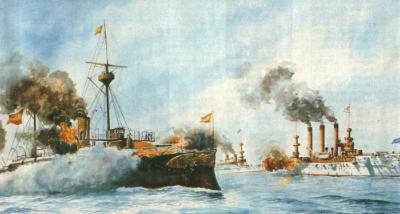
Here we have the Giuseppe Garibaldi-class armored cruiser of the Spanish Navy, Cristóbal Colón.

The Cristóbal Colón was built in Italy in 1895-97 and acquired by the Spanish Government with a war looming in the New World over Cuba. Designed with a large main 10-inch gun the ship was never armed with such as went to war with a staggered armament of 8, 6, and 3-inch weapons along with early machine guns and torpedo tubes.

She was part of Admiral Cervera’s squadron in the harbor of Santiago de Cuba when an American squadron arrived on 27 May 1898 and began a blockade which would drag on for 37 days. Finally, the squadron charged out to tried to break the blockade.

One by one her squadron mates were sent to the bottom by massed firepower of the US Fleet. Cristóbal Colón steamed on alone, the last survivor of Cervera’s squadron. For a time, it seemed that she might get away. Although her machinery was not able to get her up to her top speed after months of hard steaming, she was rated as the fastest ship of either side in the battle, was better armored and armed than her erstwhile squadron mates, and thus far had taken only two 5-inch (127 mm) or 6-inch (152 mm) hits. She was making 15 knots (28 km/h), and the fastest and closest U.S. ship, Brooklyn, was now six miles (10 km) behind her. Vixen was close behind Brooklyn. Armored cruiser USS New York, making 20 knots (37 km/h), was closing, and, farther behind, battleships Texas and Oregon also were making their best speed in pursuit.

By Manuel García García

By Manuel García García. Note the empty turret

After another hour, Cristóbal Colón had run through all of her best coal, switched to an inferior grade, and began to lose speed. At 1220, Oregon fired a 13-inch (330-mm) round which landed just astern of Cristóbal Colón, and soon more 13-inch (330 mm) rounds, as well as 8-inch (203-mm) shells from Brooklyn and New York, were landing around the Spanish ship. In contrast, she had only one 6-inch (152-mm) gun that would bear on her pursuers.

All told, the Spanish cruiser was hit six times.When the range dropped to 2,000 yards (1,830 m), the commanding officer of Cristóbal Colón, Captain Jose de Paredes, decided that after a 50 mile run, the chase was over; in order to save the lives of her crew, he beached her at the mouth of the Tarquino River, 75 miles (65 nmi; 121 km) west of Santiago, at 1315 hours. It was the end of the Battle of Santiago de Cuba.

Some of her sailors made it ashore, although they had to beware of Cuban insurgents, who began to shoot the survivors of the wrecked Spanish ships. Others were rescued by American sailors who came alongside the wreck in small boats to take off survivors.

That night, a U.S. Navy salvage team from repair ship USS Vulcan decided that Cristóbal Colón was worth salvaging and towed her off the rocks. But she lacked watertight integrity and quickly capsized and sank, a total loss. Today she is a popular dive destination off the Cuban coast, especially with Spanish tourists.

Displacement:     7,972 long tons (8,100 t) full load
Length:     366 ft 8 in (111.76 m)
Beam:     59 ft 10 1⁄2 in (18.250 m)
Draft:     23 ft 3 1⁄2 in (7.099 m) maximum
Installed power:     13,655–14,713 ihp (10.183–10.971 MW)
Propulsion:     Vertical triple expansion, 24 boilers
Speed:     19.3–20.02 knots (35.7–37.08 km/h)
Endurance:     4,400 nmi at 10 knots
(8,100 km at 19 km/h)
Complement:     510 to 559 officers and enlisted
Armament:     1 × 10 inch/45-caliber (254 mm) gun (never installed)
2 × 8 inch/45-caliber (203 mm) guns
14 × 6 inch/40 caliber (152 mm)
10 × 3 inch (76.2 mm)/40-caliber
6 × 47 mm guns
2 Maxim machine guns,br />4 × 17.7 inch (450 mm)torpedo tubes.
Armor:     Belt: 4.8 in (122 mm);
Conning tower 4.8 in (122 mmm)
Deck 1.5 in (38 mm)
Turrets 4.8 in (122 mm)
Deck gunshields 2 in (51 mm)
Notes:     1,050 long tons (1,070 t) coal (normal)

A-7 Plane Wreckage found after 37 Years

On a cold winter day in December of 1974, two A7-C jets collide at 15,000 feet offshore St. Augustine. One of the A7′s quickly becomes uncontrollable and falls out of the sky into the ocean below. The other aircraft is able to limp its way home.

Nearly 40 years later, the TISIRI team finds themselves investigating aircraft wreckage off the Coast of St. Augustine Florida. Scuba diving searches of one wreckage site has revealed what appears to be large aluminum metal structures and large tires. Structures that are often associated with military aircraft.

TISIRI divers have made several dives to the wreckage looking for clues to help lead to the identification of the aircraft. See pictures captured of the wreckage at TISIRI’s website here

« Older Entries Recent Entries »