Category Archives: military history

Warship Wednesday, Nov. 29, 2023: As Easy as 123

Here at LSOZI, we take off every Wednesday for a look at the old steam/diesel navies of the 1833-1954 period and will profile a different ship each week. These ships have a life, a tale all their own, which sometimes takes them to the strangest places. – Christopher Eger

Warship Wednesday, Nov. 29, 2023: As Easy As 123

Naval History and Heritage Command Photograph NH 109514

Above we see Wickes-class tin can USS Gamble (Destroyer No. 123) steaming into after the review of Pacific Fleet, 13 September 1919, with her sister USS Radford (DD-120) trailing behind.

Brand new and beautiful in this image, she was commissioned 105 years ago today. Gamble would give her last full measure off Iwo Jima and be deep-sixed a month before the end of World War II but don’t worry, she rolled the dice and took a few of the Emperor’s ships with her.

The Wickes

Gamble was one of the iconic first flights of “Four Piper” destroyers that were designed in 1915-16 with input from no less an authority as Captain (later Admiral) W.S. Sims. Beamy ships with a flush deck and a quartet of boilers (with a smokestack for each) were coupled to a pair of Parsons geared turbines to provide 35.3 knots designed speed– which is still considered fast today, more than a century later.

The teeth of these 314-foot, 1,250-ton greyhounds were four 4-inch/50 cal MK 9 guns and a full dozen 21-inch torpedo tubes.

They reportedly had short legs and were very wet, which made long-range operations a problem, but they gave a good account of themselves. Originally a class of 50 was authorized in 1916, but once the U.S. entered WWI in April 1917, this was soon increased and increased again to some 111 ships built by 1920.


Wickes class USS Yarnall (DD-143): Booklet of General Plans – Inboard Profile / Outboard Profile, June 10, 1918, NARA NAID: 158704871


Wickes class USS Yarnall (DD-143): Booklet of General Plans – Main Deck / 1st Platform Deck / S’ch L’t P’f’m, S’ch L’t Control P’f’m, Fire Control P’f’m Bridge, Galley Top, After Dk. House and 2nd Platform Deck. / June 10, 1918, Hold NARA NAID: 158704873

Wickes class. A close-up of her stern top-down view of plans shows the Wickes class’s primary armament– a dozen torpedo tubes in four turnstiles and stern depth charges.

Meet Gamble

Our subject is the first Navy ship to be named in honor of at least two of the quartet of Gamble brothers who served in the War of 1812. The four brothers including Capt. Thomas Gamble (USN) who served aboard USS Onedia during the war and perished while in command of the sloop USS Erie of the Navy’s Mediterranean Squadron in 1818; 1st Lt. Peter Gamble (USN) killed on the USS Saratoga during the Battle of Lake Champlain in 1814; Lt. Francis B. Gamble (USN) who died of yellow fever in 1824 while in command of the USS Decoy of the navy’s West Indies Squadron; and U.S. Marine hero Lt. Col. (Brvt) John Marshall Gamble, the only member of the Corps to command an American warship in battle– the prize ship USS Greenwich in her combat with the British armed whaler Seringapatam in 1813. Only John lived into the 1830s, passing at age 44, still on active duty.

Two of the four brothers Gamble. Midshipman Thomas Gamble, USN (L) via Analectic magazine. Painted by Waldo, and engraved by J.B. Longacre. NH 49483 and Lt. John M. Gamble, USMC (R). Photo from a portrait in possession of his grandson. (Naval History and Heritage Command Photograph NH 49482)

Gamble (Destroyer No. 123) was laid down on 12 November 1917 at Newport News, launched on 11 May 1918 sponsored by a dour relative of SECNAV Josephus “Cup of Joe” Daniels; and commissioned at Norfolk 18 days after the Armistice on 29 November 1918.

Wickes class sisters USS Breese (DD-122) and USS Gamble (DD-123) on the ways at Newport News between November 1917 and May 1918. NH 43018

USS Gamble (DD-123) launched at Newport News, Virginia, on 11 May 1918. Her sistership USS Breese (DD-122) is next to her and launched the same day in a dual ceremony. NH 53813

Same as above, NH 53812

Entering a crowded and rapidly demobilizing fleet that was just coming off the Great War, Gamble would spend the next several months in a series of shakedowns and trials up and down the East Coast from Maine to Cuba but notably was one of the ships escorting the troop transport George Washington, which was carrying President Woodrow Wilson back to the U.S. from peace negotiations in Paris to Boston in February 1919 and again in July.

In May 1919, she was one of the support ships for the legendary first transatlantic flight by the Navy’s Curtiss NC flying boats, helping spot NC-4 through the Azores.

In mid-July 1919, Gamble, along with sisters Breese, Lamberton (Destroyer No. 119), and Montgomery (Destroyer No. 121), were shifted to the Pacific Fleet to join Destroyer Division 12 and made their way to San Diego via the Panama Canal.

USS Gamble (DD-123) and USS Breese (DD-122) photographed circa 1919, probably at Balboa, Panama, Canal zone. Courtesy of Jack Howland, 1983. NH 94956

Once on the West Coast, she would spend most of the next three years haze gray and underway, so to speak, steaming from up and down the West Coast from San Diego to Seattle and out to Pearl and back in a series of tests, maneuvers, and reviews.

Gamble photographed about 1919. NH 53815

Gamble at San Diego, California, circa 1919. NH 53816

USS Gamble (DD-123) photographed on 23 April 1919 with extensive tropical awnings covering her decks. Sister USS Breese (DD-122) is in the background. NH 53814

Gamble with her original DD-123 hull numbers. NH 67684

Destroyers at the Mare Island Navy Yard, 1919 (from left to right): USS Tarbell (Destroyer # 142); USS Thatcher (Destroyer # 162); USS Rizal (Destroyer # 174); USS Hart (Destroyer # 110); USS Hogan (Destroyer # 178); USS Gamble (Destroyer # 123); USS Ramsay (Destroyer # 124); and USS Williams (Destroyer # 108). Donation of Rear Admiral Ammen Farenholt, USN (Medical Corps). NH 42537

USS Gamble (DD-123) at anchor and dressed with flags, circa 1921, following the relocation of her after 4″/50 cal gun to the top of the after deckhouse. NH 59648

Battleship USS Mississippi (BB-41) at sea for maneuvers, during the early 1920s. Wickes class destroyers in the background include USS Radford (DD-120) and USS Gamble (DD-123). NH 46051

Destroyer tender USS Prairie (AD-5) in San Diego Harbor, California, with USS Gamble (DD-123) alongside, circa 1920-1922. NH 105775

U.S. fleet in Balboa, Panama, early 1920s. The center of the photo is the battleship USS New Mexico BB-40, then a cluster of flush deck destroyers including USS Ramsey DD-124, USS Montgomery DD-121, USS Breese DD-122, USS Lamberton DD-119, and USS Gamble DD-123. In the background are the battleship USS Mississippi BB-41, the tin cans USS O’Bannon DD-177, USS MacKenzie DD-175, USS Hugan DD-178, USS Anthony DD-172, and several other destroyers and another battleship in the far distance.

With budget cuts, Gamble was tapped to begin inactivation procedures and was decommissioned on 17 June 1922 and was held in reserve at San Diego.

Recall, and a job change

After nearly a decade on red lead row, Gamble was taken out of mothballs and redesignated a fast destroyer minelayer (DM-15) on 24 May 1930. This saw her head to Mare Island for a general overhaul and conversion.

The Navy had previously converted 14 Wickes and Clemson class ships to this designation in 1920, with the simple swap out of having their torpedo tubes replaced with a set of two 140-foot tracks that could carry approximately 85 1,400-pound Mark VI moored antenna mines (of which the Navy had 50,000 left over from the Great War) to drop over the stern.

The Navy ordered 100,000 Mark VI (MK 6) mines in 1917, carrying a 300-pound charge, and had so many left that even after using thousands during WWII they remained in U.S. service into the 1980s. Gamble and her sisters could carry as many as 85 of these on a pair of rails that ran, port and starboard, down the aft half of the ship.

As noted by Destroyer History.org:

Among the lessons World War I offered the US Navy was the possibility that fast ships could be effective in laying minefields to disrupt enemy operations. The surplus of flush-deckers at the end of the war provided an opportunity to experiment.

The original 14 circa 1920 rated destroyer-minelayers were slowly replaced throughout the 1930s by a smaller group of eight converted flush-deckers taken from mothballs– USS Gamble (DM-15)(DD-123), USS Ramsey (DM-16)(DD-124), USS Montgomery (DM-17)(DD-121), USS Breese (DM-18)(DD-122), USS Tracy (DM-19)(DD-214), USS Preble (DM-20)(DD-345), USS Sicard (DM-21)(DD-346) and USS Pruitt (DM-22)(DD-347).

Jane’s 1931 entry on the type. Note Breese is misspelled as “Breeze.”

Curiously, these ships would retain their white DD-hull numbers but wore Mine Force insignia on their bow, outwardly looking much more destroyer than minelayer.

Wickes-class destroyer USS Ramsey (DM-16)(DD-124) view was taken by Tai Sing Loo, at Pearl Harbor, T. H., circa 1930. Note that she is fitted out as a minelayer (DM) and retains her DD-hull number while wearing a mine-force insignia on her bow. NH 49953

In addition to these minelayers, several Wickes/Clemson class flush deckers were converted during the WWII era to other tasks including eighteen fast minesweepers (DMS), fourteen seaplane tenders (AVD), and six fast “Green Dragon” transports (APD) plus test ship Semmes (AG 24, ex-DD 189) at the Key West Sound School and damage control hulk Walker (DCH 1, ex-YW 57, ex-DD 163) which was reclaimed from commercial service as a dockside restaurant at San Diego.

All eight of the active destroyer-minelayers were formed into Mine Squadron 1 headed up by the old minelayer USS Oglala (CM 4), flagship of Rear Admiral William R. Furlong, commander of Minecraft for the Battle Force of the Pacific Fleet, and forward-based with “The Pineapple Fleet” at Pearl Harbor, where a new conflict would soon find them.

USS Oglala (CM-4); USS Gamble (DD-123/DM-15); USS Ramsay (DD-124/DM-16). (listed L-R) anchored off Cocoanut Island, Hilo Harbor, Hawaii, T.H., 12 December 1931. Mauna Kea Volcano is in the distance. Note that the DMs are still wearing their destroyer hull numbers but with Mine Force insignias. 80-G-409991

Gamble and her crew were busy while in Hawaiian waters in the 1930s, and often helped in search and rescue cases including that of the missing aircraft Stella Australis, the disabled steamer President Lincoln, and the yacht Lanikai.

She was also something of a public relations boat and was tapped to carry Territorial Governor Lawrence M. Judd from Honolulu to Hilo in 1931 then hosted the six-year-old singing and dancing wonder, Ms. Shirley Temple, in 1935.

Besides spending the day on Gamble, Temple was declared a Colonel of the Hawaiian National Guard, inducted as a Waikiki Beach lifeguard, and given a surfboard by Duke Kahanamoku during her 1935 Hawaiian trip.

Gamble (DM-15) dressed with flags while tied up in port, circa 1940 at the Golden Gate International Exposition (World’s Fair) in San Francisco. Note the circular Mine Force insignia, red/blue/white with a black center and outline, on her bow. In the distance is a USCG 240-foot Lake class cutter. Courtesy of the Mariners Museum, Newport News, Virginia. Ted Stone Collection. NH 66812

War!

All MineRon1’s ships were swaying at their berths at Pearl’s Middle Loch on 7 December 1941 when the Japanese attack came in. The squadron was divided into two divisions, with MinDiv2 consisting of Gamble, Montgomery, Breese, and Ramsay.

The response by Gamble, among others, was immediate, opening fire just two minutes after her lookouts saw enemy planes.

From her after-action report:

0745 Heard explosions on Ford Island.
0756 Wave of about 50 Japanese planes attacked battleships and Naval Air Station, Ford Island, planes flying at low altitudes about 500 feet over battleships from the direction of Diamond Head, about 700 feet over Ford Island. Five successive waves of the attack of about 10 planes each.
0758 Went to General Quarters, opened fire with .50 cal. machine guns on planes passing over nest at about 800 feet altitude. Set material condition afirm except for certain protected ammunition passages.
0759 Opened fire with 3″/23 cal. AA guns, firing as planes came within range, fuses set 3 to 8 secs.
0805 Mounted and commenced firing with .30 cal. machine guns on galley deck house.
0810 Commenced making preparations to get underway. Lighted off four boilers.
0925 One Japanese plane shot down by A.A. fire, falling in water on port beam about 1000 yards away from ship. Believed shot down by ROBERTS, W.L., BM2c, U.S.S. Gamble, port machine gunner (#2 machine gun) .50 cal., and JOOS, H.W., GM3c, U.S.S. Gamble (#1 machine gun) starboard.
0930 Division commenced getting underway. U.S.S. Breese underway.
0930 U.S.S. Gamble got underway and cleared mooring buoy.
0937 Japanese planes attacked near main channel entrance.
0955 Temporarily anchored, astern of U.S.S. Medusa.
1005 Underway proceeding out of channel.
1015 Shifted .30 cal. A.A. machine guns to top of pilot house on fire control platform.
1021 Cleared channel entrance. Eight depth charges were armed and the ship commenced off-shore anti-submarine patrol off Pearl Harbor entrance.
1204 Established sound contact with submarine and dropped three depth charges. Position bearing 162° T from Diamond Head Light, distant 2.5 miles.
1255 Proceeded on course 270° T at 20 knots to join friendly forces upon receipt of orders from CinCPac.
1412 Sighted sampan bearing 320° T.
1435 Slowed to investigate but did not search. Sampan position approximately 4 miles south of Barbers point.
1628 Sighted smoke bomb off port bow.
1631 Submarine surfaced.*
1632 Fired one shot 4″ gun and missed, short and to the left. Submarine displayed U.S. colors, and ceased firing. Submarine submerged and fired recognition red smoke bomb.
1647 Proceeded west.
1732 Sighted Enterprise and exchanged calls. Instructed by Commander Aircraft, Battle Force to join Enterprise.
1744 Joined Enterprise and took station as third ship with two other plane guard destroyers.

*The friendly submarine turned out to be the Tambor class boat USS Thresher (SS-200), which was unharmed although a critically ill member of her crew– the reason for her surfacing and heading to port– passed. She again tried to enter the harbor on 8 December but was driven off by depth bombs from a patrol plane and only made it into Pearl under escort from a seaplane tender. Thresher went on to become the most decorated submarine of the war with 15 battle stars and a Navy Unit Commendation.

Gamble would remain off Pearl for the rest of the month, dropping depth charges on at least two further underwater sound contacts, and continue her ASW mission into 1942 when she expanded her operations to Samoa and Fiji, sowing defensive minefields in the waters of both. She also picked up some much-needed extra AAA in the form of a couple of 20mm Oerlikons.

Escorting a convoy to Midway in June, Gamble returned with a high-profile enemy POW, CDR Kunizo Aiso, the former chief engineering officer of the Japanese carrier Hiryu which had been sunk in the pivotal battle.

Carrier flagship Hiryu: Last Moments of Admiral Yamaguchi at the Battle of Midway. oil painting by Renzo Kita, 1943. Most of the ship’s officers chose to ride her to the bottom or were evacuated. Aiso, forgotten in the engineering spaces with a small group of snipes, surfaced after the ship had been left to the sea and managed to take to lifeboats. 

Aiso was the senior Japanese naval officer imprisoned in the U.S. at the time and would be until 1944. Picked up at sea in a crowded lifeboat with 34 other survivors of his carrier after 12 days bobbing around the Pacific some 250 miles west of Midway, the English-speaking officer reportedly did not wish to return to Japan, nor wish his government be informed of his capture, preferring to be recorded as lost with his ship. For the trip to Hawaii, CDR Aiso was issued USN officer khakis and barricaded inside Gamble’s captain’s cabin with the wings cut off the wingnuts of the battle ports.

Finally, picking up 85 Mark VI mines at Pearl for points West, Gamble set off for Espíritu Santo in August 1942 and, from there, Guadalcanal.

DD-123, meet I-123

When it comes to pennant numbers, the meeting that Gamble had on the morning of 29 August some 60 miles east of Savo Island was curious. She came across I-123, a big Japanese I-121-class minelaying submarine, operating on the surface. On her fifth war patrol, she had left Rabaul two weeks prior under the command of LCDR Nakai Makoto and had already given the Marines on Lungga Point heartburn with her deck gun.

Type I-121 Submarine I-23 pictured at Kobe Naval Arsenal on April 28th, 1928

The rolling ship vs submarine combat between DM-15 (formerly DD-123) and I-123 over the course of four hours ended with Makoto and his 71 crewmembers receiving a promotion, posthumously.

Gamble’s report:

While the Japanese lost 131 seagoing Ro- and I-class submarines during World War II (100 by Allied action including mines, 3 in accidents, and 28 by unknown causes) I-123 was only the 12th boat sent to the bottom in the conflict and was one of the Empire’s first early losses.

Gamble was soon back to work.

The very afternoon after she sank I-123, she sped to Nura Island to pick up four shot-down TBF-1 Avenger (Bu. No. 00396) aviators of Torpedo 8 from the Saratoga (LT JG EL Fayle, ARM3c W Velogquz, S1C RL Minning and ARM3c JR Moncarrow), retrieved via her whaleboat from the surf line. She would rescue two more lost Airedales from Palikulo Bay two weeks later, picking up 2nd LT EN Railsbach, USMC, and Ens. EF Grant, USNR, after their SBD burned in.

Gamble was pressed into service at Guadalcanal as a fast troop transport, on the morning of 31 August carrying 158 Marines from Guadalcanal to Tulagi in company with sisters USS Gregory and USS Little, who were equally loaded down with Devil Dogs.

Gamble also was soon performing her primary role once again, that of sowing minefields around the area, planting 42 in a defensive belt in Segond Channel in December 1942.

Speaking of which…

Stopping the “Tokyo Express”

On 7 May 1943, Gamble and sisters Breese and Preble laid mines in the Ferguson Passage/Blackett Strait between Gizo and Wanawana Islands in the Solomons southwest of Rendova. Hidden by a rain squall and with enemy attention diverted by a supporting cruiser-destroyer group, the old four pipers were able to sow 250 sea mines in three rough lines across the strait in just 17 minutes.

Hours later, these mines were stumbled upon by a passing column of first-class Japanese tin cans of DesDiv 15 on an overnight fast troop transport run and sank the Kagero-class destroyer Kuroshio, with 83 lives, and crippled two sisterships– Oyashio and Kagero– which, barely able to maneuver and full of seawater, would be sunk the next day after being spotted by Navy dive bombers from Guadalcanal.

IJN First-class destroyer Hamakaze of the Kagerō-class. Three of her sisters were killed due to mines laid by Gamble and company. 

As noted by Allyn D. Nevitt over at Combined Fleet, “The loss of even one such modern destroyer was fast becoming intolerable to the Japanese; having a crack unit of three erased in one blow was pure catastrophe. American daring and ingenuity in the Blackett Strait had reaped a substantial reward indeed.”

After further service– including supporting the invasion of New Georgia and planting more mines– Gamble was sent to San Francisco in July 1943 for a three-month overhaul at Hunter’s Point Navy Yard. Arriving back in the South Pacific, Gamble spent November 1943 conducting several mining runs off Bougainville in the Solomon Islands in support of the Allied offensive there.

Then, as noted by DANFS:

Through late 1943 and much of 1944, Gamble generally served as convoy escort ship screening for enemy submarines while operating between Guadalcanal and Florida Island in the Solomons; Espíritu Santo; and Noumea, with additional runs to Suva, Fiji; Finschhaven and New Britain Island, New Guinea; Sydney; and Tarawa Atoll in the Gilbert Islands.

Overhaul

In September 1944, Gamble was sent back to the West Coast for four months at the Bethlehem Steel Repair Yard at Alameda. This led to a serious overhaul of her guns, landing all her old 3″/23s and 4-inchers in favor of a homogenized set of 3″/50s and 20mm Oerlikons.

According to her December 1944 plans, her WWII topside armament was mostly emplaced on a series of superstructure platforms except for a forward 3″/50 DP above the CPO quarters just 20 feet from the bow and a 20mm Oerlikon directly behind it in front of the wheelhouse. The ammo magazine was three decks down on the keel amidships and another on astern near the shafts, meaning a chain gang had to be established to hump it up top. The main gun platform was over the galley between the three remaining funnels and held two 3″/50 DPs (port and starboard) with hinged sponsons for the gun crew and two Oerlikons. A small gun tub with two single 20mm Oerlikons (port and starboard) was above Radio 3 next to the stub mast. The stern superstructure gun platform was built atop the crew’s washhouse and armory and held a single 3″/50 DP installed just 22 feet from the stern. Two portable .50 cals were set up midship atop the pilot house and on the main deck at frame 117 (of 177 frames).

She also only had three stacks by this point. 

All told, this fit gave her four 3″/50 DPs, five 20mm Oerlikons, and two .50 cals. She would also be fitted with a twin 40mm Bofors gun, although I am not sure of its placement. Not a lot of throw weight there, but then of course her main armament was in her mine rails and projectors for Mark VI depth charges.

Eight breakaway Carely float-type life rafts were installed to augment the ship’s 26-foot whaleboat and punt. The crew at this time was a skipper (LCDR/CDR) and 8 wardroom officers along with a mix of 132 rates and enlisted (62 Seamans branch, 57 Artificer branch, 4 Special branch, 4 Commissary branch, 5 Messman branch). By this time, she carried SF and SC radar sets and QCL sonar.

She also picked up a new camo scheme.

Camouflage Measure 32, Design 7D drawings prepared by the Bureau of Ships for a camouflage scheme intended for light minelayers of the DM-15 (Gamble) class. This plan, approved by Captain Torvald A. Solberg, USN, is dated 14 June 1944. 80-G-173486 and 80-G-173487.

This readied her for the “Big Show,” the push to Iwo Jima, Operation Detachment, in February 1945.

Back in the thick of it

On D+3, 17 February, Gamble closed into the beach close enough to cover the small minesweepers (YMS) and UDT teams of Sweep 5 and 6 clearing a path in the shoaling waters, shelling Japanese coastal emplacements and positions with her 3-inch and 40mm guns to silence them from harassing the cleaners via the application of 204 rounds of 3-inch AA Common and 254 of 40mm HETSD over seven hours. There, roughly six miles off Mt. Suribachi, she scored a hit on a large ammo dump with secondary explosions as well as silencing several enemy guns and bird-dogging other emplacements for the battlewagons.

Her NGFS report: 

Taking position off the old battlewagon Nevada the next night, she was hit by two small 250-pound bombs dropped by a  Japanese Kawasaki Ki-45 Toryu (Nick) twin-engine bomber that came in low and fast while she was silhouetted by star shells ashore. The bombs effectively wrecked our Gamble.

From her report:

Her crew was removed, and the shattered Gamble was towed to Saipan where she was decommissioned on 1 June 1945, and her name was stricken from the Navy Register three weeks later.

Stripped of anything thought useful, a series of images and videos were captured of her scuttling process, which took place off Guam on 16 July.


“Down Went the Gamble (DM 15).” Gamble was scuttled in June 1945. She was previously hit by Japanese enemy bombs in Feb 1945. Artist: Standish Backus, No.9. U.S. Navy photograph, now in the collections of the National Archives. 428-GX-KN 18978

Gamble received seven battle stars for service in World War II.

Epilogue

As Gamble was scuttled off Guam in deep water, few relics of her remain topside.

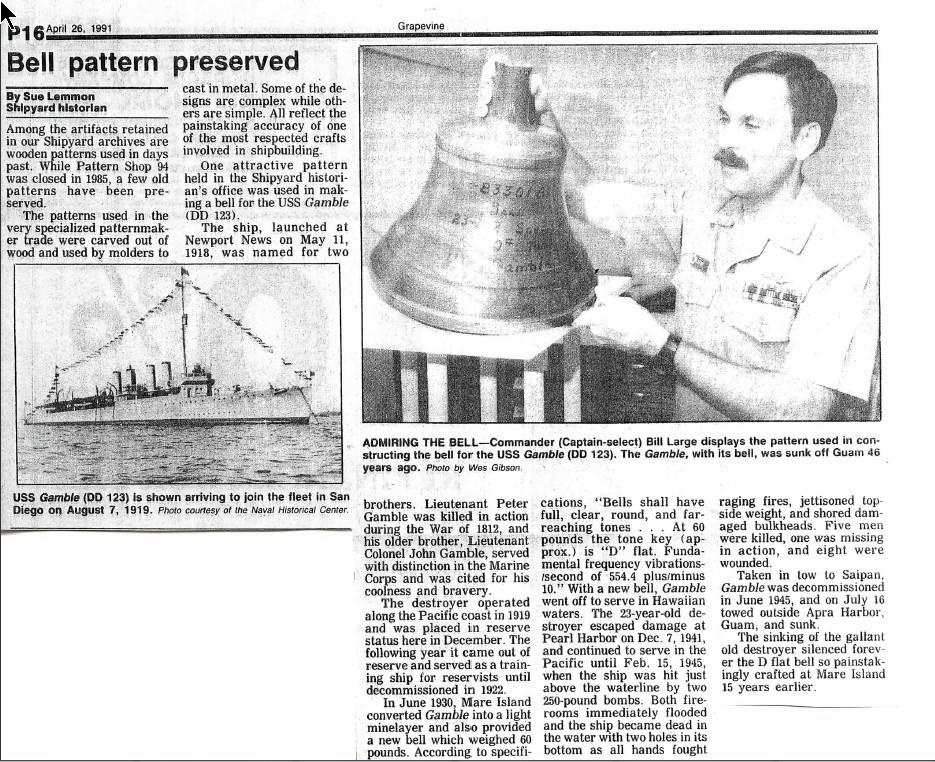
The wooden mold for her D Sharp ship’s bell, cast at Mare Island, resurfaced in 1991.

Her plans, drawings, deck logs, and war history are online in the National Archives. 

As for Shirley Temple, a bosun whistle presented to her by Gamble’s crew in 1935 remained a treasured possession for years. After all, she would meet her future husband, Charles Alden Black, a former Naval intelligence officer, in Hawaii in 1950 so perhaps those long-ago Pearl Harbor USN memories were prized. The whistle remained part of Ms. Temple’s estate and archives until it was sold at a 2015 auction by Theriault’s in New York.

It is undoubtedly in some collector’s display as this is written and perhaps will resurface one day.

Thus far, the Navy has chosen to not reissue the name “Gamble” to a second ship, which is a pity.


Ships are more than steel
and wood
And heart of burning coal,
For those who sail upon
them know
That some ships have a
soul.


If you liked this column, please consider joining the International Naval Research Organization (INRO), Publishers of Warship International

They are possibly one of the best sources of naval study, images, and fellowship you can find. http://www.warship.org/membership.htm

The International Naval Research Organization is a non-profit corporation dedicated to the encouragement of the study of naval vessels and their histories, principally in the era of iron and steel warships (about 1860 to date). Its purpose is to provide information and a means of contact for those interested in warships.

With more than 50 years of scholarship, Warship International, the written tome of the INRO, has published hundreds of articles, most of which are unique in their sweep and subject.

PRINT still has its place. If you LOVE warships you should belong.

I’m a member, so should you be!

Walking through the woods and boom: Bofors

Marcus Edin and friends recently got a chance to check out an ~almost~ fully working 1941 Bofors M/24 12cm/50 cal gun and some surrounding bunkers in quite good condition in Sweden.

Apparently, the last service was performed on these in 1988 as the Swedes kept these low-tech but still effective coastal guns in operation through the end of the Cold War. After all, it would track that these were still capable of zapping an interloping Soviet destroyer or amphib that came in close enough and they were immune to EMP in the worst-case scenario.

Marcus has a great video with a closer look.

Remote Work

For those with a little chill in the air, how about this breathtaking photo from U.S. Coast Guard Air Station Clearwater of an MH-60 Jayhawk somewhere in their AOR, likely in the Keys but could be in points further South or West.

Photo by LT Scott Kellerman, USCG

Formed in 1934, CGAS Clearwater currently counts 700 personnel and has 10 MH-60T Jayhawks and four HC-130H Hercules (upgrading to HC-130Js) assigned as well as Port Security Unit 307.

As detailed by base:

We are the largest and busiest Air Station in the Coast Guard. In addition to the local area, our Area of Operations includes the Gulf of Mexico, the Caribbean basin, and the Bahamas. We constantly maintain deployed H-60s for Operations Bahamas, Turks and Caicos (OPBAT), a joint DEA, Coast Guard, Bahamian Turks and Caicos anti-drug and migrant smuggling operation in the Bahamas. We also have C-130s deployed in support of Joint Interagency Task Force (JIATF) operations in the Caribbean. This is done while simultaneously maintaining a constant Bravo Zero Search and Rescue response at home in Florida.

103 Carrier Deployments in 13 Years

Aviation Ordnancemen, assigned to Carrier Air Wing (CVW) 8, perform routine maintenance on an F/A-18E Super Hornet on the flight deck of the world’s largest aircraft carrier USS Gerald R. Ford (CVN 78) in the Mediterranean Sea, Oct. 16, 2023. VFA-37 is deployed aboard Gerald R. Ford as part of Carrier Air Wing (CVW) 8. Gerald R. Ford is the U.S. Navy’s newest and most advanced aircraft carrier, representing a generational leap in the U.S. Navy’s capacity to project power on a global scale. The Gerald R. Ford Carrier Strike Group is currently operating in the Mediterranean Sea, at the direction of the Secretary of Defense. The U.S. maintains forward-deployed, ready, and postured forces to deter aggression and support security and stability around the world. (U.S. Navy photo by Mass Communication Specialist Seaman Tajh Payne)

With the current “where’s the carriers” moment in history– including having the Ford Carrier Strike Group (CVN-78/CAW-8) in the Eastern Mediterranean along with U.S. 6th Fleet command ship USS Mount Whitney (LCC-20) and USS Mesa Verde (LPD-19) with half of the 26th MEU aboard while the Eisenhower Carrier Strike Group (CVN-69/CAW-3) is operating in the Gulf of Oman near the Strait of Hormuz with the Bataan Amphibious Ready Group and the rest of the 26th MEU in the Red Sea– a look back at the old “million sortie” war waged from Yankee and Delta Station days is relevant, in which sortie rates would average upwards of 4,000 a month when three carriers were on station.

Vietnam

The NHHC recognizes at least 103 deployments of 21 assorted fleet carriers (CV, CVA, CVAN, CVS) to support operations in/off Vietnam in the Gulf of Tonkin between USS Oriskany (CVA-34)’s first cruise that began 1 Aug 1963 and her last that ended, post-Operation Frequent Wind, on 3 March 1976– putting “Big O” as the bookends for the conflict in terms of flattop operations.

The following ships are visible (bottom to top): USS Wiltsie (DD-716), USS Tappahannock (AO-43), USS Oriskany (CVA-34), USS Mars (AFS-1), and USS Perkins (DD-877). The Oriskany, with assigned Carrier Air Wing 19 (CVW-19), was deployed to Vietnam from 16 April to 17 November 1969.

A-7B of VA-215 standing by on the catapult of USS_Oriskany (CV-34) in 1976.

Only one of these carriers (USS Shangri-la) actually touched port in the Republic of South Viet Nam and only for one day (21 June 1970) when she stood into Danang for vitally needed parts for the down Number 3 elevator– received via helo. The ship returned to Yankee Station the same day.

The carriers

The run down by carrier and number of deployments, highest to lowest:

USS Oriskany (10)
USS Hancock (9)
USS Kitty Hawk (9)
USS Constellation (8)
USS Coral Sea (8)
USS Ranger (8)
USS Enterprise (7)
USS Ticonderoga (7)
USS Bon Homme Richard (6)
USS Midway (6)
USS Bennington (4)
USS Kearsarge (4)
USS America (3)
USS Hornet (3)
USS Intrepid (3)
USS Yorktown (3)
USS Forrestal (1)
USS Franklin D. Roosevelt (1)
USS Independence (1)
USS Saratoga (1)
USS Shangri-la (1)

It was an air war that started with a generation of aircraft left over from WWII and ended with the final generations of the Cold War. 

A well-worn A-1A Skyraider of VA-215, “The Barn Owls,” is brought up to the Hancock’s catapult, while operating off the coast of Vietnam, 6 May 1966. Photographed by Photographer’s Mate Third Class Worthington, USN 1120337

An F-14A Tomcat of Fighter Squadron (VF) 2 pictured just after launching from the carrier Enterprise (CVAN 65). F-14s flew combat air patrols during Operation Frequent Wind, the evacuation of South Vietnam in 1975. (1st PHX launch from CV: Bean Barrett/Wizard McCabe) Robert L. Lawson Photograph Collection NNAM.1996.253.7419.029

Deployments by class:

Midway: 15 by 3 carriers
Essex: 50 by 10 carriers
Forrestal: 11 by 4 carriers
Kitty Hawk: 20 by 3 carriers
Enterprise: 7 by 1 carrier

Those who didn’t have a turn in the barrel

Just about every combat carrier in the U.S. arsenal during Vietnam made a deployment there with only a few exceptions.

USS John F. Kennedy (CVA-67), commissioned in 1968, spent Vietnam on Mediterranean Sea deployments. Meanwhile, the brand new USS Nimitz (CVN-68) was commissioned on 3 May 1975 and didn’t embark on her first deployment until the following summer, likewise to the Med.

Of the 19 Essex class flattops that were in commission in the era (1963-76), 10 clocked in on Vietnam’s Yankee/Delta Stations including four that were anti-sub boats. Of the others, four (Essex, Randolph, Wasp, and Lake Champlain) were East Coast anti-submarine (CVS) ships needed in the Atlantic to keep tabs on the Soviet Bear and provide recovery ships for NASA missions, Lexington was in a training role at Pensacola from 1962 onward, Antietam mothballed early in 1963, and the three unmodified “straight deck” carriers (Boxer, Princeton, and Valley Forge) rerated during the era as amphibious helicopter platforms (LPH) and served extensively in both shuttling Marines around during assorted Vietnam operations and carrying Army helicopters to the theater.

Boxer (LPH-4) loaded with 200 helicopters of the 1st Cavalry Division bound for the Vietnam War, 1965

As noted by VADM Dunn in a 2015 article on Yankee Station.

To keep three to four carriers on the line, at least seven had to be deployed. In addition to the four, one of the other three would be at Cubi Point, one at Hong Kong and one at Yokosuka, Japan. The latter had the only real ship repair facility in the western Pacific, with an aircraft repair facility close by, although lighter maintenance and less extensive alternations could be effected in Cubi as well. As for crew liberty, no one seemed to complain about any of the three ports.

Great white elephants?


Not too many years or even months ago, it was a popular pastime for amateur military strategists to speak and write words that questioned the U. S. investment in aircraft carriers in the U. S. Navy. These capital ships, termed “super-carriers” in the press, were considered to be great white elephants, vulnerable to whatever force an enemy chose to throw at them; costly dinosaurs that plodded the seas at 30 knots in an era when air speeds above a thousand knots were commonplace.
 
Today, as the continuous pounding from the three attack carriers at “Yankee Station” grinds on, this criticism is seldom heard. Instead, there are repeated requests for more carriers on the line, and expressions of approbation from quarters once opposed to the carrier weapons system. Thus, it appears appropriate after three years of conflict in Southeast Asia to examine the aircraft carrier and its aircraft and to forecast its future in this war and others the nation may encounter.

The cost was heavy

Over 700 men from air wings and ships companies were lost in action or taken prisoner. A whole generation of squadron and wing commanders was erased from the pipeline as more than 100 Navy commanders (O-5s) were killed or captured within nine years. No less than 532 Navy fixed-wing carrier aircraft were lost in combat and another 329 to operational causes with the F-4 Phantom leading the pack with 138 lost.

Those figures don’t include another 32 Sea Kings and Sea Sprites lost in operations in the Gulf of Tonkin or of Marines who flew from Navy carriers.

Throw in the terrible fires experienced by USS Oriskany (CV-34) that killed 45 in 1966Forrestal in 1967 that killed 134, and Enterprise in 1969 that left 28 dead, and you realize just how dangerous extended carrier operations can be.

Still, the refrain, “Where are the carriers,” endures. 

Warship Wednesday, Nov. 22, 2023: From Midway to Trafalgar

Here at LSOZI, we take off every Wednesday for a look at the old steam/diesel navies of the 1833-1954 period and will profile a different ship each week. These ships have a life, a tale all their own, which sometimes takes them to the strangest places. – Christopher Eger

Warship Wednesday, Nov. 22, 2023: From Midway to Trafalgar

Above we see a great bow-on shot of the FRAM’d Gearing class destroyer USS Eugene A. Greene (DD/DDR-711)with a bone in her teeth in her second life as the Spanish Navy’s Churruca (D61) in the 1980s, the country’s traditional crimson and gold Rojigualda ensign on her mast, a twin 5″/38 hood ornament and two forward-facing Mk.32 triple torpedo tubes under the bridge wings. Her original moniker comes from naval aviator Eugene Allen Green, born 98 years ago this week.

The Gearings

In July 1942 the U.S. Navy, fighting a U-boat horde in the Atlantic and the Combined Fleet in the Pacific was losing ships faster than any admiral ever feared in his worst nightmare. With that in mind, the Navy needed a lot of destroyers. While the Fletcher and Allen M. Sumner classes were being built en mass, the go-ahead for some 156 new and improved Sumners— stretched some 14 feet to allow for more fuel and thus longer legs to get to those far-off battlegrounds– was given. This simple mod led to these ships originally being considered “long hull Sumners.”

These hardy 3,500-ton/390-foot-long tin cans, the Gearing class, were soon being laid down in nine different yards across the country.

Designed to carry three twin 5-inch/38 cal DP mounts, two dozen 40mm and 20mm AAA guns, depth charge racks and projectors for submarine work, and an impressive battery of 10 21-inch torpedo tubes (downgraded to just 5 tubes) capable of blowing the bottom out of a battleship provided they could get close enough, they were well-armed. Fast at over 36 knots, they could race into and away from danger when needed.

Meet Eugene A. Greene

Our subject is the first Navy ship to be named in honor of Eugene Allen Green, born in Smithtown, New York on 21 November 1921. A 1940 graduate of Rhode Island State College, he attended ROTC while in school and promptly enlisted in the U.S. Navy Reserve’s air cadet program, earning his ensign bar along with his wings of gold by August 1941.

Assigned to Bombing (VB) Six aboard USS Enterprise (CV-6) in March 1942, he gave his last full measure behind the controls of his SBD (6-B-9) at the ripe old age of 21 during the Battle of Midway when, following the attack by VB-6 against the aircraft carrier Kaga on 4 June, he was one of 14 of the “Big E’s” pilots that had to ditch their planes on the way back home, out of fuel. Greene and his gunner, RM3c SA Mutane, along with the crews of eight other ditched aircraft from Enterprise that day, would never be seen again.

Greene was granted a posthumous Navy Cross in December 1942 and his widow, Mrs. Anita M. Greene, would sponsor the destroyer named in his honor.

The second of 16 Gearings contracted via Federal Shipbuilding, Kearny, New Jersey, the future USS Eugene A. Greene (DD-711) was laid down on 17 August 1944, launched the following March, and commissioned on 8 June 1945.

War!

While 98 Gearings would eventually be completed, most of these arrived too late to take part in WWII, with Greene joining a club that only included 44 sisters who arrived very late in the war. Although some were present in the final push to Tokyo, none were damaged or lost. Three of the class– USS Frank Knox, Southerland, and Perkins— entered Tokyo Bay in time to be present at the Japanese surrender, on 2 September 1945.

As for Greene, her WWII service, as detailed by her War History, consisted primarily of a shakedown cruise ranging from Penobscot Bay, Maine to Guantanamo Bay then, in mid-August following the news of the Japanese surrender, was assigned to the Atlantic fleet to serve as a school ship in Norfolk and Casco Bay, then to Pensacola to assist as a plane guard for aviation cadets– a task she would be well-versed in over her career.

USS Eugene A. Greene (DD-711) off New York City on 29 May 1946. She is still painted in wartime Camouflage Measure 22. NH 66345

A Chilly Peace

As the Navy’s newest destroyers, none of the new Gearings were mothballed after the war.

On 13 February 1947, Greene sailed south in a task group bound for Montevideo, Uruguay, to participate in the festivities accompanying the inauguration of the country’s new president, Tomás Berreta. The group also paid a goodwill visit to Rio de Janeiro before returning to Norfolk on 31 March.

Light cruiser USS Fresno (CL-121) on port call at Rio De Janeiro, March 1947, alongside her Gearing class consorts, USS Gearing, USS Gyatt, and USS Eugene A. Greene. Note the stern depth charge racks. The quartet was returning from Uruguay where they represented the U.S. at the inauguration of the new Uruguayan president. The Fresno was launched in 1946, too late to serve in WWII, so she took part in good-will diplomatic missions like this. She was sold for scrap in 1966. Photo attributed to Robert Norville, from NavSource.

As detailed by DANFS, the Norfolk-based Greene then became a staple of the 6th Fleet until 1960:

On 10 November 1947, Eugene A. Greene sailed on the first of 9 Mediterranean cruises made over the next 13 years. During those years, she and her sisters of the U.S. 6th Fleet have guarded the interests of peace and order in that sea which was the cradle of democratic government. Voyages to northern Europe and the Arctic varied the routine of overseas deployment for Eugene A. Greene.

What was skipped by DANFS was the fact that Greene was on hand in the region for five months through the 1956 Suez Crisis just in case she was needed.

It should be noted that, by this stage, she was significantly modernized, picking up a new tripod mast with AN/SPS-6 L-band radar (later augmented by an SPS-8A S-band capable of spotting aircraft 60nm away) and lightened her topside by landing most of her WWII AAA suite, torpedoes, and depth charges. This resulted in a change to a destroyer radar picket (DDR-711) that she held from July 1952 until she reverted to the simpler DD-711 in March 1963.

USS Eugene A. Greene (DD-711) underway at sea on 19 September 1950. Note that she has received a new tripod mast with AN/SPS-6 radar and has landed much of her WWII AAA suite, torpedoes, and depth charges. National Archives Identifier 24743125

At sea, October 1951. 80-G-442191

USS Eugene A. Greene (DDR-711) off the Norfolk Naval Shipyard on 18 December 1952. National Archives Identifier 24743145

Same as the above, bow on 24743147

Same as the above, stb profile. Note the newly installed AN/SPS-8 air search radar aft for her role as a DDR picket. 24743143

The Frostiest Part of the Cold War

Greene experienced the life that came with all the classic 1960s naval adventures in the Atlantic.

Greene is on the list of U.S. Navy ships that received the Armed Forces Expeditionary Medal for participating in the Cuban quarantine, from 24 October through 20 November 1962.

Roger Powell missed ship’s movement of the destroyer USS Rush (DD-714) — along with 44 other shipmates as she sortied out over the weekend on little notice– and was tacked on to help fill out Greene’s crew, similarly, headed for Cuba to be a plane guard alongside the USS Enterprise.

Greene would undergo a nearly year-long FRAM I reconstruction at Boston NSY, completed in October 1963. Meant to add 8 years to the ship’s life via a complete rehabilitation of all shipboard components, it also fundamentally changed the destroyer to a modern sub-buster. The 5″/38 Mount 52 forward was removed during the rebuild while a hangar and platform for the QH-50C DASH ASW drone was added in place of the SPS-8A radar house.

Also new was an 8-cell ASROC matchbox launcher amidships, SQS-23 SONAR, VDS, and a six-pack of Mark 32 torpedo tubes. She added Mk 44 ASW torps to her magazine, for use by her own Mk32s as well as DASH, which theoretically could drop them some 20 miles away from the destroyer.

When she left Boston, she became first the flag of Destroyer Squadron 28, then DESRON 32.

Like most East Coast-based Navy ships in the era, Greene participated in several NASA recovery missions between other assignments, logging two (Mercury-Atlas 2 and 3) in early 1961 and Gemini-Titan 2 (GT-2) in 1965, supporting the primary recovery ship, USS Lake Champlain (CVS-39).

A great view of the post-FRAM’d USS Eugene A. Greene (DD-711) steaming past USS Lake Champlain (CVS-39) during operations on 23 September 1964. Note her ASROC amidships and her big DASH hangar aft in place of the deleted Mount 52. She still carries her aft mount (Mount 53) and forward (51). One of the carrier’s big Sikorsky SH-3 Sea King ASW helicopters is flying by in the right foreground, and another destroyer is in the left distance. Photographer: AN Thomas J. Parrett. NH 107007

Speaking of the Med, Greene would make another four deployments there between 1968 and 1972– and on two of them job into the Persian Gulf/Indian Ocean to show the flag in the increasingly important region. This included a seven-month goodwill cruise with the U.S. Middle East Force in 1968 during which she was the first U.S. ship to enter the new Iranian port of Bander Abbas, doing the Shah’s Navy the courtesy of charting the harbor from end to end with her advanced sonar.

Earning “blue noses” for her crew, she also took part in Operation Deep Freeze ’69 in the Antarctic and two North Atlantic cruises that crossed the Arctic Circle. Warming up, she went to Latin America once again in UNITAS ’68.

War! (This time for real)

Greene, being a top-of-the-line ASW boat post FRAM mods, also sailed to the Pacific to take part in a West Pac deployment (June-December 1966) to Vietnamese waters, shipping via the Panama Canal, Pearl Harbor, Guam, Subic Bay, and Hong Kong to take up station as a plane guard alongside the carrier USS Constellation (CVA-64) on 28 July.

There she remained for a month at sea, every day closing to within 4,000 yards with a rescue detail at the ready in case one of Conny’s birds went into the drink, all the while her sonar techs kept an ear out for anything funny in the depths.

USS Constellation (CVA-64), the third ship named for the configuration of 15 stars on the original United States Flag shows an A-4 Skyhawk given landing instructions by a technical crewman using the Landing Signal Officer’s (LSO) console as the LSO watches, October 1966. Greene was her primary plane guard during a good part of Conny’s 1966 Far East Cruise (12 May–3 December) with CVW-15 on board during which 16 aircrewmen and 15 aircraft were lost in operations. K-33638

This lifeguard work paused on 21 August when Greene was dispatched to close to the South Vietnam littoral under control of Task Unit 70.8.9 where she stood by in the Republic of Vietnam’s I Corps area on call for naval gunfire support missions. Over the next five days, her gunners got in lots of work as she steamed as close as 2,000 yards from shore answering NGFS calls with 311 rounds of HE and WP and providing 90 nighttime star shell illumination for friendly outposts. She was credited with annihilating an enemy base camp, wiping out a platoon-sized element of infiltrators in the open, and destroying several enemy supply buildings.

A sampling from her deck log:

Headed back to Yankee Station after rearming while underway, she worked alongside the carrier USS Coral Sea for the rest of her deployment until she slipped her port shaft in October and had to limp into Tse Ying, Taiwan, for a quick fix that would get her to Subic Bay. Returning to Norfolk in December via the Suez and the Med, Greene ended up circumnavigating the globe in a 205-day around-the-world deployment.

In short, her 27-year career with the U.S. Navy was diverse and, well, just remarkably busy. It was little surprise one of her lasting nicknames was “The Steamin’ Greene.”

But all good things must come to an end and on 31 August 1971, with Greene almost eight promised years to the dot past her FRAM I service life extension, she was decommissioned.

A second life

With the general post-WWII rapprochement between a still very fascist Franco and the Western allies, the 1953 Madrid agreements thawed the chill between the U.S. and the country, opening it to military aid in return for basing.

Soon, the country would receive its first modern submarine, the snorkel-equipped USS Kraken (SS-370) (taken in service as Almirante García de los Reyes, E-1), later joined by three Guppy’d Balao-class smoke boats.

Then came five Lepanto-class destroyers– WWII Fletcher-class tin cans– starting with USS Capps (DD-550) in 1957, which were transferred. The old light carrier USS Cabot was loaned to the Spanish Navy on 30 August 1967, which renamed her Dédalo (R.01).

In many ways, the Spanish fleet by the late 1960s, was very American.

These were soon joined by five FRAM I Gearing class destroyers, starting with USS Eugene A. Greene (DD/DDR-711) in 1972. By this time, the Spanish were also slated to get five new-made Baleares-class frigates, variants of the Knox class destroyer escort/fast frigates updated with Standard SAM suites.

Greene, still on the Navy List, was loaned to Spain the same day she was decommissioned. Renamed Churruca (D61) she honored RADM Cosme Damián Churruca y Elorza, who was lost on his ship-of-the-line San Juan Nepomuceno at Trafalgar in 1805.

Muerte de Cosme Damián Churruca (detalle), Eugenio Álvarez Dumont

Stricken from the U.S. Navy List on 2 June 1975 three years after she joined the Spanish Navy, Greene was sold to Spain for a token fee and remained in service with the force through the 1980s, class leader of her 11th Destroyer Division sisters. To be fair, although they were 30 years old, these FRAM I Gearings in the 1970s and 80s were still capable against Russki Whiskey, Romeo and Foxtrot-type smoke boats and their guns still worked enough for old-school NGFS should the large Spanish naval infantry need fire missions.

Period photos of Churruca show her still very much in her prime.

With the Cold War ending, so did the Gearings worldwide. Churruca was stricken by Spain on 15 September 1989, and disposed of in a SINKEX in 1991.

Sent to the bottom by a mixture of ordnance from Spanish Air Force F-18s and Spanish Navy AV-8 Matadors as well as some Standard missiles and Harpoons, her death was captured on grainy video, much like a snuff film.

Her four sisters in Spanish service (Gravina, ex-USS Furse; Méndez Núñez, ex-USS O’Hare; Lángara, ex-USS Leary; and Blas de Lezo, ex-USS Noa) were all disposed of within another year.

Epilogue

Greene’s deck logs are digitized in the National Archives and represent one of the few items left of the old girl. 

Of her massive armada of 98 Gearing-class sisterships that were completed, 10 survive above water in one form or another including three largely inactive hulls in the navies of Mexico and Taiwan. The others are museum ships overseas except for USS Joseph P. Kennedy, Jr. (DD-850) in Fall River, Massachusetts; and the USS Orleck (DD-886) in Jacksonville. Please visit these vital floating maritime relics.

Orleck, fresh out of dry dock, being towed to her new home in Jacksonville


Ships are more than steel
and wood
And heart of burning coal,
For those who sail upon
them know
That some ships have a
soul.


If you liked this column, please consider joining the International Naval Research Organization (INRO), Publishers of Warship International

They are one of the best sources of naval study, images, and fellowship you can find. http://www.warship.org/membership.htm

The International Naval Research Organization is a non-profit corporation dedicated to the encouragement of the study of naval vessels and their histories, principally in the era of iron and steel warships (about 1860 to date). Its purpose is to provide information and a means of contact for those interested in warships.

With more than 50 years of scholarship, Warship International, the written tome of the INRO, has published hundreds of articles, most of which are unique in their sweep and subject.

PRINT still has its place. If you LOVE warships you should belong.

I’m a member, so should you be!

The Mile a Minute Interceptor

The new Boeing–Saab T-7 Red Hawk, which has admittedly had some serious teething problems (what weapon doesn’t?), is described by the company as “a low-risk, leading-edge, live, virtual and constructive fifth-generation aircrew training system that delivers a multi-generational leap in capability to revolutionize and reinvigorate fighter pilot training.”

First delivered T-7, Boeing image 230914-F-F3456-1001

It certainly looks fast and capable on the ground, but of course, time will tell on these things and the USAF just accepted its first (of 351 planned) Red Hawks in September.

Now it seems some in the fighter mafia want to arm it up and develop it into the F-7, to use it to replace older F-16s.

There is a long history of simple yet very aerobatic trainers turned into fine combat aircraft and low-cost exports for cash-poor allies. For instance, the two-seat Northrop T-38 Talon — which the Red Hawk is replacing after a storied 60-year run– was developed into the single-seat F-5A the year after the first T-38 was delivered and began shipping to overseas allies two years after that. The Soviets inherited a few post the fall of Saigon and in tests found that it beat the MiG-21 and 23 almost every single time. 

But it doesn’t always work out like that.

Take the case of the CW-21.

Curtiss Wright developed the single-seat CW-21 Interceptor (often mistakenly called the CW-21 Demon) in the late 1930s from Carl W. Scott’s two-seater CW-19 utility/advanced trainer aircraft which had some limited export success to Caribbean and Latin American countries.

Keeping almost the exact same length, wing area, and span as the CW-19, the CW-21 was given better aerodynamics and a huge boost in power (from 350 hp to 850 hp) that, combined with its low weight, meant it was optimized for climb and speed, capable of 314 mph (roughly the same as the Morane-Saulnier MS.410 and the Hawker Hurricane and superior to both the Oscar and Zero).

The armament was nose-heavy with a pair of Colt .50 caliber machine guns above the massive engine inside the cowling and another pair of Colt .30 caliber machine guns below it, synchronized to fire through the propeller disc, keeping the thin swept wings light.

It looked great and got some good press as being able to climb a “mile in a minute and one half.”

The thing is, it was criticized by pilots as being difficult to handle, with one U.S. Army Air Corps officer famously saying that it “took a genius to land it.”

Nevertheless, the KMT Chinese and the Free Dutch East Indies governments, to whom it was pitched as just the thing to zap roaming Japanese bombers, were hungry for just about anything they could get and Curtiss was already selling them lots of other types as well.

In “Curtiss Aircraft 1907-1947″ by Peter M. Bowers, he details just four CW-21s were built by the company (NX19431, 19941-19943. C/ns: 21-1/21-4) and a further 51 sold as kits in two types to be assembled by the host country.

The completed aircraft and 27 kits were sold to China to be built by CAMCO at Loiwing, near the Burma border for use by the Flying Tigers. This ended in failure with the original demonstrator crashing in China, and the three production aircraft crashing into a mountain while being ferried from Rangoon to Kunming two weeks after Pearl Harbor. None of the kits made it out of Loiwing, being abandoned and destroyed in place when the Japanese rushed in the spring of 1942.

It seems some of the kit remnants were still there when the Allies came back to Loiwing in 1945.

The rest of the kits (24 Type B aircraft with a billed top speed of 333 mph) made it to Andir airfield in Java and to the hands of the military aviation branch of the Royal Dutch East Indies Army (ML-KNIL) where they were assembled locally starting in February 1941 and equipped the Vliegtuiggroep IV, Afdeling 2 (“Air Group IV, No. 2 Squadron”; 2-VLG IV). under 1/Lt. R.A.D. Anemaet. However, the combination of a big engine on a light aircraft at the hands of green pilots led to almost immediate structural problems and only nine were still in service by that December.

Still, they certainly looked fast and capable on the ground in 1941 in Java, with several images surviving today of 2-VLG IV and their newly assembled and camouflaged CW-21Bs in the NIMH archives, captured at the time by one Jan B. van der Kolk.

Curtiss Wright CW-21 Interceptor van ML-KNIL. AKL023173

Curtiss Wright CW-21 Interceptor van ML-KNIL AKL082371a

Curtiss Wright CW-21 Interceptor van ML-KNIL 2039-001-087-009

Curtiss Wright CW-21 Interceptor van ML-KNIL AKL082365

Curtiss Wright CW-21 Interceptor van ML-KNIL AKL082371b

Curtiss Wright CW-21 Interceptor van ML-KNIL AKL082370

They reportedly had a few limited victories against the Japanese but by 3 March 1942, the final CW-21 combat sortie had been flown.

One ex-Dutch aircraft was recovered in Japanese service in 1945 at the Tachikawa test facility in Singapore.

Today, the only CW-21 around are scale models. 

ML-KNIL Curtiss Wright CW-21 Interceptor #CW-357 piloted by Sgt. Hermann depicted shooting down a Japanese Mitsubishi F1M2 (Pete) as seen on MPM models box art by painter Stan Hayek

Preserving Ms. Higgins

US Coast Guard-manned LCVP landing craft carried invasion troops toward Luzon in Lingayen Gulf, 9 Jan 1945

PA31-17, a humble 36-foot long LCVP (Landing Craft, Vehicle, and Personnel), or “Higgins boat” after the New Orleans manufacturer that churned them out by the thousands (23,000 to be exact) in WWII, was found derelict on the shores of Shasta Lake in fall 2021.

The thing is, although it was old and damaged, it was still in more or less original condition, still with lots of her Higgins-installed mahogany including the original paint on the ramp.

Further, it turned out that PA31-17, assigned throughout the war to the Crescent City class attack transport USS Monrovia (AP-64), landed troops on the beach in seven different campaigns– Sicily, Tarawa, Kwajalein, Saipan (the last three with Devil Dogs of the 2nd Marine Division), Guam (77th Infantry Division), Luzon (96th Infantry then 1st Cavalry Division) and Okinawa (6th Marine Division).

Acquired by the Nebraska National Guard Museum in Columbus, Nebraska—the birthplace of Andrew Higgins, the organization made the move to protect it, not restore it.

So who do you get to stabilize an 80-year-old combat veteran wooden landing craft? A 75-year-old combat veteran woodworker, that’s who. Eric Hollenbeck with Blue Ox Millworks in Eureka, California took on the two-month task and it is documented in The Craftsman – Preserving the Last Higgins Boat, which I just saw online on Max but it is out there on other platforms as well.

If you have a chance, do check it out.

Looking for a man cave centerpiece?

Passing this on to those of you who may be itching to buy a big piece of vintage military gear in superb condition (or know someone who would like one in a stocking next month).

Bowman (I’ve bought lots of old training and dewatted ordnance from them) has German WWII portable artillery rangefinders from Finland, where they were sent during the conflict as aid, and later refurbed by SA into “pristine” condition during the Cold War then put into storage.

Compare to these:

Gotta admit they look pretty sweet, are only $499, and if I had room for one I’d buy two, especially considering my Finnish-used/German-made helmet collection.

Warship Wednesday (on a Thursday) Nov. 16, 2023: The Darkest Twist

Here at LSOZI, we take off every Wednesday for a look at the old steam/diesel navies of the 1833-1954 period and will profile a different ship each week. These ships have a life, a tale all their own, which sometimes takes them to the strangest places. – Christopher Eger

Warship Wednesday (on a Thursday) Nov. 16, 2023: The Darkest Twist

Official USN photo probably by Tai Sing Loo, courtesy of George & Linda Salava. This photo was from the collection of FC3 Frank Salava who was lost when the Sculpin (SS-191) was sunk & 62 other crewmen were K.I.A. on 19 November 1943. Via Navsource

Above we see the S-type (Sargo-class) fleet boat USS Sculpin (SS-191) entering Pearl Harbor sometime between April 1940 and October 1941, in tense but happy times. Note the bright white pre-war pennant numbers on her fairwater. Sculpin would soon be at war, one that she would not emerge.

The Sargo class

The 10 early fleet boats of the Sargo class came in the wake of the half-dozen very similar Salmon class vessels (indeed, they are typically referred to as the “S-Class 2nd Group”) and 10 early 1930s Porpoise class boats, which paved the way for the Navy to get the long-range Pacific submarine design nailed down in the follow-on Tambor, Gato (85 boats), Balao (134 boats), and Tench (29 boat) classes. Importantly, their new and improved battery design would become the standard for American diesel boats through the 1950s when they were replaced by the Sargo II batteries under the GUPPY program.

View of some of the Sargo-type battery cells as seen through a floor hatch aboard the museum ship, the Balao-class submarine USS Ling (SS-297), located in Hackensack, New Jersey. Photo date 31 Aug 2013 “Instead of a single hard rubber case, it had two concentric hard rubber cases with a layer of soft rubber between them. This was to prevent sulfuric acid leakage in the event one case cracked during depth-charging. Leaking sulfuric acid is capable of corroding steel, burning the skin of crew members it came into contact with, and if mixed with any seawater in the bilges would generate poisonous chlorine gas.”

Some 2,300 tons (submerged) the Sargos ran 310 feet overall, a foot shorter than the much more prolific Gatos.

Capable of making 21 knots on the surface and with a range of 11,000 nm, they had an operational depth of over 250 feet and carried an impressive main battery of eight (four forward, four aft) 21-inch torpedo tubes and the ability to carry 24 torpedoes. Meanwhile, the deck gun was a puny 3″/50 DP wet mount (which was later replaced by a bigger 4″50 later in the war).

The 10 Sargos were all given aquatic names beginning with “S” and were built by EB in Groton (Sargo, Saury, Spearfish, Seadragon and Sealion), Mare Island Navy Yard (Swordfish) and Portsmouth Navy Yard in Maine (Sculpin, Squalus, Searaven, and Seawolf) on an extremely compressed timeline with the first being laid down in May 1937 and the last commissioning in December 1939– just 31 months. Not bad for peacetime production.

Launch of Sargo-class submarine USS Swordfish (SS-193) at Mare Island Navy Yard, California on April 1st, 1939. This is the earliest known color Official Navy Photograph that can be precisely dated.

Still, the class was cramped, with just 36 bunks for 62 enlisted men.

Meet Scuplin

Our subject is the first Navy ship to be named in honor of the “spiny, large-headed, broad-mouthed, usually scale-less fish of the family Cottidae” and was laid down on 7 September 1937 at Portsmouth, launched on 27 July 1938, and commissioned on 16 January 1939.

Sculpin launched

No sooner had she begun her career than, while on shakedown, Sculpin was tasked with finding lost classmate (and yard mate) USS Squalus (SS-192), which had suffered a catastrophic valve failure during a test dive off the Isle of Shoals at 0740 on 23 May, drowning 26 men immediately. Partially flooded, Squalus sank to the bottom and came to rest, keel down, in 40 fathoms of water with 32 surviving crewmembers and one civilian trapped in the forward section.

USS Squalus Sweating It Out. Painting, Watercolor, and Ink on Paper; by John Groth; 1966; Unframed Dimensions 26H X 36W NHHC Accession #: 88-161-QX

At 1040, when Squalus was an hour overdue for regular check-in, the red flag went up.

Luckily, Sculpin was due to leave Portsmouth for Newport at 1130 and was directed to the last known position of Squalus.

By 1241, Sculpin spotted a red smoke bomb from Squalus and soon after found the lost boat’s marker buoy and attached telephone line then contacted the survivors some 240 feet down.

Fixing the sub’s position via sonar, Sculpin stood by while the Navy’s Experimental Dive Unit own Allan Rockwell McCann and Charles Bowers Momsen arrived on the old Great War Lapwing-class minesweeper-turned-submarine rescue ship USS Falcon (AM-28/ASR-2) and a swarm of Coast Guard assets to begin the rescue.

Aerial photograph showing, from left to right, fleet tug USS Wandank, submarine USS Sculpin, submarine rescue ship USS Falcon, naval shipyard tug Penacook, and Lighthouse Service tender Hibiscus, in addition to Coast Guard boats and spectator boats. USCG Photo 230717-G-ZW188-2000

Four enlisted divers using then-new heliox diving schedules and the McCann Submarine Rescue Chamber (SRC) ran constantly for 14 hours making four trips down to Squalus’s forward trunk, rescuing all 33 survivors.

A fifth trip was made to the Squalus’s after torpedo room hatch to verify that no men survived in the flooded portion of the boat — one of the most stirring successes in submarine rescue operations.

The four enlisted divers– Chief Boatswain’s Mate Orson L. Crandall, Chief Metalsmith James Harper McDonald, Chief Machinist’s Mate William Badders, and Chief Torpedoman John Mihalowski — received rare peacetime Medals of Honor in January 1940.

Squalus was eventually raised in July 1939 with the help of Sculpin and repaired, and was put back into service as USS Sailfish, with the same hull number (SS-192). More on her later.

Submarine Sculpin Lying off the Port Beam of the Salvage Ship Falcon, Assisting with Pumping Operations through a Hose Line. NARA

View from the USS Sculpin of the Raising of the Pontoons Attached to the Bow of the USS Squalus. NARA

USN 1149026

Salvage of USS Squalus (SS-192). USS Falcon (ASR-2) moored over the sunken Squalus, during salvage operations off the New Hampshire coast in the Summer of 1939. USS Sculpin (SS-191) is in the right background. USN 1149028

War!

Sculpin and her class were built for the looming war in the Pacific and, as soon as she wrapped up her duty in the Squalus rescue and raising, she was off to Pearl Harbor, arriving there in April 1940 via “The Ditch” and San Diego. Operating from Hawaii with the Pacific Fleet, with tensions bubbling up with the Empire of Japan, she was forward deployed 5,100 miles West to Admiral Thomas Hart’s Asiatic Fleet in the Philippines in late October, arriving at Cavite Navy Yard on 8 November to join Submarine Division 22.

A month later the war got real.

Just after the inaugural Japanese air raids from Formosa, Sculpin and her sister USS Seawolf (SS-197) got underway from Cavite on 8 December 1941 to escort the old aircraft carrier Langley (then used as an aircraft transport, pennant AV-3), and the precious oilers USS Pecos (AO–6) and USS Trinity (AO-13) from the yard off Sangley Point that evening, clearing the American minefield and zig-zagging through the Verde Island Passage with her skipper notingLangley used general signals freely, probably unaware that we have landed the greater part of our classified publications.”

Handing Langley and the two irreplaceable tankers to the four-piper destroyers USS Pope (DD-225) and USS John D. Ford (DD-228) the next morning to shepherd further to Dutch Borneo, the Sculpin and Seawolf separated and embarked on their first war patrols. They made it out of Cavite just in time as it was attacked on the morning of 10 December by 80 Japanese bombers and 52 fighter planes, destroying it as a base for the Asiatic Fleet and leaving 500 dead. Among the shattered vessels left at Cavite was Sargo-class sister USS Sealion (SS-195).

Sculpin conducted her patrol like clockwork, submerging just before dawn in her assigned zone north of Luzon, patrolling slowly on her electric motors at 100 feet down, surfacing at dusk, and remaining on the surface all night with lookouts. She was plagued with mechanical issues, suffering a freon leak in her refrigerator, shipping water from her No. 7 torpedo tube, and her fathometer called it quits on the fourth day of the war. Worse, she was beset with a lack of targets, only encountering the occasional passing local sampans and coasters.

On 10 January, she came across a juicy target, a 10-ship Japanese convoy off the Surigao Strait. She worked close enough to get a bead on a big freighter thought to have been of the Shoei Maru type and fired four torpedoes with two believed to have been hits.

While DANFS lists this as “possibly Sculpin should be given credit for eliminating 3,817-ton merchantman, Akita Maru” it is generally thought that that vessel, an Army transport, was sunk the same day some distance away at the mouth of the Gulf of Siam along with the cargo ship Tairyu Maru by the hard-charging Dutch sub Hr.Ms. O-19.

Sculpin ended her 1st patrol on 22 January 1942 at Surabaya, Java, having sailed some 6,921 miles.

Her 2nd war patrol started a week later, leaving Java to patrol the Celebes in the south Philippines on 30 January. There, on 4 February, she torpedoed and damaged the Japanese destroyer Suzukaze off Staring Bay, south of Kendari, Celebes. Suzukaze was heavily damaged, with nine of her crew killed, and was knocked out of the war for five months. Two days later she attacked and sank what was reported to be a “heavily screened Tenry-class enemy cruiser.”

Sculpin had a third run on a convoy spoiled by a grueling depth charge attack on 17 February– with the explosions jamming the steering and stern planes of the boat forcing her to a near-crush depth of 340 feet, and ending her patrol to seek repairs at Exmouth Bay, Australia.

Her third patrol, begun from Australia in March after she had been roughly patched up, included three attacks made while in patrol off the Moluccas while struggling with a new radar installation and faulty torpedoes. She steamed 7,895 miles in 21 days, about 80 percent of that on the surface.

With the war just over four months old, and most of that spent running and fighting in Japanese-controlled waters, constantly shifting homeports further and further south, her crew was at the breaking point.

As noted by her skipper, LT Lucius Henry Chappell (USNA 1927):

Her 4th war patrol, in the South China Sea from 29 May to 17 July, would be even longer, stretching 9,349 miles.

Her 5th patrol would be her most successful, leaving Brisbane on 8 September to patrol in the target-rich Bismarck Sea with the Solomons Campaign underway. She torpedoed and damaged the Japanese seaplane carrier Nisshin east of Kokoda Island off New Britain on 28 September and was damaged by depth charges but was able to continue her patrol, going on to sink the troop transports Naminoue Maru (4731 GRT) and Sumiyoshi Maru (1921 GRT) in early October before arriving back at Brisbane on 26 October then made a run on the light cruiser Yura without success.

The tactics had changed, with 42 of 48 days of her 5th war patrol spent with at least some time submerged, cruising some 8,594 miles.

Her 6th patrol, off Truk in the Caroline Islands from 18 November through the end of the year, netted no trophies– although she did stalk a Japanese flattop on the surface at night and earn some bracketing shell fire as a participation award– after ending it on 8 January 1943 at Pearl Harbor, she sailed back to the West Coast for a much-needed overhaul.

At this point in her career, she carried 13 enemy ships on her Jolly Roger.

“Undersea Hunters Mark Up 13 Victories. They found good hunting. Back at a Pacific base after a cruise in enemy waters, officers and crew of the Sculpin (SS-191) display a flag symbolic of three Japanese warships and ten merchantmen sent to the bottom.” Crew photo taken 7 March 1943. The men are from left to right, (Front Row) Carlos Tulea, 29, OS2c (officers steward) of Cavite, P.I.; Lt Corwin G. Mendenhall, USN, 26, of Anehuac, Texas; Weldon E. Moore, Chief Signalman, 34, of Colorado Springs. Colorado;(KIA), Lt. John H. Turner, USN, 29. (Back Row) John J. Pepersack, Chief Electrician, 42 of Baltimore, MD; A. W. Coulter, QM3/c, 20, of St. Louis, MO; K. E. Waidelich, SM3c, 21, of Jackson, Michigan; Charlie Coleman, MoMM2c, 24, Philadelphia, PA (KIA); John Swift, EM1c, 25, of Newfane, NY; John J. Hollenbach, MM1c, 27 of Brookville, ID; Ralph S. Austin, MM2c, 21, of Springtown, TX; F. J. Dyboske, CEM, 33, of Rockford, IL; C. A. De Armond, MM1c, 30, of Denver CO. Text i.d. courtesy of Ric Hednan. (Official U. S. Navy photo from NEA). Image and text provided by the University of North Carolina at Chapel Hill Library, Chapel Hill, NC. Photo & text by The Wilmington Morning Star. (Wilmington, N.C.) 1909-1990, 10 March 1943, FINAL EDITION, Image 1, courtesy of chroniclingamerica.loc.gov.

A better version of the above image.

Her refit left her with a series of great images of her late-war appearance, including moving her 3-inch popgun forward of the tower.

USS Sculpin (SS-191) At the Bethlehem Steel Company shipyard, San Francisco, California, on 1 May 1943, following an overhaul. This view of the forward end of her sail identifies changes recently made to the ship. Note 20mm and 3/50 guns: SD and SJ radar antennas. NH 97305

USS Sculpin (SS-191) At the Bethlehem Steel Company shipyard, San Francisco, California, on 1 May 1943, following an overhaul. This view of the after end of her sail identifies changes recently made to the ship. Note 20mm gun, SD and SJ radar antennas. The Coast Guard lighthouse tender Balsam (WAGL-62) is in the floating drydock in the right background. NH 97306

USS Sculpin (SS-191) In San Francisco Bay, California, on 1 May 1943, following an overhaul. The San Francisco Bay Bridge is in the background. NH 97303

Same as above, NH 97302

Back in the war, she started her 7th war patrol from Pearl Harbor on 24 May, bound for Japanese home waters where she stalked the light carrier Hiyo and sank two small vessels via naval gunfire off Inubozak, ending her patrol on Independence Day in Midway.

Her 8th war patrol, leaving Midway on 25 July, would span some 9,074 miles of ocean and she claimed a 4,000-ton AK sunk– postwar confirmed as the cargo ship Sekko Maru (3183 GRT) — off Formosa. Returning to Midway on 17 September, LT Chappell, who had earned two Navy Crosses on Sculpin, would leave the boat he had commanded since April 1941 to command Submarine Division 281.

Chappell survived the war and later had command of Submarine Squadron 7, USS Mt. McKinley (AGC-7), and the cruiser USS Quincy (CA-71) — ironic considering he claimed at least two attacks on Japanese cruisers during the war. While a rear admiral, he served as the technical advisor to films The Wackiest Ship in the Army and Operation Petticoat, the latter in which the USS Balao (SS 285) was painted pink. He passed away in 1980.

Sculpin’s new skipper, LCDR Fred “Fee” Connaway (USNA 1932), formerly XO and skipper of the training boats USS S-13 (SS-118) and USS S-48 (SS 159), took over on 20 October.

Two weeks later, with a third of her 84 men aboard sailing to war for the first time, on 5 November, Sculpin left Pearl Harbor for her 9th war patrol in a wolf pack (err, “Submarine Coordinated Attack Group”) with two other submarines (Searaven and Apagon), ordered to patrol north of Truk, to intercept and attack Japanese forces leaving that stronghold to oppose the planned Allied invasion of the Tarawa in the Gilbert Islands.

The wolf pack commodore’s flag, carried aboard Sculpin, was Captain John P. Cromwell (USNA 1924), formerly commander of Submarine Divisions 203, 44, and 43 and one of the stars of COMSUBPAC VADM Charles Lockwood’s staff. He had been an officer in the Bureau of Engineering/BuShips in Washington for two years concerning submarine development and was the Engineering officer for the Pacific Fleet’s Sub force. In short, if it was submarine-related, he knew it including details of performance, construction, machinery, communications, and exploitable flaws. Plus, he was privy to Ultra intercept secrets.

Sculpin, Connaway, and Cromwell would never come back, with the submarine reported missing in November, presumed lost on 30 December, and struck from the Navy list on 25 March 1944.

The Tragic End

Post-VJ Day, Allied rescuers recovered 21 members of Sculpin’s final crew from Japanese prison camps working the copper mines of Ashio, mostly junior enlisted but including one officer (Diving officer LT George E Brown., Jr.– who was kept in solitary confinement when not being interrogated, put on reduced rations, given frequent beatings, and threatened with death if he refused to answer questions).

Pieced together from their interviews, the sub attacked a Japanese convoy on the night of 18 November, but it all went pear-shaped and by the next morning, she was battered and headed to the mat, racing down to 700 feet at one point. This led ultimately to a last-ditch surface gunfight with the Japanese destroyer Yamagumo at point-blank range.

As detailed by Combined Fleets: 

19 November:
Encountered enemy submarine.
Action:

  • 0640 Sighted enemy submarine (USS SCULPIN) surfacing on the port beam, and seeing it submerge begins a series of alternate depth-charge and pinging runs.
  • 1109 the damaged submarine accidentally broaches the surface, and the destroyer intensifies the attack.
  • 1256 The SCULPIN surfaces, being crippled and unable to stay submerged. The submarine opts for a desperate gunfire duel with its starboard side facing YAMAGUMO’s starboard side as they exchange fire at 2,000 yards.
  • 1307 The submarine is listing and the destroyer ceases fire and ten minutes later dispatches rescue boats as the scuttled submarine submerges for the last time in what looked to her survivors almost like a normal dive. Forty-one survivors are rescued, and YAMAGUMO returns to Truk with them.

As detailed by the NHHC:

About noon on 19 November, a close string of 18 depth charges threw Sculpin, already at deep depth, badly out of control. The pressure hull was distorted, she was leaking, the steering and diving plane gear were damaged and she was badly out of trim. Commander Connaway decided to surface and to fight clear.

The ship was surfaced and went to gun action.

During the battle Commander Connaway and the Gunnery Officer were on the bridge, and the Executive Officer was in the conning tower. When the destroyer placed a shell through the main induction and one or more through the conning tower, these officers and several men were killed. Lt. Brown succeeded to command. He decided to scuttle the ship, and gave the order “all hands abandon ship.” After giving the order the last time the ship was dived at emergency speed by opening all vents.

About 12 men rode the ship down, including Captain Cromwell and one other officer, both of whom refused to leave it. Captain Cromwell, being familiar with plans for our operations in the Gilberts and other areas, stayed with the ship to ensure that the enemy could not gain any of the information he possessed.

The Japanese pulled 42 men from the ocean, tossed one back overboard that was seriously wounded, and landed 3 officers and 38 men at Truk for rough questioning.

Separating these into two groups for transport to Japan, the first, consisting of 21 men, was in the brig of the escort carrier Chuyo when she was sunk by the Sailfish (SS-192) — ironically the old Squalus that Sculpin had been so key in rescuing and raising in 1939.

Only one wounded American made it off Chuyo, George Rocek, MoMMIc, USN, who was rescued by a Japanese destroyer (again) only to be sent to join the rest of his crewmates in the Ashio copper mines, who had made it safely to Japan in the brig of the carrier Un’yō. The mines also held survivors from the lost American subs USS Grenadier, Perch, Sculpin, Tang, S-44, and Tullibee.

Sculpin was awarded eight battle stars for her service in World War II, in addition to the Philippine Presidential Unit Citation. Her wartime tally, not entirely confirmed by post-war records, was sinking 9 ships for 42,200 tons and damaging 10, totaling 63,000 tons.

Epilogue

Sculpin is one of 52 U.S. submarines lost in WWII-– almost one out of five subs that logged combat patrols– taking with them 374 officers and 3,131 enlisted men. These personnel losses represented 16 percent of the officers and 13 percent of the enlisted operational personnel in the submarine branch.

Her final desperate stand is remembered in maritime art.

DUE 117: USN Submarine vs IJN Antisubmarine Escort,’ illustrated by Ian Palmer, shows the death of USS Sculpin, via Osprey Publications.

The 1950s TV show “Silent Service” had an episode devoted to Sculpin, including a guest appearance by LT Brown. 

The reports for the first eight of her patrols are in the National Archives. 

Considered to be on Eternal Patrol, Sculpin and her lost crew are thus remembered in several memorials nationwide. Her sisters Seawolf, Sealion, and Swordfish are also among the 52.

Their names are inscribed on a memorial at the USS Albacore Museum in New Hampshire. (Photo: Chris Eger)

When it came to the rest of the 10-boat Sargo class, they were disposed of shortly after the war as obsolete, all sold for scrap or sunk as targets before their 10th birthdays. They claimed no less than 73 enemy ships during the war and chalked up 84 battle stars between them. Class member Seawolf (SS-197) is tied for seventh place in confirmed ships sunk by U.S. subs, according to the postwar accounting of the Joint Army–Navy Assessment Committee (JANAC).

LT Brown earned a November 1945 Silver Star for his performance during Sculpin’s doomed final patrol. He had made five runs with USS S-40, and four on Sculpin, filling his dance card long before he spent the last 23 months of the war in a hellish series of POW camps.

First-Class Motor Machinist’s Mate George Rocek passed in 2007, aged a ripe old 86, having seen some serious shit including being in the unenviable position of being rescued twice by the Japanese from the sea.

Cromwell, the wolf pack commander who had served on ADM Lockwood’s staff and whose head was filled with Ultra intercept secrets that he took to the bottom with him, would be recommended for and receive the Medal of Honor, posthumously, and the destroyer escort USS Cromwell (DE-1014), commissioned in 1954, was named in his honor.

He was the most senior submariner to earn the MOH and LT Brown, the last man to see him alive, recalled him “sitting on an empty 20mm shell container, holding a picture of his wife and children” as Sculpin was going down.

Cromwell’s wife, Margaret, received his Medal of Honor with it being placed on his son John P. “Duke” Cromwell, Jr. (USNA ’51, ret Capt.) by VADM Richard S. Edwards (USNA 1907), commander of Western Sea Frontier.

Cromwell’s sacrifice has been well recorded in naval lore, from comic books to novels and tomes of military history. He and Connaway is remembered in Memorial Hall at the United States Naval Academy where his name is engraved under the “DONT GIVE UP THE SHIP” flag honoring those alumni killed in action.

Vignette gives details on why Captain Cromwell received the Medal of Honor for actions taken during the loss of USS Sculpin on 19 November 1943, by Mario DeMarco, published in the Navy Times circa 1956. NH 86993

“There is a port of no return-” Captain John P. Cromwell goes down with the stricken Sculpin (SS-191) to prevent seizure and possible enemy extortion of special information confided to his care. The sea will keep his secret well, and his name will become a naval synonym for valor. “Sailor, rest your oar-” Drawing by Lt. Cmdr. Fred Freemen, courtesy of Theodore Roscoe, from his book “U.S. Submarine Operations of WW II”, published by USNI, via Navsource.

OAAW #239 1971 by Norman Maurer

OAAW #239 1971 by Norman Maurer

As for Sculpin, while plans for a Tench class submarine to carry her name onward failed when the war ended, about the only tangible part of her is the eight-patrol Jolly Roger battle flag presented by the crew to LT (later RADM) Chappell when he left the boat in 1943.

It is cherished and maintained by his family. Photo courtesy of Randy Chappell, son of Lt. Commander Lucius H Chappell, via PIGBOATs

Fred Connaway, the skipper of Sculpin killed in her last surface engagement, was posthumously awarded the Silver Star. Fred’s widow, Loretta, was there with three former POWs of Sculpin’s last crew– including LT Brown– when the new Skipjack-class hunter-killer USS Sculpin (SSN-590) was launched in Pascagoula on 31 March 1960.

USS Sculpin (SS (N) -590) Sponsor and three survivors of the first SCULPIN. L to R: Mr. George Brown, Mrs. Fred Connaway, Mr. Paul L. Murphy, Mr. Billy M. Cooper NH 108726

USS Sculpin (SSN-590) launching, 31 March 1960 Ingalls east bank Pascagoula NH 108730

The second Sculpin served until 1990 then was decommissioned and recycled.


Ships are more than steel
and wood
And heart of burning coal,
For those who sail upon
them know
That some ships have a
soul.


If you liked this column, please consider joining the International Naval Research Organization (INRO), Publishers of Warship International

They are possibly one of the best sources of naval study, images, and fellowship you can find. http://www.warship.org/membership.htm

The International Naval Research Organization is a non-profit corporation dedicated to the encouragement of the study of naval vessels and their histories, principally in the era of iron and steel warships (about 1860 to date). Its purpose is to provide information and a means of contact for those interested in warships.

With more than 50 years of scholarship, Warship International, the written tome of the INRO has published hundreds of articles, most of which are unique in their sweep and subject.

PRINT still has its place. If you LOVE warships, you should belong.

I am a member, so should you be!

Vampire over Ocean

Talk about old-school cool.

How about this full-page ad from the 1946 edition of Jane’s in my collection? Taken out by the De Havilland company, it shows one of its new Sea Vampire jets– LZ551G– over the recently-completed RN Colossus-class aircraft carrier, HMS Ocean (R68).

As we have covered in the past, it was on 3 December 1945, when an early model Sea Vampire flown by LCDR Eric “Winkle” Brown made the first ever carrier landing of a purely jet-powered aircraft when he touched down on HMS Ocean, then soon after completed the first take off. It is the same one in the above ad. 

De Havilland Sea Vampire Mk.10 LZ551G catches the arresting wire aboard HMS Ocean, on 3 December 1945.

Ocean, which served in the Korean War as a traditional flattop and in the Suez Crisis as a helicopter platform, was scrapped in 1962.

Meanwhile, Capt. Eric Melrose “Winkle” Brown, CBE, DSC, AFC, retired from the RN in 1970 capping a 31-year career during which he flew 487 types of aircraft. Brown passed in 2016, aged 96.

But he did get to see his old De Havilland again. 

Captain Eric M. Brown with the De Havilland DH.100 Sea Vampire Mk.10, LZ551, at the Fleet Air Arm Museum, Yeovilton, Somerset, England. (Nigel Cheffers-Heard, Fleet Air Arm Museum)

« Older Entries Recent Entries »