Tag Archives: famous ship

Warship Wednesday, Dec. 6, 2023: One Hearty Brazilian

Here at LSOZI, we take off every Wednesday for a look at the old steam/diesel navies of the 1833-1954 period and will profile a different ship each week. These ships have a life, a tale all their own, which sometimes takes them to the strangest places. – Christopher Eger

Warship Wednesday, Dec. 6, 2023: One Hearty Brazilian

Photo by LT CH Parnall, Royal Navy official photographer, IWM A 20897

Above we see a scene from the life of the modified H-class destroyer HMS Hesperus (H57), some 80 years ago today on 6 December 1943, with Ordinary Seaman P. S. Buckingham, of Norwich, freshening up the ship’s record of U-boat kills on the side of the wheelhouse as the greyhound was docked at Liverpool.

While many ships would see their scoreboard whittled down greatly following post-war analysis, Hesperus went down in the books as going five for five.

The H-class

The British Royal Navy would order some 27 assorted “G”, “H” and “I” Class destroyers between 1934 and 1936 as part of the rearmament to safeguard against the growing German, Italian, and Japanese fleets in the uneasy peace leading up to WWII. They were slight ships, of just 1,800 tons and 323 feet overall length with a narrow 33-foot beam, giving them a dagger-like 1:10 length-to-beam ratio. With a speed of 35 knots and a 5,000 nm range at half that, they could keep up with the fleet or operate independently and had long enough legs for North Atlantic convoy work, should such a thing ever be needed in the future.

The differences between the three classes were primarily in engineering fit, minor superstructure changes, and armament. They were typically fitted with a quartet of QF 4.7-inch (120 mm) Mk IX guns, a few AAA mounts, between 8 and 10 anti-ship torpedo tubes, and depth charges for ASW work.

HMS Grenade (H86), a G-class destroyer. Note her layout which was like all her sisters. Grenade would be sunk in May 1940 off Dunkirk by German Stukas.

The 27th and last of the type delivered to the RN from the ships the Admiralty ordered was HMS Ivanhoe (D16) on 24 August 1937, completing the classes built out in just four years, which is not bad for peacetime production.

The G/H/Is would prove so successful of a design that the British exported it, accepting prewar orders for 19 ships for overseas allies: Argentina (seven Buenos Aires class ships delivered in 1938), Greece (two Georgios class delivered in 1939), Turkey (four desperately needed Inconstant class delivered in 1942, largely to keep Istanbul friendly at a crucial time in the war) and a half-dozen Jurua-class tin cans for the Brazilian Navy…that’s where Hesperus comes in.

Meet Hesperus

The Brazilian Navy in early 1938 ordered six modified H-class destroyers, spread across the Vickers, White, and Thornycroft yards. They would be named Jurua, Javary, Jutahy, Juruena, Jaguaribe, and Japura after rivers and towns in Brazil. Construction proceeded along nicely, and all were christened with their intended names by visiting dignitaries from the Latin American country and afloat in the summer of 1939.

Then, with the war in Europe, London made a deal to purchase the six nearly complete Juruas from Rio while they were still fitting out in a deal that would include providing assistance and plans for Brazil to build another six H-class destroyers domestically at the government’s Ilha das Cobras shipyard.

Rather than a fit for four 4.7-inch guns, these six former Brazilian destroyers in British service would carry only three with the extra deck space freed up to be used for more depth charges– capable of toting as many as 110 ash cans across three rails and eight throwers. They would enter service between December 1939 and June 1940 as the Havant class (Havant, Handy, Havelock, Hearty, Highlander, and Hurricane) keeping with the “H” class naming sequence.

Our subject, the former Brazilian Juruena, was at first dubbed HMS Hearty on 15 January 1940 and then became the first of HM’s warships to be named Hesperus on 27 February 1940 in honor of the Greek name for the planet Venus in the evening, son of the dawn goddess Eos, and half-brother of Phosphorus– the latter the name for the same planet in the morning. This latter name change came to avoid confusing HMS Hearty with near-sister HMS Hardy (H87) in signals.

War!

In March 1940, after a rushed shakedown, Hesperus was assigned to convoy escort duty in the Northwest Approaches, a duty that would take up most of her wartime experience. In all, she would serve on no less than 74 crossings from Convoy AP 001/3 in April 1940 to Convoy MKF 042 in April 1945.

Hesperus underway at sea, resplendent in her war paint. IWM A 7101

In this work, Hesperus made five (two shared) high-profile confirmed “kills” on Donitz’s steel sharks inside of 18 months:

  • Type VIIC U-208 (Oblt. Alfred Schlieper) on 7 December 1941, west of Gibraltar, shared with sister HMS Harvester.
  • Type VIIC U-93 (Oblt. Horst Elfe) on 15 January 1942 north-east of Madeira
  • Type VIIC U-357 (Kptlt. Adolf Kellner) on 26 December 1942, north-west of Ireland, shared with HMS Vanessa
  • Type IXC/40 U-191 (Kptlt. Helmut Fiehn) on 23 April 1943, south-east of Cape Farewell, Greenland
  • Type IXC/40 U-186 (KrvKpt. Siegfried Hesemann) on 14 May 1943, northwest of the Azores.

She plucked Oblt. Elfe and 40 survivors from U-93 out of the water and delivered them ashore at Gibraltar to finish their war in a POW camp, providing useful intelligence when interrogated. U-357 went down with only six survivors fished from the drink by the British. Meanwhile, U-208, U-191, and U-186 went down with all hands.

Waterlogged survivors of U-93 leaving HMS Hesperus at Gibraltar on 16 January 1942. IWM A 8116

Prisoners from the U-boat, likely U-357, disembarking from HMS Hesperus at Liverpool. Note the rope stays used by the guards as clubs. IWM A 13978

The fight with U-357 was particularly rough, ending on the surface with the boat electing to fight it out after depth charges and Hesperus finishing her off by ramming– the oldest of ASW techniques.

HMS Hesperus entering Liverpool harbor, on 28 December 1942, showing damage to her bows caused by ramming U-357. IWM A 13987

Same as the above, IWM A 13986

In addition to her ASW work, Hesperus also took breaks from her convoy work to escort HMs battlewagons and carriers including HMS Resolution and HMS Ark Royal to Norway (in a campaign that also saw Hesperus ferry men of the Scots Guards ashore at Bodo in May 1940).

She would again team up with Ark Royal for the Malta relief convoys in 1941 (Operations Tiger and Splice) and as a screen for the battlecruiser HMS Renown during the hunt for the Bismarck. She screened the Churchill-carrying HMS Prince of Wales to Newfoundland for him to meet with FDR in August 1941.

Kodachrome of HMS Hesperus H57 in Canadian waters, circa 1942. Library and Archives Canada MIKAN 4821059

Aerial photo of HMS Hesperus, September 1942. Note her extensive depth charge fit. IWM A 20376

In May 1945, with the endgame in Europe, she escorted surrendered U-boats from Lochalsh to Loch Foyle for disposal as part of Operation Deadlight then, on the 29th, headed back to Norway to assist with the demobilization of German troops there.

By mid-June 1945, she was tasked with supporting aircrew training, a role that meant she was an OPFOR for coastal command bombers and patrol planes. She endured this until May 1946 when she was reduced to Reserve status at Rosyth.

Hesperus, post-war, sans camouflage and most of her depth charges. IWM A 30688.

Nominated for sale and, after removal of equipment and stores, laid up at Grangemouth awaiting demolition, ex-Hesperus was broken up there in May 1947 by G W Brunton.

End of a U-boat by Norman Wilkinson via Royal Museums Greenwich, depicting a GHI-type destroyer next to a German U-boat in its death throes amid a convoy– a sight seen by Hesperus and her sisters many times. 

As for her 27 British, two Greek, and six British via Brazil sisters that saw combat, a whopping 25 were lost during the war to assorted causes, most in direct combat with the Germans.

The 10 battle-scarred survivors were either, like Hesperus, scrapped almost immediately post-war or transferred abroad for further service (Garland to the Dutch, Hotspur to the Dominican Navy).

The last G/H/I afloat were the Buenos Aires-class destroyers in Argentine service, scrapped in 1973, with their Turkish sisters preceding them. None of the class members endure or are maintained as museums.

Epilogue

At the helm of Hesperus for three of her U-boat kills was CDR Donald George Frederick Wyville MacIntyre, DSO, RN. He would add two Bars to his DSO and a DSC to his coat before his tour on Hesperus was over. He had been her plank owner skipper and commanded her for the first year of her war, including the Norway campaign, but had taken a break from the ship to command HMS Walker (D 27) in 1941– during which he was responsible for sinking two of Germany’s foremost U-boat aces, Otto Kretschmer and Joachim Schepkle aboard U-100.

MacIntyre would retire from the RN in 1955 after a 33-year career, and pass in 1981, aged 77.

Oh yes, remember Kapitänleutnant Horst Elfe, of U-93? He was the sole U-boat skipper to survive a brush with Hesperus, and survived the war as well by nature of his time as a POW in Canada which only ended in 1947 and included the “Battle of Bowmanville.” He died in Berlin in 2008, aged 91.

Elfe went on eight patrols, four as a skipper, without sinking a ship. He became a noted steel executive in Germany after the war.

HMS Hesperus had been “adopted” by Yeovil and District in its National Savings “Warship Week” that began on 28 February 1942, in which the building cost, more than £300,000 was raised.

The town has a plaque carried aboard the ship during the war as well as her final white ensign in the tower of St John’s church.

War artist William Dring visited Hesperus during the war and painted several pastels of her crew at work.

Engine Room Artificer W Wakefield wearing overalls, turning a large wheel in the engine room. Behind him are two other colleagues at work. IWM ART LD 3536

She is also remembered in modern maritime art.

Jones, C.; HMS ‘Hesperus’; Poole Museum Service; http://www.artuk.org/artworks/hms-hesperus-60183

HMS Hesperus, by Dion Pears

Thus far, the RN has chosen to not reissue the name “Hesperus” to a second ship, which is a shame.


Ships are more than steel
and wood
And heart of burning coal,
For those who sail upon
them know
That some ships have a
soul.


If you liked this column, please consider joining the International Naval Research Organization (INRO), Publishers of Warship International

They are possibly one of the best sources of naval study, images, and fellowship you can find. http://www.warship.org/membership.htm

The International Naval Research Organization is a non-profit corporation dedicated to the encouragement of the study of naval vessels and their histories, principally in the era of iron and steel warships (about 1860 to date). Its purpose is to provide information and a means of contact for those interested in warships.

With more than 50 years of scholarship, Warship International, the written tome of the INRO, has published hundreds of articles, most of which are unique in their sweep and subject.

PRINT still has its place. If you LOVE warships you should belong.

I’m a member, so should you be!

Warship Wednesday, Nov. 29, 2023: As Easy as 123

Here at LSOZI, we take off every Wednesday for a look at the old steam/diesel navies of the 1833-1954 period and will profile a different ship each week. These ships have a life, a tale all their own, which sometimes takes them to the strangest places. – Christopher Eger

Warship Wednesday, Nov. 29, 2023: As Easy As 123

Naval History and Heritage Command Photograph NH 109514

Above we see Wickes-class tin can USS Gamble (Destroyer No. 123) steaming into after the review of Pacific Fleet, 13 September 1919, with her sister USS Radford (DD-120) trailing behind.

Brand new and beautiful in this image, she was commissioned 105 years ago today. Gamble would give her last full measure off Iwo Jima and be deep-sixed a month before the end of World War II but don’t worry, she rolled the dice and took a few of the Emperor’s ships with her.

The Wickes

Gamble was one of the iconic first flights of “Four Piper” destroyers that were designed in 1915-16 with input from no less an authority as Captain (later Admiral) W.S. Sims. Beamy ships with a flush deck and a quartet of boilers (with a smokestack for each) were coupled to a pair of Parsons geared turbines to provide 35.3 knots designed speed– which is still considered fast today, more than a century later.

The teeth of these 314-foot, 1,250-ton greyhounds were four 4-inch/50 cal MK 9 guns and a full dozen 21-inch torpedo tubes.

They reportedly had short legs and were very wet, which made long-range operations a problem, but they gave a good account of themselves. Originally a class of 50 was authorized in 1916, but once the U.S. entered WWI in April 1917, this was soon increased and increased again to some 111 ships built by 1920.


Wickes class USS Yarnall (DD-143): Booklet of General Plans – Inboard Profile / Outboard Profile, June 10, 1918, NARA NAID: 158704871


Wickes class USS Yarnall (DD-143): Booklet of General Plans – Main Deck / 1st Platform Deck / S’ch L’t P’f’m, S’ch L’t Control P’f’m, Fire Control P’f’m Bridge, Galley Top, After Dk. House and 2nd Platform Deck. / June 10, 1918, Hold NARA NAID: 158704873

Wickes class. A close-up of her stern top-down view of plans shows the Wickes class’s primary armament– a dozen torpedo tubes in four turnstiles and stern depth charges.

Meet Gamble

Our subject is the first Navy ship to be named in honor of at least two of the quartet of Gamble brothers who served in the War of 1812. The four brothers including Capt. Thomas Gamble (USN) who served aboard USS Onedia during the war and perished while in command of the sloop USS Erie of the Navy’s Mediterranean Squadron in 1818; 1st Lt. Peter Gamble (USN) killed on the USS Saratoga during the Battle of Lake Champlain in 1814; Lt. Francis B. Gamble (USN) who died of yellow fever in 1824 while in command of the USS Decoy of the navy’s West Indies Squadron; and U.S. Marine hero Lt. Col. (Brvt) John Marshall Gamble, the only member of the Corps to command an American warship in battle– the prize ship USS Greenwich in her combat with the British armed whaler Seringapatam in 1813. Only John lived into the 1830s, passing at age 44, still on active duty.

Two of the four brothers Gamble. Midshipman Thomas Gamble, USN (L) via Analectic magazine. Painted by Waldo, and engraved by J.B. Longacre. NH 49483 and Lt. John M. Gamble, USMC (R). Photo from a portrait in possession of his grandson. (Naval History and Heritage Command Photograph NH 49482)

Gamble (Destroyer No. 123) was laid down on 12 November 1917 at Newport News, launched on 11 May 1918 sponsored by a dour relative of SECNAV Josephus “Cup of Joe” Daniels; and commissioned at Norfolk 18 days after the Armistice on 29 November 1918.

Wickes class sisters USS Breese (DD-122) and USS Gamble (DD-123) on the ways at Newport News between November 1917 and May 1918. NH 43018

USS Gamble (DD-123) launched at Newport News, Virginia, on 11 May 1918. Her sistership USS Breese (DD-122) is next to her and launched the same day in a dual ceremony. NH 53813

Same as above, NH 53812

Entering a crowded and rapidly demobilizing fleet that was just coming off the Great War, Gamble would spend the next several months in a series of shakedowns and trials up and down the East Coast from Maine to Cuba but notably was one of the ships escorting the troop transport George Washington, which was carrying President Woodrow Wilson back to the U.S. from peace negotiations in Paris to Boston in February 1919 and again in July.

In May 1919, she was one of the support ships for the legendary first transatlantic flight by the Navy’s Curtiss NC flying boats, helping spot NC-4 through the Azores.

In mid-July 1919, Gamble, along with sisters Breese, Lamberton (Destroyer No. 119), and Montgomery (Destroyer No. 121), were shifted to the Pacific Fleet to join Destroyer Division 12 and made their way to San Diego via the Panama Canal.

USS Gamble (DD-123) and USS Breese (DD-122) photographed circa 1919, probably at Balboa, Panama, Canal zone. Courtesy of Jack Howland, 1983. NH 94956

Once on the West Coast, she would spend most of the next three years haze gray and underway, so to speak, steaming from up and down the West Coast from San Diego to Seattle and out to Pearl and back in a series of tests, maneuvers, and reviews.

Gamble photographed about 1919. NH 53815

Gamble at San Diego, California, circa 1919. NH 53816

USS Gamble (DD-123) photographed on 23 April 1919 with extensive tropical awnings covering her decks. Sister USS Breese (DD-122) is in the background. NH 53814

Gamble with her original DD-123 hull numbers. NH 67684

Destroyers at the Mare Island Navy Yard, 1919 (from left to right): USS Tarbell (Destroyer # 142); USS Thatcher (Destroyer # 162); USS Rizal (Destroyer # 174); USS Hart (Destroyer # 110); USS Hogan (Destroyer # 178); USS Gamble (Destroyer # 123); USS Ramsay (Destroyer # 124); and USS Williams (Destroyer # 108). Donation of Rear Admiral Ammen Farenholt, USN (Medical Corps). NH 42537

USS Gamble (DD-123) at anchor and dressed with flags, circa 1921, following the relocation of her after 4″/50 cal gun to the top of the after deckhouse. NH 59648

Battleship USS Mississippi (BB-41) at sea for maneuvers, during the early 1920s. Wickes class destroyers in the background include USS Radford (DD-120) and USS Gamble (DD-123). NH 46051

Destroyer tender USS Prairie (AD-5) in San Diego Harbor, California, with USS Gamble (DD-123) alongside, circa 1920-1922. NH 105775

U.S. fleet in Balboa, Panama, early 1920s. The center of the photo is the battleship USS New Mexico BB-40, then a cluster of flush deck destroyers including USS Ramsey DD-124, USS Montgomery DD-121, USS Breese DD-122, USS Lamberton DD-119, and USS Gamble DD-123. In the background are the battleship USS Mississippi BB-41, the tin cans USS O’Bannon DD-177, USS MacKenzie DD-175, USS Hugan DD-178, USS Anthony DD-172, and several other destroyers and another battleship in the far distance.

With budget cuts, Gamble was tapped to begin inactivation procedures and was decommissioned on 17 June 1922 and was held in reserve at San Diego.

Recall, and a job change

After nearly a decade on red lead row, Gamble was taken out of mothballs and redesignated a fast destroyer minelayer (DM-15) on 24 May 1930. This saw her head to Mare Island for a general overhaul and conversion.

The Navy had previously converted 14 Wickes and Clemson class ships to this designation in 1920, with the simple swap out of having their torpedo tubes replaced with a set of two 140-foot tracks that could carry approximately 85 1,400-pound Mark VI moored antenna mines (of which the Navy had 50,000 left over from the Great War) to drop over the stern.

The Navy ordered 100,000 Mark VI (MK 6) mines in 1917, carrying a 300-pound charge, and had so many left that even after using thousands during WWII they remained in U.S. service into the 1980s. Gamble and her sisters could carry as many as 85 of these on a pair of rails that ran, port and starboard, down the aft half of the ship.

As noted by Destroyer History.org:

Among the lessons World War I offered the US Navy was the possibility that fast ships could be effective in laying minefields to disrupt enemy operations. The surplus of flush-deckers at the end of the war provided an opportunity to experiment.

The original 14 circa 1920 rated destroyer-minelayers were slowly replaced throughout the 1930s by a smaller group of eight converted flush-deckers taken from mothballs– USS Gamble (DM-15)(DD-123), USS Ramsey (DM-16)(DD-124), USS Montgomery (DM-17)(DD-121), USS Breese (DM-18)(DD-122), USS Tracy (DM-19)(DD-214), USS Preble (DM-20)(DD-345), USS Sicard (DM-21)(DD-346) and USS Pruitt (DM-22)(DD-347).

Jane’s 1931 entry on the type. Note Breese is misspelled as “Breeze.”

Curiously, these ships would retain their white DD-hull numbers but wore Mine Force insignia on their bow, outwardly looking much more destroyer than minelayer.

Wickes-class destroyer USS Ramsey (DM-16)(DD-124) view was taken by Tai Sing Loo, at Pearl Harbor, T. H., circa 1930. Note that she is fitted out as a minelayer (DM) and retains her DD-hull number while wearing a mine-force insignia on her bow. NH 49953

In addition to these minelayers, several Wickes/Clemson class flush deckers were converted during the WWII era to other tasks including eighteen fast minesweepers (DMS), fourteen seaplane tenders (AVD), and six fast “Green Dragon” transports (APD) plus test ship Semmes (AG 24, ex-DD 189) at the Key West Sound School and damage control hulk Walker (DCH 1, ex-YW 57, ex-DD 163) which was reclaimed from commercial service as a dockside restaurant at San Diego.

All eight of the active destroyer-minelayers were formed into Mine Squadron 1 headed up by the old minelayer USS Oglala (CM 4), flagship of Rear Admiral William R. Furlong, commander of Minecraft for the Battle Force of the Pacific Fleet, and forward-based with “The Pineapple Fleet” at Pearl Harbor, where a new conflict would soon find them.

USS Oglala (CM-4); USS Gamble (DD-123/DM-15); USS Ramsay (DD-124/DM-16). (listed L-R) anchored off Cocoanut Island, Hilo Harbor, Hawaii, T.H., 12 December 1931. Mauna Kea Volcano is in the distance. Note that the DMs are still wearing their destroyer hull numbers but with Mine Force insignias. 80-G-409991

Gamble and her crew were busy while in Hawaiian waters in the 1930s, and often helped in search and rescue cases including that of the missing aircraft Stella Australis, the disabled steamer President Lincoln, and the yacht Lanikai.

She was also something of a public relations boat and was tapped to carry Territorial Governor Lawrence M. Judd from Honolulu to Hilo in 1931 then hosted the six-year-old singing and dancing wonder, Ms. Shirley Temple, in 1935.

Besides spending the day on Gamble, Temple was declared a Colonel of the Hawaiian National Guard, inducted as a Waikiki Beach lifeguard, and given a surfboard by Duke Kahanamoku during her 1935 Hawaiian trip.

Gamble (DM-15) dressed with flags while tied up in port, circa 1940 at the Golden Gate International Exposition (World’s Fair) in San Francisco. Note the circular Mine Force insignia, red/blue/white with a black center and outline, on her bow. In the distance is a USCG 240-foot Lake class cutter. Courtesy of the Mariners Museum, Newport News, Virginia. Ted Stone Collection. NH 66812

War!

All MineRon1’s ships were swaying at their berths at Pearl’s Middle Loch on 7 December 1941 when the Japanese attack came in. The squadron was divided into two divisions, with MinDiv2 consisting of Gamble, Montgomery, Breese, and Ramsay.

The response by Gamble, among others, was immediate, opening fire just two minutes after her lookouts saw enemy planes.

From her after-action report:

0745 Heard explosions on Ford Island.
0756 Wave of about 50 Japanese planes attacked battleships and Naval Air Station, Ford Island, planes flying at low altitudes about 500 feet over battleships from the direction of Diamond Head, about 700 feet over Ford Island. Five successive waves of the attack of about 10 planes each.
0758 Went to General Quarters, opened fire with .50 cal. machine guns on planes passing over nest at about 800 feet altitude. Set material condition afirm except for certain protected ammunition passages.
0759 Opened fire with 3″/23 cal. AA guns, firing as planes came within range, fuses set 3 to 8 secs.
0805 Mounted and commenced firing with .30 cal. machine guns on galley deck house.
0810 Commenced making preparations to get underway. Lighted off four boilers.
0925 One Japanese plane shot down by A.A. fire, falling in water on port beam about 1000 yards away from ship. Believed shot down by ROBERTS, W.L., BM2c, U.S.S. Gamble, port machine gunner (#2 machine gun) .50 cal., and JOOS, H.W., GM3c, U.S.S. Gamble (#1 machine gun) starboard.
0930 Division commenced getting underway. U.S.S. Breese underway.
0930 U.S.S. Gamble got underway and cleared mooring buoy.
0937 Japanese planes attacked near main channel entrance.
0955 Temporarily anchored, astern of U.S.S. Medusa.
1005 Underway proceeding out of channel.
1015 Shifted .30 cal. A.A. machine guns to top of pilot house on fire control platform.
1021 Cleared channel entrance. Eight depth charges were armed and the ship commenced off-shore anti-submarine patrol off Pearl Harbor entrance.
1204 Established sound contact with submarine and dropped three depth charges. Position bearing 162° T from Diamond Head Light, distant 2.5 miles.
1255 Proceeded on course 270° T at 20 knots to join friendly forces upon receipt of orders from CinCPac.
1412 Sighted sampan bearing 320° T.
1435 Slowed to investigate but did not search. Sampan position approximately 4 miles south of Barbers point.
1628 Sighted smoke bomb off port bow.
1631 Submarine surfaced.*
1632 Fired one shot 4″ gun and missed, short and to the left. Submarine displayed U.S. colors, and ceased firing. Submarine submerged and fired recognition red smoke bomb.
1647 Proceeded west.
1732 Sighted Enterprise and exchanged calls. Instructed by Commander Aircraft, Battle Force to join Enterprise.
1744 Joined Enterprise and took station as third ship with two other plane guard destroyers.

*The friendly submarine turned out to be the Tambor class boat USS Thresher (SS-200), which was unharmed although a critically ill member of her crew– the reason for her surfacing and heading to port– passed. She again tried to enter the harbor on 8 December but was driven off by depth bombs from a patrol plane and only made it into Pearl under escort from a seaplane tender. Thresher went on to become the most decorated submarine of the war with 15 battle stars and a Navy Unit Commendation.

Gamble would remain off Pearl for the rest of the month, dropping depth charges on at least two further underwater sound contacts, and continue her ASW mission into 1942 when she expanded her operations to Samoa and Fiji, sowing defensive minefields in the waters of both. She also picked up some much-needed extra AAA in the form of a couple of 20mm Oerlikons.

Escorting a convoy to Midway in June, Gamble returned with a high-profile enemy POW, CDR Kunizo Aiso, the former chief engineering officer of the Japanese carrier Hiryu which had been sunk in the pivotal battle.

Carrier flagship Hiryu: Last Moments of Admiral Yamaguchi at the Battle of Midway. oil painting by Renzo Kita, 1943. Most of the ship’s officers chose to ride her to the bottom or were evacuated. Aiso, forgotten in the engineering spaces with a small group of snipes, surfaced after the ship had been left to the sea and managed to take to lifeboats. 

Aiso was the senior Japanese naval officer imprisoned in the U.S. at the time and would be until 1944. Picked up at sea in a crowded lifeboat with 34 other survivors of his carrier after 12 days bobbing around the Pacific some 250 miles west of Midway, the English-speaking officer reportedly did not wish to return to Japan, nor wish his government be informed of his capture, preferring to be recorded as lost with his ship. For the trip to Hawaii, CDR Aiso was issued USN officer khakis and barricaded inside Gamble’s captain’s cabin with the wings cut off the wingnuts of the battle ports.

Finally, picking up 85 Mark VI mines at Pearl for points West, Gamble set off for Espíritu Santo in August 1942 and, from there, Guadalcanal.

DD-123, meet I-123

When it comes to pennant numbers, the meeting that Gamble had on the morning of 29 August some 60 miles east of Savo Island was curious. She came across I-123, a big Japanese I-121-class minelaying submarine, operating on the surface. On her fifth war patrol, she had left Rabaul two weeks prior under the command of LCDR Nakai Makoto and had already given the Marines on Lungga Point heartburn with her deck gun.

Type I-121 Submarine I-23 pictured at Kobe Naval Arsenal on April 28th, 1928

The rolling ship vs submarine combat between DM-15 (formerly DD-123) and I-123 over the course of four hours ended with Makoto and his 71 crewmembers receiving a promotion, posthumously.

Gamble’s report:

While the Japanese lost 131 seagoing Ro- and I-class submarines during World War II (100 by Allied action including mines, 3 in accidents, and 28 by unknown causes) I-123 was only the 12th boat sent to the bottom in the conflict and was one of the Empire’s first early losses.

Gamble was soon back to work.

The very afternoon after she sank I-123, she sped to Nura Island to pick up four shot-down TBF-1 Avenger (Bu. No. 00396) aviators of Torpedo 8 from the Saratoga (LT JG EL Fayle, ARM3c W Velogquz, S1C RL Minning and ARM3c JR Moncarrow), retrieved via her whaleboat from the surf line. She would rescue two more lost Airedales from Palikulo Bay two weeks later, picking up 2nd LT EN Railsbach, USMC, and Ens. EF Grant, USNR, after their SBD burned in.

Gamble was pressed into service at Guadalcanal as a fast troop transport, on the morning of 31 August carrying 158 Marines from Guadalcanal to Tulagi in company with sisters USS Gregory and USS Little, who were equally loaded down with Devil Dogs.

Gamble also was soon performing her primary role once again, that of sowing minefields around the area, planting 42 in a defensive belt in Segond Channel in December 1942.

Speaking of which…

Stopping the “Tokyo Express”

On 7 May 1943, Gamble and sisters Breese and Preble laid mines in the Ferguson Passage/Blackett Strait between Gizo and Wanawana Islands in the Solomons southwest of Rendova. Hidden by a rain squall and with enemy attention diverted by a supporting cruiser-destroyer group, the old four pipers were able to sow 250 sea mines in three rough lines across the strait in just 17 minutes.

Hours later, these mines were stumbled upon by a passing column of first-class Japanese tin cans of DesDiv 15 on an overnight fast troop transport run and sank the Kagero-class destroyer Kuroshio, with 83 lives, and crippled two sisterships– Oyashio and Kagero– which, barely able to maneuver and full of seawater, would be sunk the next day after being spotted by Navy dive bombers from Guadalcanal.

IJN First-class destroyer Hamakaze of the Kagerō-class. Three of her sisters were killed due to mines laid by Gamble and company. 

As noted by Allyn D. Nevitt over at Combined Fleet, “The loss of even one such modern destroyer was fast becoming intolerable to the Japanese; having a crack unit of three erased in one blow was pure catastrophe. American daring and ingenuity in the Blackett Strait had reaped a substantial reward indeed.”

After further service– including supporting the invasion of New Georgia and planting more mines– Gamble was sent to San Francisco in July 1943 for a three-month overhaul at Hunter’s Point Navy Yard. Arriving back in the South Pacific, Gamble spent November 1943 conducting several mining runs off Bougainville in the Solomon Islands in support of the Allied offensive there.

Then, as noted by DANFS:

Through late 1943 and much of 1944, Gamble generally served as convoy escort ship screening for enemy submarines while operating between Guadalcanal and Florida Island in the Solomons; Espíritu Santo; and Noumea, with additional runs to Suva, Fiji; Finschhaven and New Britain Island, New Guinea; Sydney; and Tarawa Atoll in the Gilbert Islands.

Overhaul

In September 1944, Gamble was sent back to the West Coast for four months at the Bethlehem Steel Repair Yard at Alameda. This led to a serious overhaul of her guns, landing all her old 3″/23s and 4-inchers in favor of a homogenized set of 3″/50s and 20mm Oerlikons.

According to her December 1944 plans, her WWII topside armament was mostly emplaced on a series of superstructure platforms except for a forward 3″/50 DP above the CPO quarters just 20 feet from the bow and a 20mm Oerlikon directly behind it in front of the wheelhouse. The ammo magazine was three decks down on the keel amidships and another on astern near the shafts, meaning a chain gang had to be established to hump it up top. The main gun platform was over the galley between the three remaining funnels and held two 3″/50 DPs (port and starboard) with hinged sponsons for the gun crew and two Oerlikons. A small gun tub with two single 20mm Oerlikons (port and starboard) was above Radio 3 next to the stub mast. The stern superstructure gun platform was built atop the crew’s washhouse and armory and held a single 3″/50 DP installed just 22 feet from the stern. Two portable .50 cals were set up midship atop the pilot house and on the main deck at frame 117 (of 177 frames).

She also only had three stacks by this point. 

All told, this fit gave her four 3″/50 DPs, five 20mm Oerlikons, and two .50 cals. She would also be fitted with a twin 40mm Bofors gun, although I am not sure of its placement. Not a lot of throw weight there, but then of course her main armament was in her mine rails and projectors for Mark VI depth charges.

Eight breakaway Carely float-type life rafts were installed to augment the ship’s 26-foot whaleboat and punt. The crew at this time was a skipper (LCDR/CDR) and 8 wardroom officers along with a mix of 132 rates and enlisted (62 Seamans branch, 57 Artificer branch, 4 Special branch, 4 Commissary branch, 5 Messman branch). By this time, she carried SF and SC radar sets and QCL sonar.

She also picked up a new camo scheme.

Camouflage Measure 32, Design 7D drawings prepared by the Bureau of Ships for a camouflage scheme intended for light minelayers of the DM-15 (Gamble) class. This plan, approved by Captain Torvald A. Solberg, USN, is dated 14 June 1944. 80-G-173486 and 80-G-173487.

This readied her for the “Big Show,” the push to Iwo Jima, Operation Detachment, in February 1945.

Back in the thick of it

On D+3, 17 February, Gamble closed into the beach close enough to cover the small minesweepers (YMS) and UDT teams of Sweep 5 and 6 clearing a path in the shoaling waters, shelling Japanese coastal emplacements and positions with her 3-inch and 40mm guns to silence them from harassing the cleaners via the application of 204 rounds of 3-inch AA Common and 254 of 40mm HETSD over seven hours. There, roughly six miles off Mt. Suribachi, she scored a hit on a large ammo dump with secondary explosions as well as silencing several enemy guns and bird-dogging other emplacements for the battlewagons.

Her NGFS report: 

Taking position off the old battlewagon Nevada the next night, she was hit by two small 250-pound bombs dropped by a  Japanese Kawasaki Ki-45 Toryu (Nick) twin-engine bomber that came in low and fast while she was silhouetted by star shells ashore. The bombs effectively wrecked our Gamble.

From her report:

Her crew was removed, and the shattered Gamble was towed to Saipan where she was decommissioned on 1 June 1945, and her name was stricken from the Navy Register three weeks later.

Stripped of anything thought useful, a series of images and videos were captured of her scuttling process, which took place off Guam on 16 July.


“Down Went the Gamble (DM 15).” Gamble was scuttled in June 1945. She was previously hit by Japanese enemy bombs in Feb 1945. Artist: Standish Backus, No.9. U.S. Navy photograph, now in the collections of the National Archives. 428-GX-KN 18978

Gamble received seven battle stars for service in World War II.

Epilogue

As Gamble was scuttled off Guam in deep water, few relics of her remain topside.

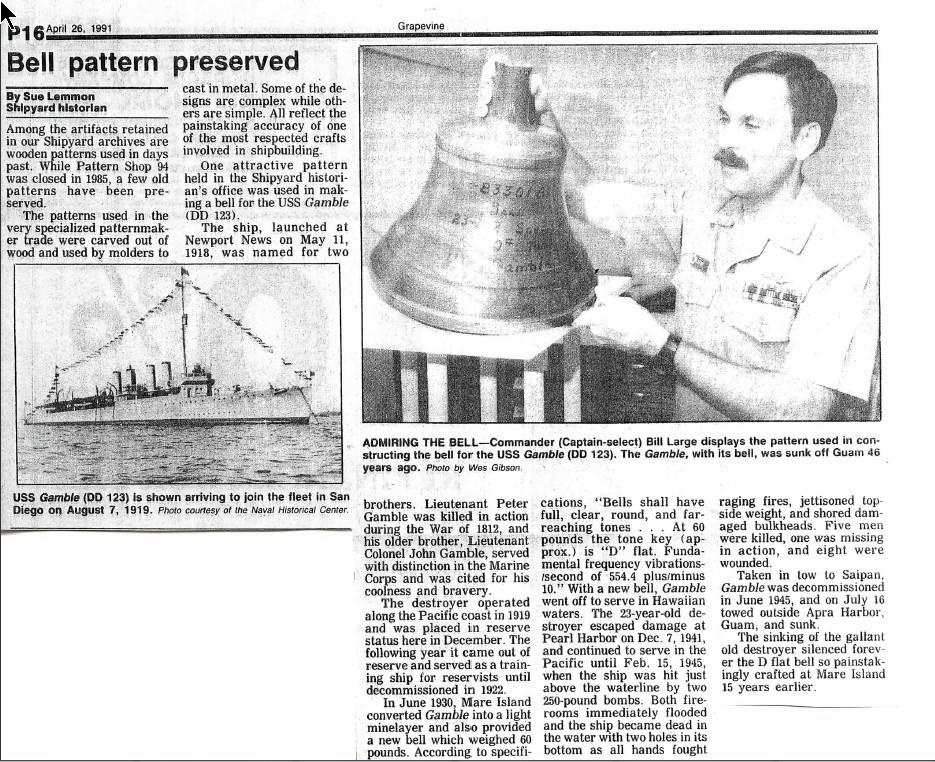
The wooden mold for her D Sharp ship’s bell, cast at Mare Island, resurfaced in 1991.

Her plans, drawings, deck logs, and war history are online in the National Archives. 

As for Shirley Temple, a bosun whistle presented to her by Gamble’s crew in 1935 remained a treasured possession for years. After all, she would meet her future husband, Charles Alden Black, a former Naval intelligence officer, in Hawaii in 1950 so perhaps those long-ago Pearl Harbor USN memories were prized. The whistle remained part of Ms. Temple’s estate and archives until it was sold at a 2015 auction by Theriault’s in New York.

It is undoubtedly in some collector’s display as this is written and perhaps will resurface one day.

Thus far, the Navy has chosen to not reissue the name “Gamble” to a second ship, which is a pity.


Ships are more than steel
and wood
And heart of burning coal,
For those who sail upon
them know
That some ships have a
soul.


If you liked this column, please consider joining the International Naval Research Organization (INRO), Publishers of Warship International

They are possibly one of the best sources of naval study, images, and fellowship you can find. http://www.warship.org/membership.htm

The International Naval Research Organization is a non-profit corporation dedicated to the encouragement of the study of naval vessels and their histories, principally in the era of iron and steel warships (about 1860 to date). Its purpose is to provide information and a means of contact for those interested in warships.

With more than 50 years of scholarship, Warship International, the written tome of the INRO, has published hundreds of articles, most of which are unique in their sweep and subject.

PRINT still has its place. If you LOVE warships you should belong.

I’m a member, so should you be!

Warship Wednesday, Nov. 22, 2023: From Midway to Trafalgar

Here at LSOZI, we take off every Wednesday for a look at the old steam/diesel navies of the 1833-1954 period and will profile a different ship each week. These ships have a life, a tale all their own, which sometimes takes them to the strangest places. – Christopher Eger

Warship Wednesday, Nov. 22, 2023: From Midway to Trafalgar

Above we see a great bow-on shot of the FRAM’d Gearing class destroyer USS Eugene A. Greene (DD/DDR-711)with a bone in her teeth in her second life as the Spanish Navy’s Churruca (D61) in the 1980s, the country’s traditional crimson and gold Rojigualda ensign on her mast, a twin 5″/38 hood ornament and two forward-facing Mk.32 triple torpedo tubes under the bridge wings. Her original moniker comes from naval aviator Eugene Allen Green, born 98 years ago this week.

The Gearings

In July 1942 the U.S. Navy, fighting a U-boat horde in the Atlantic and the Combined Fleet in the Pacific was losing ships faster than any admiral ever feared in his worst nightmare. With that in mind, the Navy needed a lot of destroyers. While the Fletcher and Allen M. Sumner classes were being built en mass, the go-ahead for some 156 new and improved Sumners— stretched some 14 feet to allow for more fuel and thus longer legs to get to those far-off battlegrounds– was given. This simple mod led to these ships originally being considered “long hull Sumners.”

These hardy 3,500-ton/390-foot-long tin cans, the Gearing class, were soon being laid down in nine different yards across the country.

Designed to carry three twin 5-inch/38 cal DP mounts, two dozen 40mm and 20mm AAA guns, depth charge racks and projectors for submarine work, and an impressive battery of 10 21-inch torpedo tubes (downgraded to just 5 tubes) capable of blowing the bottom out of a battleship provided they could get close enough, they were well-armed. Fast at over 36 knots, they could race into and away from danger when needed.

Meet Eugene A. Greene

Our subject is the first Navy ship to be named in honor of Eugene Allen Green, born in Smithtown, New York on 21 November 1921. A 1940 graduate of Rhode Island State College, he attended ROTC while in school and promptly enlisted in the U.S. Navy Reserve’s air cadet program, earning his ensign bar along with his wings of gold by August 1941.

Assigned to Bombing (VB) Six aboard USS Enterprise (CV-6) in March 1942, he gave his last full measure behind the controls of his SBD (6-B-9) at the ripe old age of 21 during the Battle of Midway when, following the attack by VB-6 against the aircraft carrier Kaga on 4 June, he was one of 14 of the “Big E’s” pilots that had to ditch their planes on the way back home, out of fuel. Greene and his gunner, RM3c SA Mutane, along with the crews of eight other ditched aircraft from Enterprise that day, would never be seen again.

Greene was granted a posthumous Navy Cross in December 1942 and his widow, Mrs. Anita M. Greene, would sponsor the destroyer named in his honor.

The second of 16 Gearings contracted via Federal Shipbuilding, Kearny, New Jersey, the future USS Eugene A. Greene (DD-711) was laid down on 17 August 1944, launched the following March, and commissioned on 8 June 1945.

War!

While 98 Gearings would eventually be completed, most of these arrived too late to take part in WWII, with Greene joining a club that only included 44 sisters who arrived very late in the war. Although some were present in the final push to Tokyo, none were damaged or lost. Three of the class– USS Frank Knox, Southerland, and Perkins— entered Tokyo Bay in time to be present at the Japanese surrender, on 2 September 1945.

As for Greene, her WWII service, as detailed by her War History, consisted primarily of a shakedown cruise ranging from Penobscot Bay, Maine to Guantanamo Bay then, in mid-August following the news of the Japanese surrender, was assigned to the Atlantic fleet to serve as a school ship in Norfolk and Casco Bay, then to Pensacola to assist as a plane guard for aviation cadets– a task she would be well-versed in over her career.

USS Eugene A. Greene (DD-711) off New York City on 29 May 1946. She is still painted in wartime Camouflage Measure 22. NH 66345

A Chilly Peace

As the Navy’s newest destroyers, none of the new Gearings were mothballed after the war.

On 13 February 1947, Greene sailed south in a task group bound for Montevideo, Uruguay, to participate in the festivities accompanying the inauguration of the country’s new president, Tomás Berreta. The group also paid a goodwill visit to Rio de Janeiro before returning to Norfolk on 31 March.

Light cruiser USS Fresno (CL-121) on port call at Rio De Janeiro, March 1947, alongside her Gearing class consorts, USS Gearing, USS Gyatt, and USS Eugene A. Greene. Note the stern depth charge racks. The quartet was returning from Uruguay where they represented the U.S. at the inauguration of the new Uruguayan president. The Fresno was launched in 1946, too late to serve in WWII, so she took part in good-will diplomatic missions like this. She was sold for scrap in 1966. Photo attributed to Robert Norville, from NavSource.

As detailed by DANFS, the Norfolk-based Greene then became a staple of the 6th Fleet until 1960:

On 10 November 1947, Eugene A. Greene sailed on the first of 9 Mediterranean cruises made over the next 13 years. During those years, she and her sisters of the U.S. 6th Fleet have guarded the interests of peace and order in that sea which was the cradle of democratic government. Voyages to northern Europe and the Arctic varied the routine of overseas deployment for Eugene A. Greene.

What was skipped by DANFS was the fact that Greene was on hand in the region for five months through the 1956 Suez Crisis just in case she was needed.

It should be noted that, by this stage, she was significantly modernized, picking up a new tripod mast with AN/SPS-6 L-band radar (later augmented by an SPS-8A S-band capable of spotting aircraft 60nm away) and lightened her topside by landing most of her WWII AAA suite, torpedoes, and depth charges. This resulted in a change to a destroyer radar picket (DDR-711) that she held from July 1952 until she reverted to the simpler DD-711 in March 1963.

USS Eugene A. Greene (DD-711) underway at sea on 19 September 1950. Note that she has received a new tripod mast with AN/SPS-6 radar and has landed much of her WWII AAA suite, torpedoes, and depth charges. National Archives Identifier 24743125

At sea, October 1951. 80-G-442191

USS Eugene A. Greene (DDR-711) off the Norfolk Naval Shipyard on 18 December 1952. National Archives Identifier 24743145

Same as the above, bow on 24743147

Same as the above, stb profile. Note the newly installed AN/SPS-8 air search radar aft for her role as a DDR picket. 24743143

The Frostiest Part of the Cold War

Greene experienced the life that came with all the classic 1960s naval adventures in the Atlantic.

Greene is on the list of U.S. Navy ships that received the Armed Forces Expeditionary Medal for participating in the Cuban quarantine, from 24 October through 20 November 1962.

Roger Powell missed ship’s movement of the destroyer USS Rush (DD-714) — along with 44 other shipmates as she sortied out over the weekend on little notice– and was tacked on to help fill out Greene’s crew, similarly, headed for Cuba to be a plane guard alongside the USS Enterprise.

Greene would undergo a nearly year-long FRAM I reconstruction at Boston NSY, completed in October 1963. Meant to add 8 years to the ship’s life via a complete rehabilitation of all shipboard components, it also fundamentally changed the destroyer to a modern sub-buster. The 5″/38 Mount 52 forward was removed during the rebuild while a hangar and platform for the QH-50C DASH ASW drone was added in place of the SPS-8A radar house.

Also new was an 8-cell ASROC matchbox launcher amidships, SQS-23 SONAR, VDS, and a six-pack of Mark 32 torpedo tubes. She added Mk 44 ASW torps to her magazine, for use by her own Mk32s as well as DASH, which theoretically could drop them some 20 miles away from the destroyer.

When she left Boston, she became first the flag of Destroyer Squadron 28, then DESRON 32.

Like most East Coast-based Navy ships in the era, Greene participated in several NASA recovery missions between other assignments, logging two (Mercury-Atlas 2 and 3) in early 1961 and Gemini-Titan 2 (GT-2) in 1965, supporting the primary recovery ship, USS Lake Champlain (CVS-39).

A great view of the post-FRAM’d USS Eugene A. Greene (DD-711) steaming past USS Lake Champlain (CVS-39) during operations on 23 September 1964. Note her ASROC amidships and her big DASH hangar aft in place of the deleted Mount 52. She still carries her aft mount (Mount 53) and forward (51). One of the carrier’s big Sikorsky SH-3 Sea King ASW helicopters is flying by in the right foreground, and another destroyer is in the left distance. Photographer: AN Thomas J. Parrett. NH 107007

Speaking of the Med, Greene would make another four deployments there between 1968 and 1972– and on two of them job into the Persian Gulf/Indian Ocean to show the flag in the increasingly important region. This included a seven-month goodwill cruise with the U.S. Middle East Force in 1968 during which she was the first U.S. ship to enter the new Iranian port of Bander Abbas, doing the Shah’s Navy the courtesy of charting the harbor from end to end with her advanced sonar.

Earning “blue noses” for her crew, she also took part in Operation Deep Freeze ’69 in the Antarctic and two North Atlantic cruises that crossed the Arctic Circle. Warming up, she went to Latin America once again in UNITAS ’68.

War! (This time for real)

Greene, being a top-of-the-line ASW boat post FRAM mods, also sailed to the Pacific to take part in a West Pac deployment (June-December 1966) to Vietnamese waters, shipping via the Panama Canal, Pearl Harbor, Guam, Subic Bay, and Hong Kong to take up station as a plane guard alongside the carrier USS Constellation (CVA-64) on 28 July.

There she remained for a month at sea, every day closing to within 4,000 yards with a rescue detail at the ready in case one of Conny’s birds went into the drink, all the while her sonar techs kept an ear out for anything funny in the depths.

USS Constellation (CVA-64), the third ship named for the configuration of 15 stars on the original United States Flag shows an A-4 Skyhawk given landing instructions by a technical crewman using the Landing Signal Officer’s (LSO) console as the LSO watches, October 1966. Greene was her primary plane guard during a good part of Conny’s 1966 Far East Cruise (12 May–3 December) with CVW-15 on board during which 16 aircrewmen and 15 aircraft were lost in operations. K-33638

This lifeguard work paused on 21 August when Greene was dispatched to close to the South Vietnam littoral under control of Task Unit 70.8.9 where she stood by in the Republic of Vietnam’s I Corps area on call for naval gunfire support missions. Over the next five days, her gunners got in lots of work as she steamed as close as 2,000 yards from shore answering NGFS calls with 311 rounds of HE and WP and providing 90 nighttime star shell illumination for friendly outposts. She was credited with annihilating an enemy base camp, wiping out a platoon-sized element of infiltrators in the open, and destroying several enemy supply buildings.

A sampling from her deck log:

Headed back to Yankee Station after rearming while underway, she worked alongside the carrier USS Coral Sea for the rest of her deployment until she slipped her port shaft in October and had to limp into Tse Ying, Taiwan, for a quick fix that would get her to Subic Bay. Returning to Norfolk in December via the Suez and the Med, Greene ended up circumnavigating the globe in a 205-day around-the-world deployment.

In short, her 27-year career with the U.S. Navy was diverse and, well, just remarkably busy. It was little surprise one of her lasting nicknames was “The Steamin’ Greene.”

But all good things must come to an end and on 31 August 1971, with Greene almost eight promised years to the dot past her FRAM I service life extension, she was decommissioned.

A second life

With the general post-WWII rapprochement between a still very fascist Franco and the Western allies, the 1953 Madrid agreements thawed the chill between the U.S. and the country, opening it to military aid in return for basing.

Soon, the country would receive its first modern submarine, the snorkel-equipped USS Kraken (SS-370) (taken in service as Almirante García de los Reyes, E-1), later joined by three Guppy’d Balao-class smoke boats.

Then came five Lepanto-class destroyers– WWII Fletcher-class tin cans– starting with USS Capps (DD-550) in 1957, which were transferred. The old light carrier USS Cabot was loaned to the Spanish Navy on 30 August 1967, which renamed her Dédalo (R.01).

In many ways, the Spanish fleet by the late 1960s, was very American.

These were soon joined by five FRAM I Gearing class destroyers, starting with USS Eugene A. Greene (DD/DDR-711) in 1972. By this time, the Spanish were also slated to get five new-made Baleares-class frigates, variants of the Knox class destroyer escort/fast frigates updated with Standard SAM suites.

Greene, still on the Navy List, was loaned to Spain the same day she was decommissioned. Renamed Churruca (D61) she honored RADM Cosme Damián Churruca y Elorza, who was lost on his ship-of-the-line San Juan Nepomuceno at Trafalgar in 1805.

Muerte de Cosme Damián Churruca (detalle), Eugenio Álvarez Dumont

Stricken from the U.S. Navy List on 2 June 1975 three years after she joined the Spanish Navy, Greene was sold to Spain for a token fee and remained in service with the force through the 1980s, class leader of her 11th Destroyer Division sisters. To be fair, although they were 30 years old, these FRAM I Gearings in the 1970s and 80s were still capable against Russki Whiskey, Romeo and Foxtrot-type smoke boats and their guns still worked enough for old-school NGFS should the large Spanish naval infantry need fire missions.

Period photos of Churruca show her still very much in her prime.

With the Cold War ending, so did the Gearings worldwide. Churruca was stricken by Spain on 15 September 1989, and disposed of in a SINKEX in 1991.

Sent to the bottom by a mixture of ordnance from Spanish Air Force F-18s and Spanish Navy AV-8 Matadors as well as some Standard missiles and Harpoons, her death was captured on grainy video, much like a snuff film.

Her four sisters in Spanish service (Gravina, ex-USS Furse; Méndez Núñez, ex-USS O’Hare; Lángara, ex-USS Leary; and Blas de Lezo, ex-USS Noa) were all disposed of within another year.

Epilogue

Greene’s deck logs are digitized in the National Archives and represent one of the few items left of the old girl. 

Of her massive armada of 98 Gearing-class sisterships that were completed, 10 survive above water in one form or another including three largely inactive hulls in the navies of Mexico and Taiwan. The others are museum ships overseas except for USS Joseph P. Kennedy, Jr. (DD-850) in Fall River, Massachusetts; and the USS Orleck (DD-886) in Jacksonville. Please visit these vital floating maritime relics.

Orleck, fresh out of dry dock, being towed to her new home in Jacksonville


Ships are more than steel
and wood
And heart of burning coal,
For those who sail upon
them know
That some ships have a
soul.


If you liked this column, please consider joining the International Naval Research Organization (INRO), Publishers of Warship International

They are one of the best sources of naval study, images, and fellowship you can find. http://www.warship.org/membership.htm

The International Naval Research Organization is a non-profit corporation dedicated to the encouragement of the study of naval vessels and their histories, principally in the era of iron and steel warships (about 1860 to date). Its purpose is to provide information and a means of contact for those interested in warships.

With more than 50 years of scholarship, Warship International, the written tome of the INRO, has published hundreds of articles, most of which are unique in their sweep and subject.

PRINT still has its place. If you LOVE warships you should belong.

I’m a member, so should you be!

Warship Wednesday (on a Thursday) Nov. 16, 2023: The Darkest Twist

Here at LSOZI, we take off every Wednesday for a look at the old steam/diesel navies of the 1833-1954 period and will profile a different ship each week. These ships have a life, a tale all their own, which sometimes takes them to the strangest places. – Christopher Eger

Warship Wednesday (on a Thursday) Nov. 16, 2023: The Darkest Twist

Official USN photo probably by Tai Sing Loo, courtesy of George & Linda Salava. This photo was from the collection of FC3 Frank Salava who was lost when the Sculpin (SS-191) was sunk & 62 other crewmen were K.I.A. on 19 November 1943. Via Navsource

Above we see the S-type (Sargo-class) fleet boat USS Sculpin (SS-191) entering Pearl Harbor sometime between April 1940 and October 1941, in tense but happy times. Note the bright white pre-war pennant numbers on her fairwater. Sculpin would soon be at war, one that she would not emerge.

The Sargo class

The 10 early fleet boats of the Sargo class came in the wake of the half-dozen very similar Salmon class vessels (indeed, they are typically referred to as the “S-Class 2nd Group”) and 10 early 1930s Porpoise class boats, which paved the way for the Navy to get the long-range Pacific submarine design nailed down in the follow-on Tambor, Gato (85 boats), Balao (134 boats), and Tench (29 boat) classes. Importantly, their new and improved battery design would become the standard for American diesel boats through the 1950s when they were replaced by the Sargo II batteries under the GUPPY program.

View of some of the Sargo-type battery cells as seen through a floor hatch aboard the museum ship, the Balao-class submarine USS Ling (SS-297), located in Hackensack, New Jersey. Photo date 31 Aug 2013 “Instead of a single hard rubber case, it had two concentric hard rubber cases with a layer of soft rubber between them. This was to prevent sulfuric acid leakage in the event one case cracked during depth-charging. Leaking sulfuric acid is capable of corroding steel, burning the skin of crew members it came into contact with, and if mixed with any seawater in the bilges would generate poisonous chlorine gas.”

Some 2,300 tons (submerged) the Sargos ran 310 feet overall, a foot shorter than the much more prolific Gatos.

Capable of making 21 knots on the surface and with a range of 11,000 nm, they had an operational depth of over 250 feet and carried an impressive main battery of eight (four forward, four aft) 21-inch torpedo tubes and the ability to carry 24 torpedoes. Meanwhile, the deck gun was a puny 3″/50 DP wet mount (which was later replaced by a bigger 4″50 later in the war).

The 10 Sargos were all given aquatic names beginning with “S” and were built by EB in Groton (Sargo, Saury, Spearfish, Seadragon and Sealion), Mare Island Navy Yard (Swordfish) and Portsmouth Navy Yard in Maine (Sculpin, Squalus, Searaven, and Seawolf) on an extremely compressed timeline with the first being laid down in May 1937 and the last commissioning in December 1939– just 31 months. Not bad for peacetime production.

Launch of Sargo-class submarine USS Swordfish (SS-193) at Mare Island Navy Yard, California on April 1st, 1939. This is the earliest known color Official Navy Photograph that can be precisely dated.

Still, the class was cramped, with just 36 bunks for 62 enlisted men.

Meet Scuplin

Our subject is the first Navy ship to be named in honor of the “spiny, large-headed, broad-mouthed, usually scale-less fish of the family Cottidae” and was laid down on 7 September 1937 at Portsmouth, launched on 27 July 1938, and commissioned on 16 January 1939.

Sculpin launched

No sooner had she begun her career than, while on shakedown, Sculpin was tasked with finding lost classmate (and yard mate) USS Squalus (SS-192), which had suffered a catastrophic valve failure during a test dive off the Isle of Shoals at 0740 on 23 May, drowning 26 men immediately. Partially flooded, Squalus sank to the bottom and came to rest, keel down, in 40 fathoms of water with 32 surviving crewmembers and one civilian trapped in the forward section.

USS Squalus Sweating It Out. Painting, Watercolor, and Ink on Paper; by John Groth; 1966; Unframed Dimensions 26H X 36W NHHC Accession #: 88-161-QX

At 1040, when Squalus was an hour overdue for regular check-in, the red flag went up.

Luckily, Sculpin was due to leave Portsmouth for Newport at 1130 and was directed to the last known position of Squalus.

By 1241, Sculpin spotted a red smoke bomb from Squalus and soon after found the lost boat’s marker buoy and attached telephone line then contacted the survivors some 240 feet down.

Fixing the sub’s position via sonar, Sculpin stood by while the Navy’s Experimental Dive Unit own Allan Rockwell McCann and Charles Bowers Momsen arrived on the old Great War Lapwing-class minesweeper-turned-submarine rescue ship USS Falcon (AM-28/ASR-2) and a swarm of Coast Guard assets to begin the rescue.

Aerial photograph showing, from left to right, fleet tug USS Wandank, submarine USS Sculpin, submarine rescue ship USS Falcon, naval shipyard tug Penacook, and Lighthouse Service tender Hibiscus, in addition to Coast Guard boats and spectator boats. USCG Photo 230717-G-ZW188-2000

Four enlisted divers using then-new heliox diving schedules and the McCann Submarine Rescue Chamber (SRC) ran constantly for 14 hours making four trips down to Squalus’s forward trunk, rescuing all 33 survivors.

A fifth trip was made to the Squalus’s after torpedo room hatch to verify that no men survived in the flooded portion of the boat — one of the most stirring successes in submarine rescue operations.

The four enlisted divers– Chief Boatswain’s Mate Orson L. Crandall, Chief Metalsmith James Harper McDonald, Chief Machinist’s Mate William Badders, and Chief Torpedoman John Mihalowski — received rare peacetime Medals of Honor in January 1940.

Squalus was eventually raised in July 1939 with the help of Sculpin and repaired, and was put back into service as USS Sailfish, with the same hull number (SS-192). More on her later.

Submarine Sculpin Lying off the Port Beam of the Salvage Ship Falcon, Assisting with Pumping Operations through a Hose Line. NARA

View from the USS Sculpin of the Raising of the Pontoons Attached to the Bow of the USS Squalus. NARA

USN 1149026

Salvage of USS Squalus (SS-192). USS Falcon (ASR-2) moored over the sunken Squalus, during salvage operations off the New Hampshire coast in the Summer of 1939. USS Sculpin (SS-191) is in the right background. USN 1149028

War!

Sculpin and her class were built for the looming war in the Pacific and, as soon as she wrapped up her duty in the Squalus rescue and raising, she was off to Pearl Harbor, arriving there in April 1940 via “The Ditch” and San Diego. Operating from Hawaii with the Pacific Fleet, with tensions bubbling up with the Empire of Japan, she was forward deployed 5,100 miles West to Admiral Thomas Hart’s Asiatic Fleet in the Philippines in late October, arriving at Cavite Navy Yard on 8 November to join Submarine Division 22.

A month later the war got real.

Just after the inaugural Japanese air raids from Formosa, Sculpin and her sister USS Seawolf (SS-197) got underway from Cavite on 8 December 1941 to escort the old aircraft carrier Langley (then used as an aircraft transport, pennant AV-3), and the precious oilers USS Pecos (AO–6) and USS Trinity (AO-13) from the yard off Sangley Point that evening, clearing the American minefield and zig-zagging through the Verde Island Passage with her skipper notingLangley used general signals freely, probably unaware that we have landed the greater part of our classified publications.”

Handing Langley and the two irreplaceable tankers to the four-piper destroyers USS Pope (DD-225) and USS John D. Ford (DD-228) the next morning to shepherd further to Dutch Borneo, the Sculpin and Seawolf separated and embarked on their first war patrols. They made it out of Cavite just in time as it was attacked on the morning of 10 December by 80 Japanese bombers and 52 fighter planes, destroying it as a base for the Asiatic Fleet and leaving 500 dead. Among the shattered vessels left at Cavite was Sargo-class sister USS Sealion (SS-195).

Sculpin conducted her patrol like clockwork, submerging just before dawn in her assigned zone north of Luzon, patrolling slowly on her electric motors at 100 feet down, surfacing at dusk, and remaining on the surface all night with lookouts. She was plagued with mechanical issues, suffering a freon leak in her refrigerator, shipping water from her No. 7 torpedo tube, and her fathometer called it quits on the fourth day of the war. Worse, she was beset with a lack of targets, only encountering the occasional passing local sampans and coasters.

On 10 January, she came across a juicy target, a 10-ship Japanese convoy off the Surigao Strait. She worked close enough to get a bead on a big freighter thought to have been of the Shoei Maru type and fired four torpedoes with two believed to have been hits.

While DANFS lists this as “possibly Sculpin should be given credit for eliminating 3,817-ton merchantman, Akita Maru” it is generally thought that that vessel, an Army transport, was sunk the same day some distance away at the mouth of the Gulf of Siam along with the cargo ship Tairyu Maru by the hard-charging Dutch sub Hr.Ms. O-19.

Sculpin ended her 1st patrol on 22 January 1942 at Surabaya, Java, having sailed some 6,921 miles.

Her 2nd war patrol started a week later, leaving Java to patrol the Celebes in the south Philippines on 30 January. There, on 4 February, she torpedoed and damaged the Japanese destroyer Suzukaze off Staring Bay, south of Kendari, Celebes. Suzukaze was heavily damaged, with nine of her crew killed, and was knocked out of the war for five months. Two days later she attacked and sank what was reported to be a “heavily screened Tenry-class enemy cruiser.”

Sculpin had a third run on a convoy spoiled by a grueling depth charge attack on 17 February– with the explosions jamming the steering and stern planes of the boat forcing her to a near-crush depth of 340 feet, and ending her patrol to seek repairs at Exmouth Bay, Australia.

Her third patrol, begun from Australia in March after she had been roughly patched up, included three attacks made while in patrol off the Moluccas while struggling with a new radar installation and faulty torpedoes. She steamed 7,895 miles in 21 days, about 80 percent of that on the surface.

With the war just over four months old, and most of that spent running and fighting in Japanese-controlled waters, constantly shifting homeports further and further south, her crew was at the breaking point.

As noted by her skipper, LT Lucius Henry Chappell (USNA 1927):

Her 4th war patrol, in the South China Sea from 29 May to 17 July, would be even longer, stretching 9,349 miles.

Her 5th patrol would be her most successful, leaving Brisbane on 8 September to patrol in the target-rich Bismarck Sea with the Solomons Campaign underway. She torpedoed and damaged the Japanese seaplane carrier Nisshin east of Kokoda Island off New Britain on 28 September and was damaged by depth charges but was able to continue her patrol, going on to sink the troop transports Naminoue Maru (4731 GRT) and Sumiyoshi Maru (1921 GRT) in early October before arriving back at Brisbane on 26 October then made a run on the light cruiser Yura without success.

The tactics had changed, with 42 of 48 days of her 5th war patrol spent with at least some time submerged, cruising some 8,594 miles.

Her 6th patrol, off Truk in the Caroline Islands from 18 November through the end of the year, netted no trophies– although she did stalk a Japanese flattop on the surface at night and earn some bracketing shell fire as a participation award– after ending it on 8 January 1943 at Pearl Harbor, she sailed back to the West Coast for a much-needed overhaul.

At this point in her career, she carried 13 enemy ships on her Jolly Roger.

“Undersea Hunters Mark Up 13 Victories. They found good hunting. Back at a Pacific base after a cruise in enemy waters, officers and crew of the Sculpin (SS-191) display a flag symbolic of three Japanese warships and ten merchantmen sent to the bottom.” Crew photo taken 7 March 1943. The men are from left to right, (Front Row) Carlos Tulea, 29, OS2c (officers steward) of Cavite, P.I.; Lt Corwin G. Mendenhall, USN, 26, of Anehuac, Texas; Weldon E. Moore, Chief Signalman, 34, of Colorado Springs. Colorado;(KIA), Lt. John H. Turner, USN, 29. (Back Row) John J. Pepersack, Chief Electrician, 42 of Baltimore, MD; A. W. Coulter, QM3/c, 20, of St. Louis, MO; K. E. Waidelich, SM3c, 21, of Jackson, Michigan; Charlie Coleman, MoMM2c, 24, Philadelphia, PA (KIA); John Swift, EM1c, 25, of Newfane, NY; John J. Hollenbach, MM1c, 27 of Brookville, ID; Ralph S. Austin, MM2c, 21, of Springtown, TX; F. J. Dyboske, CEM, 33, of Rockford, IL; C. A. De Armond, MM1c, 30, of Denver CO. Text i.d. courtesy of Ric Hednan. (Official U. S. Navy photo from NEA). Image and text provided by the University of North Carolina at Chapel Hill Library, Chapel Hill, NC. Photo & text by The Wilmington Morning Star. (Wilmington, N.C.) 1909-1990, 10 March 1943, FINAL EDITION, Image 1, courtesy of chroniclingamerica.loc.gov.

A better version of the above image.

Her refit left her with a series of great images of her late-war appearance, including moving her 3-inch popgun forward of the tower.

USS Sculpin (SS-191) At the Bethlehem Steel Company shipyard, San Francisco, California, on 1 May 1943, following an overhaul. This view of the forward end of her sail identifies changes recently made to the ship. Note 20mm and 3/50 guns: SD and SJ radar antennas. NH 97305

USS Sculpin (SS-191) At the Bethlehem Steel Company shipyard, San Francisco, California, on 1 May 1943, following an overhaul. This view of the after end of her sail identifies changes recently made to the ship. Note 20mm gun, SD and SJ radar antennas. The Coast Guard lighthouse tender Balsam (WAGL-62) is in the floating drydock in the right background. NH 97306

USS Sculpin (SS-191) In San Francisco Bay, California, on 1 May 1943, following an overhaul. The San Francisco Bay Bridge is in the background. NH 97303

Same as above, NH 97302

Back in the war, she started her 7th war patrol from Pearl Harbor on 24 May, bound for Japanese home waters where she stalked the light carrier Hiyo and sank two small vessels via naval gunfire off Inubozak, ending her patrol on Independence Day in Midway.

Her 8th war patrol, leaving Midway on 25 July, would span some 9,074 miles of ocean and she claimed a 4,000-ton AK sunk– postwar confirmed as the cargo ship Sekko Maru (3183 GRT) — off Formosa. Returning to Midway on 17 September, LT Chappell, who had earned two Navy Crosses on Sculpin, would leave the boat he had commanded since April 1941 to command Submarine Division 281.

Chappell survived the war and later had command of Submarine Squadron 7, USS Mt. McKinley (AGC-7), and the cruiser USS Quincy (CA-71) — ironic considering he claimed at least two attacks on Japanese cruisers during the war. While a rear admiral, he served as the technical advisor to films The Wackiest Ship in the Army and Operation Petticoat, the latter in which the USS Balao (SS 285) was painted pink. He passed away in 1980.

Sculpin’s new skipper, LCDR Fred “Fee” Connaway (USNA 1932), formerly XO and skipper of the training boats USS S-13 (SS-118) and USS S-48 (SS 159), took over on 20 October.

Two weeks later, with a third of her 84 men aboard sailing to war for the first time, on 5 November, Sculpin left Pearl Harbor for her 9th war patrol in a wolf pack (err, “Submarine Coordinated Attack Group”) with two other submarines (Searaven and Apagon), ordered to patrol north of Truk, to intercept and attack Japanese forces leaving that stronghold to oppose the planned Allied invasion of the Tarawa in the Gilbert Islands.

The wolf pack commodore’s flag, carried aboard Sculpin, was Captain John P. Cromwell (USNA 1924), formerly commander of Submarine Divisions 203, 44, and 43 and one of the stars of COMSUBPAC VADM Charles Lockwood’s staff. He had been an officer in the Bureau of Engineering/BuShips in Washington for two years concerning submarine development and was the Engineering officer for the Pacific Fleet’s Sub force. In short, if it was submarine-related, he knew it including details of performance, construction, machinery, communications, and exploitable flaws. Plus, he was privy to Ultra intercept secrets.

Sculpin, Connaway, and Cromwell would never come back, with the submarine reported missing in November, presumed lost on 30 December, and struck from the Navy list on 25 March 1944.

The Tragic End

Post-VJ Day, Allied rescuers recovered 21 members of Sculpin’s final crew from Japanese prison camps working the copper mines of Ashio, mostly junior enlisted but including one officer (Diving officer LT George E Brown., Jr.– who was kept in solitary confinement when not being interrogated, put on reduced rations, given frequent beatings, and threatened with death if he refused to answer questions).

Pieced together from their interviews, the sub attacked a Japanese convoy on the night of 18 November, but it all went pear-shaped and by the next morning, she was battered and headed to the mat, racing down to 700 feet at one point. This led ultimately to a last-ditch surface gunfight with the Japanese destroyer Yamagumo at point-blank range.

As detailed by Combined Fleets: 

19 November:
Encountered enemy submarine.
Action:

  • 0640 Sighted enemy submarine (USS SCULPIN) surfacing on the port beam, and seeing it submerge begins a series of alternate depth-charge and pinging runs.
  • 1109 the damaged submarine accidentally broaches the surface, and the destroyer intensifies the attack.
  • 1256 The SCULPIN surfaces, being crippled and unable to stay submerged. The submarine opts for a desperate gunfire duel with its starboard side facing YAMAGUMO’s starboard side as they exchange fire at 2,000 yards.
  • 1307 The submarine is listing and the destroyer ceases fire and ten minutes later dispatches rescue boats as the scuttled submarine submerges for the last time in what looked to her survivors almost like a normal dive. Forty-one survivors are rescued, and YAMAGUMO returns to Truk with them.

As detailed by the NHHC:

About noon on 19 November, a close string of 18 depth charges threw Sculpin, already at deep depth, badly out of control. The pressure hull was distorted, she was leaking, the steering and diving plane gear were damaged and she was badly out of trim. Commander Connaway decided to surface and to fight clear.

The ship was surfaced and went to gun action.

During the battle Commander Connaway and the Gunnery Officer were on the bridge, and the Executive Officer was in the conning tower. When the destroyer placed a shell through the main induction and one or more through the conning tower, these officers and several men were killed. Lt. Brown succeeded to command. He decided to scuttle the ship, and gave the order “all hands abandon ship.” After giving the order the last time the ship was dived at emergency speed by opening all vents.

About 12 men rode the ship down, including Captain Cromwell and one other officer, both of whom refused to leave it. Captain Cromwell, being familiar with plans for our operations in the Gilberts and other areas, stayed with the ship to ensure that the enemy could not gain any of the information he possessed.

The Japanese pulled 42 men from the ocean, tossed one back overboard that was seriously wounded, and landed 3 officers and 38 men at Truk for rough questioning.

Separating these into two groups for transport to Japan, the first, consisting of 21 men, was in the brig of the escort carrier Chuyo when she was sunk by the Sailfish (SS-192) — ironically the old Squalus that Sculpin had been so key in rescuing and raising in 1939.

Only one wounded American made it off Chuyo, George Rocek, MoMMIc, USN, who was rescued by a Japanese destroyer (again) only to be sent to join the rest of his crewmates in the Ashio copper mines, who had made it safely to Japan in the brig of the carrier Un’yō. The mines also held survivors from the lost American subs USS Grenadier, Perch, Sculpin, Tang, S-44, and Tullibee.

Sculpin was awarded eight battle stars for her service in World War II, in addition to the Philippine Presidential Unit Citation. Her wartime tally, not entirely confirmed by post-war records, was sinking 9 ships for 42,200 tons and damaging 10, totaling 63,000 tons.

Epilogue

Sculpin is one of 52 U.S. submarines lost in WWII-– almost one out of five subs that logged combat patrols– taking with them 374 officers and 3,131 enlisted men. These personnel losses represented 16 percent of the officers and 13 percent of the enlisted operational personnel in the submarine branch.

Her final desperate stand is remembered in maritime art.

DUE 117: USN Submarine vs IJN Antisubmarine Escort,’ illustrated by Ian Palmer, shows the death of USS Sculpin, via Osprey Publications.

The 1950s TV show “Silent Service” had an episode devoted to Sculpin, including a guest appearance by LT Brown. 

The reports for the first eight of her patrols are in the National Archives. 

Considered to be on Eternal Patrol, Sculpin and her lost crew are thus remembered in several memorials nationwide. Her sisters Seawolf, Sealion, and Swordfish are also among the 52.

Their names are inscribed on a memorial at the USS Albacore Museum in New Hampshire. (Photo: Chris Eger)

When it came to the rest of the 10-boat Sargo class, they were disposed of shortly after the war as obsolete, all sold for scrap or sunk as targets before their 10th birthdays. They claimed no less than 73 enemy ships during the war and chalked up 84 battle stars between them. Class member Seawolf (SS-197) is tied for seventh place in confirmed ships sunk by U.S. subs, according to the postwar accounting of the Joint Army–Navy Assessment Committee (JANAC).

LT Brown earned a November 1945 Silver Star for his performance during Sculpin’s doomed final patrol. He had made five runs with USS S-40, and four on Sculpin, filling his dance card long before he spent the last 23 months of the war in a hellish series of POW camps.

First-Class Motor Machinist’s Mate George Rocek passed in 2007, aged a ripe old 86, having seen some serious shit including being in the unenviable position of being rescued twice by the Japanese from the sea.

Cromwell, the wolf pack commander who had served on ADM Lockwood’s staff and whose head was filled with Ultra intercept secrets that he took to the bottom with him, would be recommended for and receive the Medal of Honor, posthumously, and the destroyer escort USS Cromwell (DE-1014), commissioned in 1954, was named in his honor.

He was the most senior submariner to earn the MOH and LT Brown, the last man to see him alive, recalled him “sitting on an empty 20mm shell container, holding a picture of his wife and children” as Sculpin was going down.

Cromwell’s wife, Margaret, received his Medal of Honor with it being placed on his son John P. “Duke” Cromwell, Jr. (USNA ’51, ret Capt.) by VADM Richard S. Edwards (USNA 1907), commander of Western Sea Frontier.

Cromwell’s sacrifice has been well recorded in naval lore, from comic books to novels and tomes of military history. He and Connaway is remembered in Memorial Hall at the United States Naval Academy where his name is engraved under the “DONT GIVE UP THE SHIP” flag honoring those alumni killed in action.

Vignette gives details on why Captain Cromwell received the Medal of Honor for actions taken during the loss of USS Sculpin on 19 November 1943, by Mario DeMarco, published in the Navy Times circa 1956. NH 86993

“There is a port of no return-” Captain John P. Cromwell goes down with the stricken Sculpin (SS-191) to prevent seizure and possible enemy extortion of special information confided to his care. The sea will keep his secret well, and his name will become a naval synonym for valor. “Sailor, rest your oar-” Drawing by Lt. Cmdr. Fred Freemen, courtesy of Theodore Roscoe, from his book “U.S. Submarine Operations of WW II”, published by USNI, via Navsource.

OAAW #239 1971 by Norman Maurer

OAAW #239 1971 by Norman Maurer

As for Sculpin, while plans for a Tench class submarine to carry her name onward failed when the war ended, about the only tangible part of her is the eight-patrol Jolly Roger battle flag presented by the crew to LT (later RADM) Chappell when he left the boat in 1943.

It is cherished and maintained by his family. Photo courtesy of Randy Chappell, son of Lt. Commander Lucius H Chappell, via PIGBOATs

Fred Connaway, the skipper of Sculpin killed in her last surface engagement, was posthumously awarded the Silver Star. Fred’s widow, Loretta, was there with three former POWs of Sculpin’s last crew– including LT Brown– when the new Skipjack-class hunter-killer USS Sculpin (SSN-590) was launched in Pascagoula on 31 March 1960.

USS Sculpin (SS (N) -590) Sponsor and three survivors of the first SCULPIN. L to R: Mr. George Brown, Mrs. Fred Connaway, Mr. Paul L. Murphy, Mr. Billy M. Cooper NH 108726

USS Sculpin (SSN-590) launching, 31 March 1960 Ingalls east bank Pascagoula NH 108730

The second Sculpin served until 1990 then was decommissioned and recycled.


Ships are more than steel
and wood
And heart of burning coal,
For those who sail upon
them know
That some ships have a
soul.


If you liked this column, please consider joining the International Naval Research Organization (INRO), Publishers of Warship International

They are possibly one of the best sources of naval study, images, and fellowship you can find. http://www.warship.org/membership.htm

The International Naval Research Organization is a non-profit corporation dedicated to the encouragement of the study of naval vessels and their histories, principally in the era of iron and steel warships (about 1860 to date). Its purpose is to provide information and a means of contact for those interested in warships.

With more than 50 years of scholarship, Warship International, the written tome of the INRO has published hundreds of articles, most of which are unique in their sweep and subject.

PRINT still has its place. If you LOVE warships, you should belong.

I am a member, so should you be!

Warship Wednesday, Nov. 8, 2023: Wrong Place at the Wrong Time

Here at LSOZI, we take off every Wednesday for a look at the old steam/diesel navies of the 1833-1954 period and will profile a different ship each week. These ships have a life, a tale all their own, which sometimes takes them to the strangest places. – Christopher Eger

Warship Wednesday, Nov. 8, 2023: Wrong Place at the Wrong Time

Above we see the mighty King Edward VII class battleship HMS Britannia, circa 1908, in all her fine peacetime glory. She would give more wartime service than her sisters and came within two days of finishing the conflict unscathed, tragically sent to the bottom 105 years ago this week.

The King Edward VII class

Hitting over 17,000 tons when fully loaded and with a 453-foot overall length, the eight battleships of the King Edward VII class (King Edward VII, Africa, Britannia, Commonwealth, Dominion, Hibernia, Hindustan, and New Zealand/Zealandia) were big for pre-Dreadnoughts (more than 2,000 tons heavier and 30 feet longer than the preceding Duncan class), as well as being fast, capable of hitting 18.5 knots on a pair of triple expansion steam engines driven by as many as 18 water tube boilers.

King Edward VII, the class leader, was completed in February 1905, just 22 months before HMS Dreadnought.

Carrying a 9-inch Krupp armor belt with barbettes, turrets, conning tower, and bulkheads thickening to as much as 12 inches, they could take abuse and could dish it out as well in the form of four BL 12″/40 (30.5 cm) Mark IX guns-– which were the first large-caliber British gun to use a Welin breech mechanism that considerably shortened the loading time. 

Forecastle of HMS Britannia ca. October 1914. Note the forward twin 12-inch/40 mount

Rather than the 6-inch secondary battery of the Duncans, the KEVIIs carried another four 9.2″/47 (23.4 cm) Mark Xs in single gun beam turrets with about a 170-degree arc of fire and 10 6-inch casemates as a tertiary battery.

Note one of the four single 9.2-inch mounts

Added to this were nearly 30 12- and 3-pounder counter-boat guns and a quartet of 18-inch torpedo tubes.

Jane’s 1914 on the King Edward VII class

Had it not been for the fact that Dreadnought came along in 1906, the KEVIIs would have been top-of-the-line but instead were obsolete almost as soon as they were finished. In fact, other than the two Lord Nelson-class battleships (which were just improved KEVIIs) the King Edward VII class was the last pre-Dreadnoughts ordered by the Admiralty.

Meet Britannia

Our subject is the sixth RN warship– going back to a 100-gun first-rate ship of the line launched in 1682– to carry the name of Britannia, the goddess and personification of Great Britain.

National Service Britannia poster by Septimus E. Scott Great Wr

One of the most majestic and hard-serving of the five prior ships (all sail-powered) was the 120-gun first-rate launched in 1820 and remained in the line through 1859 then endured as a training hulk for some years after.

HMS Britannia entering Devonport Harbor, 1820. Hand-colored lithograph print, from a painting by Thomas Lyle Hornbrook, (L) and HMS Britannia, a 120-gun first-rate ship of the line, lithograph by John Ward (R).

Laid down on 4 February 1904 at the Portsmouth Dockyard, our Britannia was launched that December and entered service in September 1906, just three months before Dreadnought— a short run on top!

Battleship HMS Britannia 1906 Symonds & Co Collection IWM Q 21042

Battleship HMS Britannia Photo by E Hopkins IWM Q 75235

Still, the new class of KEVIIs were majestic for a time and served as a unit with first the Channel Fleet and then the Home Fleet, with the class leader as the flag of each in turn.

Noted maritime artist William Lionel Wyllie sailed with the squadron and captured them in his eye.

Battleships steaming in two columns towards the artist’s viewpoint, led by the ‘King Edward VII’class ‘Britannia’ of 1904 on the right by William Lionel Wyllie. The ships are all of the type colloquially known as pre-dreadnoughts and the date is 1906-07, since ‘Britannia’ was the only one to carry a white funnel band mid-way on each funnel and she only wore these bands in those years. Wyllie has apparently used a very large number of pins to hold the paper down, suggesting the sketch may have been made at sea. National Maritime Museum, Greenwich, London RMG PU9918

“No.2 / Reduce speed to 30 Revolutions’ [‘King Edward VII’, ‘New Zealand’, ‘Hibernia’, ‘Britannia’, ‘Hindustan’, ‘Africa’] by William Lionel Wyllie. Numbered and inscribed by the artist, as title, and with the ship names identifying those shown. It is one of a group of four (PAE1035-PAE1038) showing battleships of the ‘King Edward VII’ class during squadron evolutions in the period 1907-09 while serving in the Channel Fleet. The set, each within a ruled frame, was probably made for illustration use. National Maritime Museum, Greenwich, London RMG PV1036

A general view of Line B with the battleships at anchor during the Naval Review or Kings Review of the Fleet at Spithead. HMS King Edward VII in front, with Britannia, Hindostan, and Dominion behind. The ship on the column on the left side of the photo is the Queen. The ships were in Spithead for a naval review witnessed by King Edward VII, in July 1909. National Maritime Museum, Greenwich, London RMG 4793355124

King Edward VII-class battleships on maneuvers ca. 1909

By 1912, with the number of modern fast battleships filling the ranks of the Royal Navy, the eight still young but out-gunned KEVIIs made up the newly-formed 3rd Battle Squadron, where they were nicknamed “the wobbly eight” due to their slight tendency to roll in heavy seas and have issues holding formation due to their hull form.

HMS Hindustan seen astern of HMS Britannia ca. October 1914. While they had long legs, the KEVII’s were not great seaboats

And, of course, running these coal-eating and steel-spitting leviathans required a lot of hard work. 

Royal Naval Coaling Crew, HMS Britannia 12.9.09. The class had bunkerage for 2,150 tons of coal and another 400 of oil for superheating, allowing a range of 7,000nm at 10 knots. 

Soon after they were ordered to the Mediterranean to stand by during the Balkan Wars but were back in home waters by 1913.

Royal Navy’s Third Battleship Squadron at Valetta’s Grand Harbour, Malta – 1st December 1912. Working from left to right HMS Hindustan (bow only), Africa, Hibernia, and King Edward VII.

War!

The 3rd Battle Squadron, under VADM Edward Bradford, spent the tail end of 1914 and most of 1915 racing around in support of the cruisers on the Northern Patrol but managed to not bump into the Germans.

Battleship HMS Britannia 1914 Symonds & Co Collection IWM Q 21043A

It was during this period that Britannia ran aground on Inchkeith in January 1915 and suffered severe damage that took her offline for repairs at Devonport. Further, Hibernia and Zealandia were detached for Gallipoli.

The squadron was permanently reduced in early 1916 when class leader King Edward VII struck a mine laid by the German auxiliary cruiser SMS Mowe off Cape Wrath and took 10 hours to sink. The remaining seven members, with Hibernia and Zealandia, returned and Britannia back from repair, screened by the 3rd Cruiser Squadron (HMS Antrim, Devonshire, and Roxburgh) and the destroyers Beaver, Druid, Ferret, Hind, Hornet, Mastiff, Matchless, and Sandfly, was left behind when the Grand Fleet went to scrap with Scheer at Jutland in May.

Post-Jutland and with the Allied effort to force the Dardanelles abandoned, there was little for Britannia and the rest of the 3rd BS to do in Northern Europe, and she and sister Africa were sent to rove in warmer waters.

Britannia left Portsmouth on 18 October 1916 for Taranto via Gibraltar and Malta, arriving in the Italian port on 20 November. She would remain there through Christmas and New Years, conducting training and sending parties ashore before shoving off on 16 February 1917 for the South Atlantic, turning left at Gibraltar and heading to Freetown, Sierra Leone then setting out to escort a six-ship convoy from West Africa to Bermuda in late March.

Returning to Sierra Leone in May, Britannia would sortie 3,700 miles down the continent to Simonstown, South Africa, beginning on 7 June 1917 in convoy with two merchantmen, passing the French cruiser Dupleix and Japanese cruiser Tsushima with their own Northbound convoys on the way. Britannia would arrive in South Africa then promptly turn back around on the 26th with another Freetown-bound eight-ship convoy, arriving there on 11 July when she hoisted the flag of RADM T.D.L. Sheppard, commanding the 9th Cruiser Squadron.

After a quick run to Ascension, Britannia would return to Freetown to pick up a 10-ship convoy to Simonstown on 8 August and remain in South African waters for a spell, shifting to Cape Town, before heading back to Sierra Leone at the end of September– with the battleship herself carrying a load of bullion north in addition to her escort role.

“Nearing Cape Town.” Portrait of a ship and the Table mountain range behind taken from the SS Durham Castle which was being escorted by HMS Britannia from Sierra Leone to Cape Town. The image is from an album chronicling the wartime experiences of Archibald Clive Irvine (1893-1974) in East Africa. During this time he would meet Dr John W Arthur which in turn would lead to his missionary work at Chogoria in Kenya.

This 8,000-mile roundtrip convoy-and-gold run would repeat another five times (November 1917, January 1918, March 1918, May 1918, and July 1918), shelping gold from South African mines to Freetown for further shipment to England from there, then returning to Simonstown with ammunition and stores that had been sent down from Europe.

In general, she would accomplish the trip in 15 days from port to port, making the 3,700-mile trip at about 10 knots the whole way. While the idea of a sole battlewagon with no other escorts shepherding a slow convoy would seem ludicrous to most in WWII, in 1917-18 it wasn’t a bad idea when you keep in mind this was off Africa and the most likely German warship encountered would have been the occasional auxiliary cruiser commerce raider of the same sort as SMS Mowe (9,800t, 4×6″, 1x 4″, 2xtt, 13 knots) and SMS Wolf (11,000t, 8×6″, 4xtt, 11 knots). It was boring work, but Britannia found a useful niche that arguably needed a pre-dreadnought battleship to fill. Meanwhile, her six sisters left behind in Europe were at this time being relegated to ignoble use as depot, training, floating barracks, and support ships.

On 20 October 1918, she set off for Gibraltar on her final convoy run.

While our battleship did not (knowingly) come across a U-boat in all of these African cruises, between June 1917 and September 1918, her deck logs noted that she put her periscope target over the side for gunners and spotters to work with while underway on no less than 39 occasions while she “exercised submarine stations.” Besides, other than the rare case of the large cruiser submarine U-154 appearing off the coast of Liberia in April 1918, no German U-boat of the Great War made it into the South Atlantic.

In fact, Britannia almost made it to the Armistice without having a bad interaction with the Kaiser’s underwater sharks.

Almost.

The Tragic Final Act

The UB III type submarine SM UB 50 under Oblt. Heinrich Kukat was roving out from the Med in November 1918 from her home as part of the Pola, Croatia-based Mittelmeer II Flotilla. Notably, U-Flottille Pola had at the time been disbanded as Austro-Hungary was rapidly leaving the war (and dissolving as a country) with the eight remaining KM U-boats still there on 28 October (U-47, U-65, UB-48, UB-116, UC-25, UC-53, and UC-54) scuttled by their crews.

UB 50 had already been a terribly busy and successful boat during the war,  credited with sinking 39 Allied ships and damaging another 7 in just 14 months.

With both UB 50 and Britannia heading home from their respective wars, they chanced upon each other in the Strait of Gibraltar on the morning of 9 November 1918. Kukat managed to get close enough to fire two torpedoes into the Englishman while she was steaming 11 miles NNW of Cape Spartel just to the West of Gibraltar. Stopping dead in the water, a cordite explosion in one of Britannia’s 9.2-inch magazines went up and she was doomed.

HMS Britannia sinking NARA 45511435

Still, under the cool leadership of her skipper, Capt. Francis Wade Caulfeild– formerly the commander of the battleship HMS Venerable and cruisers Fox, Juno, and Royal Arthur— most of her crew (712 of 762) made it off as she sank slowly for nearly three hours. It was just two days before the signing of the Armistice and, other than the Racecourse-class minesweeper HMS Ascot that was sent to the bottom by UB 67 on 11 November, she was the last Royal Navy ship lost to combat in WWI.

Britannia was the eighth largest allied ship sunk by German U-boats during the war, coming in just behind the French battleship Danton (18,300 tons) and the 18,000-ton liners President Lincoln and Laconia.

Epilogue

At least 23 of the men whose bodies were recovered are interred at the Garrison Cemetery in Gibraltar while the others have No Other Grave than the Sea.

HMS Britannia and her lost crewmembers have been memorialized in no less than 42 locations around the UK, led by the Plymouth Naval Memorial that commemorates more than 7,200 Royal Navy personnel and 75 sailors of the Royal Australian Navy who died during the Great War.

Plymouth Naval Memorial

With her remains on the bottom of the Atlantic, the only relics of her in circulation are period postcards. 

Meanwhile, Combrig has a detailed scale model of her. 

Britannia, Combrig

Her last skipper, Caufield, was given command of the Bellerophon class dreadnought HMS Temeraire on 13 February 1919 then shifted to the Retired List in 1920 with the rank of Rear Admiral, capping a 28-year career. It was while on the list that he was increased to Vice Admiral in 1925. He was made a Commander of the Order of the British Empire by order of King George V in the 1936 New Year Honours.

Vice-Admiral Francis Wade Caulfeild, C.B.E passed in 1947, at age 75.

As for UB 50, she made it home to a collapsing Germany and, on 16 January 1919, was surrendered to the Allies. Awarded to Britain as a trophy ship, she was broken up in Swansea in 1922.

UB 50’s final skipper, Oblt. Kukat, who held both the EK1 and EK2 and was a Komtur of the Königlicher Hausorden von Hohenzollern, threw in with the Freikorps crowd in the violent post-war era before the Weimar Republic and, as a company commander with Marine-Brigade von Loewenfeld, was killed in a clash in Bottrop during the Ruhr uprising in 1920, dead at 29. He was the only former U-boat captain killed in Freikorps service and those who served with him during the Great War including famed evangelist Martin Niemöller and some guy named Karl Dönitz spoke highly of him.

Oblt. Heinrich Kukat is listed on the memorial marker of the Loewenfeld Freikorps in Kirchhellen. Other members of the controversial interwar partisan unit included U-boat “ace of aces” Lothar von Arnauld de la Perière and future Abwehr boss, Wilhelm Canaris.

While the name Britannia did not grace another RN warship after 1918, the Royal Naval College at Dartmouth carried the name HMS Britannia as a Naval Shore Establishment after 1906, one that was retained until 1953 when the college simply became HMS Dartmouth and the name Britannia was issued to the newly launched royal yacht HMY Britannia, which in turn remained in service until 1997.

The Royal Yacht Britannia at the 1977 Spithead Fleet Review on the occasion of the Silver Jubilee of the reign of Queen Elisabeth II. In her 43-year career, she sailed over a million miles and visited 600 ports. She is preserved as part of The Royal Yacht Britannia Trust as a pier-side museum in Edinburgh.


Ships are more than steel
and wood
And heart of burning coal,
For those who sail upon
them know
That some ships have a
soul.


If you liked this column, please consider joining the International Naval Research Organization (INRO), Publishers of Warship International

They are possibly one of the best sources of naval study, images, and fellowship you can find. http://www.warship.org/membership.htm

The International Naval Research Organization is a non-profit corporation dedicated to the encouragement of the study of naval vessels and their histories, principally in the era of iron and steel warships (about 1860 to date). Its purpose is to provide information and a means of contact for those interested in warships.

With more than 50 years of scholarship, Warship International, the written tome of the INRO, has published hundreds of articles, most of which are unique in their sweep and subject.

PRINT still has its place. If you LOVE warships, you should belong.

I am a member, so should you be!

Warship Wednesday, Nov. 1, 2023: Mad Marcus

Here at LSOZI, we take off every Wednesday for a look at the old steam/diesel navies of the 1833-1954 period and will profile a different ship each week. These ships have a life, a tale all their own, which sometimes takes them to the strangest places. – Christopher Eger

Warship Wednesday, Nov. 1, 2023: Mad Marcus

Photographer: PHCM/AC Louis P. Bodine Official U.S. Navy Photograph, from the collections of the Naval History and Heritage Command. Catalog #: NH 107602

Above we see a great 1968 image of the Edsall-class destroyer escort-turned-radar picket, USS Vance (DER-387) underway off the coast of Oahu. At this time in the little tin can’s life, she had left her mark on the end of two German U-boats, frozen in polar expeditions, logged three very trying tours off coastal Vietnam, and survived a real-life Lt. Commander Queeg who, no shit, was named for a Roman emperor.

She was brought to life on this day in 1943.

The Edsall class

A total of 85 Edsall-class destroyer escorts were cranked out in four different yards in the heyday of World War II rapid production with class leader USS Edsall (DE-129) laid down 2 July 1942 and last of class USS Holder commissioned 18 January 1944– in all some four score ships built in 19 months. The Arsenal of Democracy at work–building tin cans faster than the U-boats and Kamikazes could send them to Davy Jones.

The U.S. Navy destroyer escort USS Edsall (DE-129) underway near Ambrose Light just outside New York Harbor on 25 February 1945. The photo was taken by a blimp from Squadron ZP-12. Edsall is painted in Camouflage Measure 32, Design 3D. U.S. Navy photo 80-G-306257

These 1,590-ton expendable escorts were based on their predecessors, the very successful Cannon-class boats but used an FMR type (Fairbanks-Morse reduction-geared diesel drive) propulsion suite whereas the only slightly less prolific Cannons used a DET (Diesel Electric Tandem) drive. Apples to oranges.

edsallArmed with enough popguns (3×3″/50s, 2x40mm, 8x20mm) to keep aircraft and small craft at bay, they could plug a torpedo into a passing enemy cruiser from one of their trio of above-deck 21-inch tubes, or maul a submarine with any number of ASW weapons including depth charges and Hedgehogs. Too slow for active fleet operations (21 knots) they were designed for coastal patrol (could float in just 125 inches of seawater), sub-chasing, and convoy escorts.

Meet USS Vance

Our subject is the only U.S. Navy warship to carry the name of Joseph Williams Vance, Jr.. A mustang who volunteered for the Navy Reserve at age 21 in 1940, the young Seman Vance served aboard the old battlewagon USS Arkansas (BB-33) and, as he had university hours at Southwestern and Florida on his jacket, was appointed a midshipman in the rapidly expanding Navy after four months in the fleet. Joining the flush deck tin can USS Parrott (DD-218) in the Philippines on 16 April as an ensign in charge of the destroyer’s torpedo battery. Facing the Japanese onslaught in the Western Pacific, Ensign Vance picked up a Bronze Star at the Battle of Makassar Strait (24 January 1942)– the Navy’s first surface action victory in the Pacific– saw action in the Java sea and the Badoeng Strait, and, by Guadalcanal, had been promoted to lieutenant (junior grade). With the promotion came a transfer– to the ill-fated HMAS Canberra, as liaison officer with the Royal Australian Navy. He was aboard Canberra on that tragic night off Savo Island on 9 August 1942 when the Kent-class heavy cruiser was sent to the depths of “Ironbottom Sound” with 73 other members of her crew.

His body lost to sea at age 23, his family remembered Joe in a cenotaph at Bethlehem Cemetery in Memphis. He is also marked on the Tablet of the Missing at the Manila American Cemetery and Memorial. The paperwork for Makassar Strait caught up to him eventually and his family was presented his bronze star posthumously.

The future Vance (DE-387) was laid down on 30 April 1943 at Houston, Texas by the Brown Shipbuilding Co. and launched just 10 weeks later on 16 July 1943.

She was sponsored by the late Lt. (jg.) Vance’s grieving mother, Elizabeth Sarah “Beth” Harrison Vance, and Joe’s sister, Willie.

A Coast Guard-manned DE, Vance’s pre-commissioning crew was formed in August 1943 at the sub-chaser school in Miami while their ship was under construction on the other side of the Gulf of Mexico. Consisting of 40 officers and men drawn from across the USCG– most had seen war service chasing subs and escorting convoys across the Atlantic. This skilled cadre left Miami after two months of training and headed to Houston in early October, joining 30 newly minted techs and specialists direct from A schools and 130 assorted bluejackets right from basic.

All hands moved aboard USS Vance on 1 November 1943 when she was commissioned at the Tennessee Coal & Iron Docks in Houston, LCDR Eric Alvin Anderson, USCG, in command. As noted by her War History, “The shipyard orchestra played for the commissioning ceremonies and later sandwiches and coffee were served to all hands.”

Following outfitting and shakedown cruises off Bermuda, Vance became the flagship for the all-USCG Escort Division (CortDiv) 45, including the sequentially numbered sisters USS Lansing (DE-388), Durant (DE-389), Calcaterra (DE-390), Chambers (DE-391) and Merrill (DE-392) with Commodore E.J. Roland raising his command pennant aboard on 19 December.

The CNO, ADM Ernest J. King, had, in June 1943, ordered the Coast Guard to staff and operate 30 new (mostly Edsall-class) destroyer escorts on Atlantic ASW duties, trained especially at the Submarine Training Centers at Miami and Norfolk. Each would be crewed by 11 officers and 166 NCOs/enlisted, translating to a need for 5,310 men, all told.

By November 1943, it had been accomplished! Quite a feat.

The USCG-manned DEs would be grouped in five Escort Divisions of a half dozen ships each, 23 of which were Edsalls:

  • Escort Division 20–Marchand, Hurst, Camp, Crow, Pettie, Ricketts.
  • Escort Division 22–Poole, Peterson, Harveson, Joyce, Kirkpatrick, Leopold.
  • Escort Division 23–Sellstrom, Ramsden, Mills, Rhodes, Richey, Savage.
  • Escort Division 45–Vance, Lansing, Durant, Calcaterra, Chambers, Morrill.
  • Escort Division 46–Menges, Mosley, Newell, Pride, Falgout, Lowe.

These ships were soon facing off with the Germans in the Atlantic and Mediterranean.

War!

Celebrating Christmas 1943 at sea “being tossed around like a matchstick,” Vance’s first escort job was to ride shotgun on a group of tankers running from Port Arthur, Texas to Norfolk just after the New Year, then escorting the jeep carrier USS Core (CVE-13) to New York City.

She crossed the Atlantic with her division to escort a large slow (7-10 knots) convoy, UGS.33, to Gibraltar in February then turned around to the return trip with a GUS convoy, returning to the Med with UGS 39 in May, where she would come face to face with the enemy. On 14 May 1944, the Type VIIC sub U-616 (Kplt. Siegfried Koitschka) torpedoed two Allied merchants– the British flagged G.S. Walden (7,127 tons) and Fort Fidler (10,627 tons).

From Vance’s war history:

Eight American destroyers and aircraft from five squadrons hunted U-616 until it was sunk on 17 May, lost with all hands.

1944 Palermo, Sicily – USS Vance (DE 387) via navsource

Following her battle with U-616, Vance would recycle and cross the Atlantic again with UGS.46 in June, UGS.53 in September, UGS.66 in January 1945, UGS.78 in March 1945, and UGS.90 in May 1945. The latter dispersed on 18 May as it wasn’t considered needed after the German surrender.

It was on this last convoy that the advanced Type IXD2 Schnorchel-fitted submarine, U-873 (Kptlt. Friedrich Steinhoff), was sighted on the surface at 0230 on 11 May off the Azores by Vance and her sister, Durant. Finding Steinhoff’s crew, illuminated by 24-inch searchlights and with every gun on two destroyers trained on them, ready to surrender and the boat making no offensive actions, Vance put a whaleboat with the ship’s XO, Lt. Carlton J. Schmidt, USCGR; Ensign Vance K. Randle, USCG; and 19 enlisted aboard to take U-873 as prize. They found seven Kriegsmarine officers and 52 enlisted, about half of whom had come from the gesunken U-604.

By 0410, a spare U.S. ensign was hoisted aboard the German boat, and Vance, departing the convoy with her prize, made for Bermuda, then was directed to Casco Bay to bring the sub to Portsmouth, New Hampshire, arriving there on the 17th.

U-873 is under her own power, manned by 2 officers and 19 crewmembers of USS Vance DE 387. Notably, U-873 carried a rare twin 3.7 cm Flakzwilling M43U on the DLM42 mount, seen stern. Photo courtesy of Joe Haberkern, son of Joseph W. Haberkern, Jr., MoMM2/C, Plankowner

Captain Friedrich Steinhoff (wearing white cap) and Officers and Crew of Surrendered German U-873 on Deck of Tug, Portsmouth, New Hampshire, May 17, 1945. Note the Marine to the right with a Reising SMG at the ready. NARA photo

Steinhoff under heavy Marine guard

Crewmembers of USS Vance DE 387. Showing items from their captured German U-boat, U-873. Photo courtesy of Joe Haberkern, son of Joseph W. Haberkern, Jr., MoMM2/C, Plankowner

Sadly, as detailed by U-boat.net, even though VE-Day was well past, post-war POW life would not be kind to U-873‘s crew.

Steinhoff and his men were taken, not to POW camp, but to Charles Street Jail, a Boston city jail where they were locked up with common criminals while awaiting disposition to a POW camp. There are many accounts of mistreatment of the U-boat men while they were held there.

After suffering harsh interrogation, Steinhoff- [brother of rocket scientist and future U.S> Army rocketry bright bulb Ernst Steinhoff] committed suicide on the morning of 19 May 1945, opening his arteries using broken glass from his sunglasses. U-873‘s doctor, Dr. Karl Steinke, attempted to give first aid but was too late.

Steinhoff was buried in the military cemetery at Fort Devens, age 35, while the rest of his crew were sent to warm their skin in a Mississippi POW camp until repatriated.

As for U-873, she was placed in dry dock for a design study of her type by Portsmouth Naval Shipyard engineers and then later transferred to the Philadelphia Naval Shipyard for tests. After trials, the U-boat was scrapped in 1948, her lessons being rolled into the Navy’s GUPPY program.

For Vance, her war in the Atlantic and Med was over.

She put into Boston Naval Yard for additional AAA guns and departed on 2 July 1945 bound for the Pacific. Crossing through “The Ditch” and putting into San Diego then Pearl Harbor, she was there with orders to sail for the 5th Fleet in Philippine waters when news of the Japanese surrender overtook her.

Ordered to the Green Cove Springs, Florida reserve fleet, she was decommissioned on 27 February 1946. Her Coast Guard crew returned to their home service, with most being demobilized. Her skipper for five of her eight convoy runs and the capture of U-873, LCDR Frank Vincent Helmer, USCG (USCGA ’35), would go on to retire as a rear admiral during the 1960s.

The Edsall class, 1946 Janes.

Break out the White Paint

With the dramatic surge in air and maritime traffic across some downright vacant stretches of the Pacific that came with the Korean War, the USCG was again tapped to man a growing series of Ocean Stations. Two had been formed after WWII and the Navy added another three in 1950, bringing the total to five.

These stations would serve both a meteorological purpose– with U.S. Weather Bureau personnel embarked– as well as serve as floating checkpoints for military and commercial maritime and air traffic and communication “relay” stations for aircraft on transoceanic flights crisscrossing the Pacific. Further, they provided an emergency ditch option for aircraft (a concept that had already been proved by the Bermuda Sky Queen rescue in 1947, which saw all 69 passengers and crew rescued by the cutter Bibb.)

As detailed by Scott Price in The Forgotten Service in the Forgotten War, these stations were no picnic, with the average cutter logging 4,000 miles and as many as 320 radar fixes while serving upwards of 700 hours on station.

Ocean station duty could be monotonous at one moment and terrifying the next, as the vessels rode out storms that made the saltiest sailors green. One crew member noted: “After twenty-one days of being slammed around by rough cold sea swells 20 to 50 feet high, and wild winds hitting gale force at times, within an ocean grid the size of a postage stamp, you can stand any kind of duty.”

A typical tour was composed of arriving at Midway Island for three weeks on SAR standby, three weeks on Ocean Station Victor midway between Japan and the Aleutian Islands, three weeks on SAR standby at Guam, two weeks “R and R” in Japan, three weeks on Ocean Station Sugar, three weeks on SAR standby Adak, Alaska, and then back to home port.

To stand post on these new ocean stations and backfill for other cutters detailed to the role, the Navy lent the USCG 12 mothballed Edsalls (Newell, Falgout, Lowe, Finch, Koiner, Foster, Ramsden, Rickey, Vance, Lansing,  Durant, and Chambers), nine of which the service had originally operated during WWII.

To man these extra vessels and fill other wartime roles such as establishing new LORAN stations and pulling port security, the USCG almost doubled in size from just over 18,000 to 35,082 in 1952.

The conversion to Coast Guard service included a white paint scheme, an aft weather balloon shelter (they would have to launch three balloons a day in all sea states), and the fitting of a 31-foot self-bailing motor surfboat for rescues in heavy weather. The USCG designator “W” was added to the hull number, as was the number 100.

This brings us to Vance, some seven years in Florida mothballs, being recommissioned as the white-painted USCGC Vance (WDE-487) on 9 May 1952. She was stationed at Honolulu, and, assigned to the Commander Philippine Section, served on Ocean Station Queen there from 2-23 August 1953, and again on 4-24 October 1953.

Coast Guard Cutter Vance WDE 487 working with a Sangley Point USCG-operated PBM-5G, one of two PBM-5Gs and a JRF that were assigned to augment the PBY-5As there in 1951-53. Importantly, one of the Sangley Point PBMs went to attempt the rescue of a VP-22 P2V-5 Neptune (BuNo 127744) crew shot down in the Formosa Strait while the aircraft was on a covert patrol along the Communist Chinese coast near Swatow. USCG photo 211103-G-G0000-002

Vance was decommissioned for a second time on 3 April 1954 and returned to the Navy.

DER

The DER program filled an early gap in the continental air defense system by placing a string of ships as sea-based radar platforms to provide a distant early warning line to possible attack from the Soviets. The Pacific had up to 11 picket stations while the Atlantic had as many as nine. A dozen DEs became DERs through the addition of SPS-6 and SPS-8 air search radars to help man these DEW lines as the Atlantic Barrier became fully operational in 1956 and the Pacific Barrier (which Vance took part in) by 1958.

To make room for the extra topside weight of the big radars, they gave up most of their WWII armament, keeping only their Hedgehog ASW device and two Mark 34 3-inch guns that would eventually be fitted with aluminum and fiberglass weather shields.

DER conversion of Edsall (FMR) class ships reproduced from Peter Elliot’s American Destroyer Escorts of WWII

Detail of masts. Note the WWII AAA suite, one of the 3″ guns, and centerline 21-inch tubes have been landed

Vance was towed to the Mare Island Naval Shipyard in November 1955 for conversion to a radar picket destroyer escort. Designated DER-378 as a result, she recommissioned for a second time on 5 October 1956, a 12-year-old Navy escort with its first Navy skipper, CDR Albert Martin Brouner (USNA ‘44).

USS Vance (DER-387) underway in San Francisco Bay, California (USA), on 1 November 1956. Note her 3-inch guns are open, which would change in the 1960s when they would get distinctive weather shields. Photo via Navsource

As detailed by DANFS:

Between March of 1957 and the end of the year, Vance was homeported at Seattle, Wash., as a unit of CortDiv 5 and completed eight patrols on various stations of the Radar Early Warning System in the northern Pacific. Each tour lasted approximately 17 days, and the ship maintained a round-the-clock vigil with air-search radars, tracking and reporting every aircraft entering or approaching the air space of the northwestern United States.

This continued into 1958 when she shifted homeports to Pearl Harbor; and she began operating with CortRon 7, the first ship working the DEW line in the newly organized Pacific barrier patrol. This would continue through early 1965, with a segway to join TF43 for Deepfreeze ’62, serving as the relay ship for aircraft bringing supplies to the Antarctic stations from Dunedin, New Zealand between August 1961 and March 1962. In this duty, she was called “The Loneliest Ship in the Navy.”

Then came Vietnam.

Market Time

With the DEW line service fading as far as the Navy was concerned at the same time the Navy established Operation Market Time (March 1965-1972) to prevent North Vietnamese ships from supplying enemy forces in South Vietnam, recycling the fleet’s increasingly idle shallow-draft DERs into what would be today called a littoral combat ship was an easy choice.

Vance would complete four WestPac cruises (March-Sept 1965, Jan.-August 1966, Dec. 1966- August 1967, Jan-Aug. 1968) with the 7th Fleet, detached to TF 115 for use in brown water. Of note, she was the first DER to take a Market Time station, reporting for duty to CTU 71.1.1 on 1 April 1965, and soon after was the first U.S. Navy ship to take aboard a Vietnamese Navy Liaison Officer while underway.

USS VANCE South China Sea 1966. Note the weather shields on her 3-inch mount

For example, during this time Task Force 115 consisted of an LST mothership, 70 Navy PCFs, 26 Coast Guard 82-foot patrol boats (WPBs), with the support of the “big boys” in the form of eight DERs (including Vance), and 16 smaller minesweepers (six MSCs, and 10 MSOs).

USS Vance (DER-387) – November 1967. Note her Hedgehog device uncovered and ready to rock 

A typical breakdown of how one of these deployments would run can be had from Vance’s 220-day 1967 stint which included 62 days on Market Time operations in the Vietnam littoral, 24 days on the tense Taiwan Patrol, and 15 days in Hong Kong as SOPA Admin station ship. To illustrate just how busy a Market Time rotation could be, in her short 1965 deployment which included just 92 days under TF 115, Vance had 1,538 radar contacts, sighted visually 1,001, and investigated 185 vessels.

USS Vance (DER-387) underway at sea on 26 November 1967 NHHC

Among the more notable incidents while on Market Time was saving Capt. Leland D. Holcomb, USAF, who had ejected from a burning F-100 Super Sabre in 1965 while on a ferry mission from Danang to Clark AFB in the PI. Her 1966, 1967, and 1968 reports are on file in the NHHC and make interesting and sometimes entertaining reading.

Vance as radar picket 1960s with her glad rags flying. Note by this time the large EW “pod” on her aft mast.

Oh yeah, something else happened while off Vietnam as well.

The Arnheiter Affair

LCDR Marcus Aurelius Arnheiter entered West Point in 1946 but subsequently resigned, later obtaining an appointment to Annapolis where he passed out as 628th of 783 mids in 1952 and then saw Korean War service on the battleship USS Iowa (BB-61). He later saw much service on destroyers (USS Ingersoll– where he served as XO– Fiske, Coolbaugh, Abbot, and Worden), held a series of staff appointments in the Pentagon where he authored a novel (Shadow of Pearl) under a pseudonym before arriving on Vance’s quarterdeck as her 14th (7th Navy) skipper on 22 December 1965.

Just 99 days later, he was relieved of his first, and last, seagoing command.

The scandal over just what happened in those 99 days aboard Vance is lengthy, including a book by NYT writer Neil Sheehan that was the subject of a libel suit filed by Arnheiter. Suffice it to say, there are avenues to dig deeper if you are curious but among the (many) oddities seen on Vance during Arnheiter’s command was the purchase (through MWR funds!) of a 16-foot fiberglass speedboat that was armed with a .30 caliber M1919 machine gun and painted with a shark’s mouth.

The speedboat was supposed to be for interdiction and patrol work but ended up getting Vance’s crew into problems time after time.

Other oddities included the skipper’s insistence to blare the Hellcat Reveille over the 1MC while in port rather than a simple bosun call for reveille, follow gun line destroyers into no-go areas while they were performing NGFS ashore to the point that said destroyer’s skipper directed the radio traffic be recorded and incident logged, establishing a “boner box” in the wardroom with mandatory levies of 25-cents per perceived infraction, requiring non-religious personnel to attend services, cruising danger close to shore (like within small arms range) while only one engine was working, doubling the small arms locker from 15 authorized M1 Garands to 30 without permission then holding wild live-fire drills in congested waters (to include reportedly keeping a rifle on the bridge wing that the skipper would use to zip off rounds at random “sea snakes” while VBSS crews were away checking a sampan.)

Following a six-day non-judicial inquiry at Subic, Arnheiter was removed from his command quietly but not reprimanded or court-martialed, even though he repeatedly requested the latter to clear his name, even lobbying Congress. He ended up retiring from the service in 1971, still as an LCDR, and passed in 2009, aged 83. Sheehan died in 2021, likely closing the matter although both continue to be the subject of much conversation.

As for USS Vance, her usefulness ended following extensive Vietnam service, she was decommissioned on 10 October 1969.

Her fellow DERs shared a similar fate, either laid up in mothballs or transferred to overseas allies.

1973 Janes on the Edsall class DERs.

Stricken on June 1, 1975, Vance was used as a target for several years off the California coast until finally sent to the bottom in deep water in a 1985 SINKEX.

Vance in August 1983 when being used as a target ship off San Francisco. The sign amidships reads “Target Ship – Stand Clear.” Photo from Ozzie Henry who acquired them from a sailor at a DESA Convention. Via the USS Vance veterans’ group.

Vance received seven battle stars for USN service in Vietnam in addition to her USCG service in WWII and Korea.

Epilogue

Vance’s war history, plans, and diaries are in the National Archives.

Vance’s memories are carried forward by a well-organized veterans’ group and they last had a reunion last October in Georgia.


Ships are more than steel
and wood
And heart of burning coal,
For those who sail upon
them know
That some ships have a
soul.


If you liked this column, please consider joining the International Naval Research Organization (INRO), Publishers of Warship International

They are possibly one of the best sources of naval study, images, and fellowship. http://www.warship.org/membership.htm

The International Naval Research Organization is a non-profit corporation dedicated to encouraging the study of naval vessels and their histories, principally in the era of iron and steel warships (about 1860 to date). Its purpose is to provide information and a means of contact for those interested in warships.

With more than 50 years of scholarship, Warship International, the written tome of the INRO has published hundreds of articles, most of which are unique in their sweep and subject.

PRINT still has its place. If you LOVE warships you should belong.

I’m a member, so should you be!

Warship Wednesday, Oct. 25, 2023: The Busy Bee

Here at LSOZI, we take off every Wednesday to look at the old steam/diesel navies of the 1833-1954 period and will profile a different ship each week. These ships have a life, a tale all their own, which sometimes takes them to the strangest places. – Christopher Eger

Warship Wednesday, Oct. 25, 2023: The Busy Bee

Official U.S. Navy Photograph, now in the collections of the National Archives. Catalog #: 80-G-K-2849

Above we see a beautiful period original Kodachrome of the 6-inch/47 caliber Mark 16 guns blooming on the new Cleveland-class light cruiser USS Biloxi (CL-80) as she was underway on her shakedown cruise in October 1943, some 80 years ago this month.

In less than two years in service, she would steam 202,126 miles and earn nine battle stars in the Pacific, shooting down eight Japanese aircraft, contributing to the sinking of three enemy ships including two destroyers, and delivering naval gunfire on the regular– while proving “double lucky” when the Empire struck back and only suffering a single bluejacket wounded in enemy action during her career.

The Clevelands

When the U.S. Navy took off the shackles of the London Naval Treaty and moved to make a series of new light cruisers, they based the design on the last “treaty” limited 10,000-ton Brooklyn-class light cruiser, USS Helena (CL-50), which was commissioned in 1939 (and was torpedoed and sunk in the Battle of Kula Gulf in 1943).

The resulting Cleveland class was stood up fast, with the first ship laid down in July 1940. Soon, four East Coast shipyards were filling their ways with their hulls.

The Cleveland class, via ONI 54R, 1943

The changes to the design were mostly in the armament, with the new light cruisers carrying a dozen 6″/47 Mark 16 guns in four triple turrets– rather than the 15 guns arranged in five turrets in Helena as the latter’s No. 3 gun turret was deleted.

The modification allowed for a stronger secondary armament (6 dual 5″/38 mounts and as many as 28 40mm Bofors and 20 20mm Oerlikon guns) as well as some strengthening in the hull. Notably, the latter may have worked as one of the class, USS Houston (CL-81) survived two torpedo hits and remained afloat with 7,000 tons of seawater sloshing around inside her frames, and another sister, USS Miami (CL-89), lost her bow to Typhoon Cobra but lived to tell the tale.

Much overloaded at more than 14,000 tons when fully loaded, these ships were cramped and top-heavy, which led to many further mods such as deleting catapults, aircraft, and rangefinders as the conflict went on to keep them from rolling dangerously.

Although 52 hulls were planned, only 27 made it to the fleet as cruisers while nine were completed while on the craving dock to Independence-class light carriers. A further baker’s dozen (of which only two were completed, and those too late for WWII service) were reordered as Fargo-class cruisers, which was basically a Cleveland with a single funnel and a redesigned, more compact, superstructure.

Remarkably, although the Clevelands saw much hard service in WWII, none were lost in action. No other cruiser design in history has seen so many units sail off to war and all return home.

The Cleveland class in the 1946 edition of Jane’s.

Meet USS Biloxi

Our subject is, for some unknown reason, the only warship to have ever carried the name of the hard-partying pearl of the Mississippi Gulf Coast, a city that traces its origin to D’Iberville’s landing in 1699 and past that to the Indian tribe that lived in its coastal marshes.

Laid down on 9 July 1941 at Newport News, USS Biloxi was launched on 23 February 1943, christened by the mayor’s wife, Katherine G “Kate” Jones Braun, and commissioned on 31 August 1943. The 25-month gestation period was a record for the class at the time and her construction bill ran $19,272,500.

Launching of the future USS Biloxi (CL 80) at the Newport News Shipbuilding and Dry Dock Company, via Navsource. She was one of eight Clevelands built at Newport News including Birmingham, Mobile, Houston, Vicksburg, Duluth, Amsterdam, and Portsmouth.

USS Biloxi (CL-80) underway at sea, circa late 1943. Note she doesn’t have her floatplane complement aboard. NH 45698

USS Biloxi (CL-80) early in her career, likely in September 1943 while in the Chesapeake. Her armament can be well-judged by this photo and the one above. NH 98263

By October, the brand-new cruiser was shaking the bulkheads in her initial training cruise in Chesapeake Bay then made for Trinidad to spend the first three weeks of October in battle drills. It was during this period that an amazing series of images were captured.

USS Biloxi (CL-80) on shakedown in October 1943 as her crew airs their bedding over the rails. Photo from the Allison collection, MacArthur Museum of Arkansas Military History.

USS Biloxi (CL-80) underway during her shakedown cruise, in October 1943. She is painted in Measure 21 (overall Navy Blue) camouflage. 80-G-K-2826-A

USS Biloxi (CL-80) steams in a turn, during her shakedown cruise, October 1943. 80-G-K-2826-B

USS Biloxi (CL-80). Ship’s 1,200~ crew and 80 officers in full summer/tropical whites, during her shakedown period, October 1943. They are posed on her forecastle and forward superstructure. 80-G-K-2834

USS Biloxi (CL-80) Firing her 6″/47 cal main battery guns while steaming in a turn, during her shakedown cruise, in October 1943. 80-G-K-2850

USS Biloxi (CL-80) 40mm quad-mounted guns were fired during battle practice while the ship was shaking down in October 1943. The view looks forward along the ship’s port side, with a 5/38 twin gun mount beyond the 40mm guns. 80-G-K-2844

USS Biloxi (CL-80) 40mm quad-mounted antiaircraft machine guns in action, during a shakedown cruise battle practice, October 1943. 80-G-K-14526

USS Biloxi (CL-80) one of the cruiser’s 40mm quad guns in action during her shakedown cruise, circa early 1943. Note shell cases being ejected to the deck before the gun mounting, and loaders feeding fresh shells. 80-G-K-14525

USS Biloxi (CL-80) view of signal flag “Bags” from atop the forward superstructure with the starboard forward quad 40mm gun mount beyond. Taken during the ship’s shakedown cruise, in October 1943. Note signal lamp and RDF loop. 80-G-K-2830

USS Biloxi (CL-80) personnel inspection on the ship’s afterdeck, during her shakedown period, circa October 1943. Note her aircraft catapults, with Curtiss SO3C-1 Seamew floatplanes on top, and her hangar hatch cover. Between the twin cats and their below-deck hangar, the Clevelands could carry as many as five aircraft as designed although typically carried half that complement. 80-G-K-2832

USS Biloxi (CL-80) prepares to catapult a Curtiss SO3C-1 Seamew from her starboard catapult, during her shakedown, circa October 1943. Note that the port catapult and plane have been turned to clear the launching area, before training the starboard catapult. 80-G-K-2838

USS Biloxi (CL-80) turns into the wind, as she prepares to catapult a Curtiss SO3C-1 Seamew while on shakedown, circa October 1943. Only 171 SO3C-1s were built and, with an eight-hour endurance, were mainly for gunfire correction and recon, although they could carry up to 325 pounds of small bombs or depth charges under the wings. 80-G-K-2837

USS Biloxi (CL-80) catapults a Curtiss SO3C-1 Seamew floatplane, during her shakedown period, circa October 1943. Note the plane’s national insignia, with the red surround briefly used in mid-1943. 80-G-K-2836

USS Biloxi (CL-80) catapults a SO3C-1 Seamew while on shakedown, circa October 1943. The cruiser lost one of her four SO3Cs during these ops while in a landing attempt off the port beam. Both the pilot and passenger, Ensign H. Jolly and ACMM J. Phagan, were rescued and the wreck was destroyed by gunfire as a hazard to navigation. 80-G-K-2835

Check out a typical naval gunfire support floatplane operation when calling shot: 

Floatplane calling fire USS Biloxi Wotje Jan 30, 1944, from Biloxi’s war diary

War!

Biloxi sailed south for San Francisco via the Canal Zone on 20 November, where she swapped out her quartet of SO3C Seamews or a pair of Vought OS2U Kingfishers, then, after more exercises, put to sea for the Marshall Islands after the New Year to take part in Operation Flintlock, the invasion of Kwajalein.

USS Biloxi in the Pacific, 1944. US Navy Photo 117-20

Working the Marshall Islands in late January-early February 1944 as part of Task Group 53.5, alongside sisters USS Sante Fe and USS Mobile and accompanying destroyers, Biloxi bombarded Wotje and covered the landings on Roi. This saw Biloxi fire a whopping 4,354 6″/47 and 5″/38 shells while her two floatplanes dropped 10 100-pound bombs on targets of opportunity.

Check out these tracks while delivering fire over two days. 

She also tasted Japanese steel off Wotje, receiving fire from shore-based 4.7-inch coastal guns from about 10,000 yards with several salvos coming “uncomfortably close” and one near miss hitting the water just 50 yards from the ship, breaking up and ricocheting into the forward superstructure.

Injured was Biloxi’s only wartime casualty from enemy fire, Fireman 1c Walter Henry Grunst, 8748444, USNR, of Toledo, Ohio, wounded slightly by shrapnel in “the right buttock” with the disposition noted in Biloxi’s report that he was to be “retained aboard” for recovery rather than transferred out to a hospital ship or ashore.

Poor guy.

Off Saipan in two days (Feb 19-22) while screening carriers, Biloxi endured four large Japanese air raids, downing at least one aircraft with her 5-inch battery.

Covering the carrier USS Bunker Hill during the invasion of Saipan, Biloxi’s gunners accounted for two D4Y Yokosuka Judy dive bombers on 19 June 1944 during the Great Marianas Turkey Shoot, splashed by 56 rounds of 5″/38 AA, 1,360 40mm shells, and 1,197 20mm shells. She claimed another kill the next day.

On Independence Day 1944, Biloxi, sailing with sister Sante Fe and destroyers, lit up Iwo Jima with 531 6″/47 and 389 5″/38 shells.

During an anti-shipping sweep against a reported enemy convoy and bombardment raid of Chichi Jima with Task Unit 58.1.6 (sisters Santa Fe, Mobile, and Oakland, destroyers Izard, Burns, Brown, and Charrette) on 4 August 1944, Biloxi engaged what it thought at the time was a Japanese destroyer and cargo vessel.

The ships wound up being the collier Ryoku Maru (5626 tons) and the Japanese escort destroyer Matsu (1,262 tons) of Japanese Convoy 4804. The dawn brought an ineffective Japanese air attack from two high-level Betty bombers, as well as the bombardment of the island by Biloxi and company the next day.

Another raid of Chichi Jima & Iwo Jima at the end of the month going into September was productive, with Biloxi firing another 875 rounds of 6″/47 and 363 of 5″/38 on an array of ashore installations and sheltered vessels.

Further raids on the Ryukyu Island and on Formosa set the stage for preparation for the Leyte landings, the liberation of the Philippines, and one of the largest naval clashes in history.

As part of this, on the night of 26 October, Biloxi, sailing as part of CruDiv 14 in line with sisters USS Vincennes and Miami and DesDiv 103’s Miller, Owen, and Lewis Hancock, engaged what was believed to be a Japanese cruiser. In 10 minutes– with breaks for maneuvering and checking fire–Biloxi alone “smothered the target” with 170 6″/47 steel cap HCs as viewed through the Mark 8 radar screen, all done at a range between 18,050 yards for the first salvo and 16,375 yards for the last.

The contact turned out to be the Japanese destroyer Nowaki, crowded with survivors from the lost Tone-class heavy cruiser Chikuma (which in turn had sunk the escort carrier Gambier Bay earlier in the week). Nowaki was sent to the bottom with all hands during this surface action, 65 miles south-southeast of Legaspi.

The lesson learned was dramatic.

On 29 October, Biloxi, screening the carrier USS Intrepid off Morotai, was credited with two shared kills against a swarm of Judys and Zekes.

Moving to support the landings in the Eastern Philippines in November, screening along with sisters USS Mobile and Sante Fe, and battleships USS Washington and North Carolina, of the fast carriers USS Essex, USS Ticonderoga, and light carrier Langley, Biloxi had to fill the air on several occasions with 5″/38, 40mm and 20mm ack-ack, credited with downing a Japanese dive bomber just off of Essex on 25 November.

Task Group 38.3 Enters Ulithi Anchorage After Strikes in Philippines Islands, 12 December 1944. USS Langley (CVL-27), USS Ticonderoga (CV-14), USS Washington (BB 56), USS North Carolina (BB-55), USS South Dakota (BB-57), USS Santa Fe (CL-60), USS Biloxi (CL-80), USS Mobile (CL-63), and USS Oakland (Cl-95). 80-G-301352

Same as above, showing USS Washington (BB 56), USS North Carolina (BB-55), USS South Dakota (BB-57), USS Santa Fe (CL-60), and USS Biloxi (CL-80), 80-G-301351

January 1945 had Biloxi tag along to screen Slim McCain’s fast carrier strikes on Japanese-occupied French Indochina and Hong Kong, losing one of her bluejackets, S1c Daniel A. Little, to a rogue wave– the first loss of life suffered by Biloxi’s crew.

February brought the Operation Detachment landings at Iwo Jima, which included suppressing fire on D-day, calling fire on D+1 and D+2, and harassing night fires. In this, she let fly almost 2,400 5-inch and 6-inch shells in three days.

It was during this period on 21 February that the ship was hit by its own shells, with No. 5 5″/38 mounts being hit and the gun captain of the No. 5 40mm mount, BM2c Leroy Vannatter, knocked out by concussion and dazed, S1c Ralph Henry suffering a compound fracture, and S1c Cecil Ott left with shrapnel wounds. All were retained aboard but the No. 5 5″/38 mount was knocked out.

The heavy cruiser USS Pensacola (CA-24) was photographed against Suribachi on the morning of 21 February 1945. On the right is the USS Biloxi (CL-80). Note the planes in formation overhead. Barely visible. Of note, while P-Cola was ostensibly a heavy cruiser and carried 8-inch guns rather than 6-inchers, Biloxi outweighed her by over 3,000 tons by this stage of the war.

Then came Operation Iceberg, the landings on Okinawa.

On 27 March off Okinawa, Biloxi participated in repulsing a kamikaze attack in which she expended 100 rounds of 5″/38, 897 of 40mm, and 2,653 of 20mm against an incoming wave of six Vals and Irvings. It was a swirling mess that lasted 15 minutes but left four of the five planes splashed. However, one of these planes wound up leaving Biloxi with one heck of a souvenir.

It was a wild event: 

Official caption: On the morning of March 27, 1945, during Okinawa preparations four suicide planes attacked the light cruiser, USS Biloxi. Three were shot down in flames but the fourth broke through the umbrella of ack-ack to smash itself against the cruiser’s side. Later investigation revealed a 1,100 bomb that failed to explode. Rendered harmless, the bomb became the prized possession of the quarterdeck where it is shown being examined by Major Anthony V. Ragusin (right) of Biloxi, Miss., and Ensign Jack Fisher, USNR, of Natchitoches, La., both of whom are attached to the staff of the Commander in Chief Pacific Ocean Areas.

She shrugged off her wounds and continued fighting off almost daily kamikaze runs, typically by single aircraft, and downed at least one more, a radar-assisted kill on a night bomber on 16 April utilizing the Mk. 37 and Mk. 1 computer for solutions. In all, during her nearly month-long duty off Okinawa, she fired over 6,000 rounds at incoming aircraft.

USS Biloxi (CL-80) shelling Japanese positions on Okinawa, 30 March 1945. USS Portland (CA-33) is in the left background, also taking part in the bombardment. Photographed from USS West Virginia (BB-48). 80-G-315085

Cruisers maneuver into the battle line to bombard Okinawa. Seen from the battleship USS West Virginia (BB-48). The nearest CL should be USS Biloxi beyond her maybe USS Pensacola. These two cruisers were in the same group as BB-48. 80-G-K-3831 (Color)

In 26 days on the line off Okinawa from 26 March to 20 April, Biloxi fired over 9,700 rounds of 5 and 6-inch shells in shore bombardment (as well as 1,048 40mm shells when she got within 3,000 yards of the beach to support UDT operations). Her NGFS included night harassment fire missions, covering landings, call fire for support from ground troops ashore, and interdiction, and that above total doesn’t even count 837 5-inch star shell illumination rounds.

A rundown of her directed bombardments in Okinawa:

Her only casualty off Okinawa was one of her OS2U floatplanes, lost on 28 March during recovery, with the pilot rescued by a nearby destroyer (USS Foreman) on plane guard and returned via Highline.

In all, she logged 18,082 shells of all calibers fired in her month off Okinawa.

More than three weeks after she caught her kamikaze bomb, Biloxi shoved off for the West Coast, capping a 16-month extended first cruise, arriving at San Francisco via Pearl Harbor on 11 May for refit and repair.

On 8 August 1945, while headed back from the West Coast to Ulithi to rejoin the fleet, she hit occupied Wake Island along with the cruiser Pensacola, soaking the atoll with 282 6″/47 HC rounds and 249 of 5″/38 AAC. In this, she received counterbattery fire from Japanese 4.7-inch and 8-inch guns dug in ashore with some shells coming as close as 700 yards and her spotting plane was riddled with AAA but the Busy Bee, true to form, had no casualties.

Her targets were varied: 

Biloxi was at anchor in Buckner Bay, Okinawa on VJ-Day, clustered among seven sisters of CruDiv 12 and 13. She got underway on 5 September as part of RADM Fahrion’s POW Evacuation Group (TG 55.7) and proceeded to atom-bomb devastated Nagasaki soon after, using her Marine detachment as ashore security.

She took on 217 RAMPs (Recovered Allied Military Personnel) from the U.S. (11), Britain (17), Australia (1), Canada (1), and Holland (187) on the 18th and took them to Okinawa for further repatriation home from there.

Wrapping up occupation duty, Biloxi sailed from Nagoya on 8 November with 10 extra officers and 289 enlisted passengers for Okinawa where she took on another 15 officers and 74 enlisted passengers on the 11th then let out for San Francisco via Pearl Harbor, arriving in California just after Thanksgiving 1945 with her ~400 odd passengers and 1,285 man crew.

Not able to enjoy Christmas at home, Biloxi was sent back to Okinawa on 2 December on a magic carpet run at “capacity personnel,” returning to San Francisco on the 29th.

Just after the New Year, she shifted to Puget Sound Naval Shipyard where, upon decommissioning on 29 October 1946, she joined the Great Grey Reserve Fleet and never lit her boilers nor fired her guns again.

She earned nine battle stars for her wartime service:

And has a memorial marker at the National Museum of the Pacific War (Nimitz Museum)

Epilogue

The Clevelands, always overloaded and top-heavy despite their hard service and dependability, were poor choices for post-war service and most were laid up directly after VJ Day with only one, USS Manchester (CL-83), still in service as an all-gun cruiser past 1950, lingering until 1956 and seeing much Korean War duty, successfully completing three combat tours with no major battle damage.

Six went on to see further service as Galveston and Providence-class missile slingers after an extensive topside rebuild and remained in service through the 1970s. One of these, USS Little Rock (CL-92/CLG-4/CG-4) has been preserved at the Buffalo Naval & Military Park, the only Cleveland currently above water.

As for our Biloxi, she was stricken in 1960 and sold in 1962 to Zidell Explorations, Portland, for dismantling.

Biloxi is seen being tugged to the breakers’ yard near Portland, Oregon, in 1962. (Dave Schroeder and John Chiquoine via Navsource)

Her war diaries, deck logs, and war history are digitized online in the National Archives.

Linberg paid homage to the Busy Bee with a scale model that kiddies of the day could get in conjunction with Alfa Bits cereal.

The Library of Congress has several oral histories collected from her wartime crew similarly available.

Meanwhile, the University of Southern Mississippi maintains the USS Biloxi Collection of articles, photos, and papers. The USS Biloxi Association, whose members have almost all passed the bar, established a scholarship at USM to a graduating senior from Biloxi High School that endures.

The town of Biloxi and the Mississippi Gulf Coast in general wholeheartedly adopted “their ship” and the area was awash with USS Biloxi artwork in calendars, postcards, and posters for decades even after the ship was mothballed.

She graced the cover of the First Bank of Biloxi’s calendar for years. Note this is a stylized version of US Navy Photo 117-20, above.

Lots of elements from Biloxi were salvaged for preservation including her bell, boiler and builder’s plates, and a 45-foot section of her main mast. These were shipped back home to Biloxi for installation by the City. Whereas the bell and small items have floated around various city buildings ever since, the mast was installed at what is now Biloxi’s Guice Park, located beachside on U.S. 90 at the Biloxi Small Craft Harbor, arranged by a battery of old French colonial cannon that had long ago been pulled from the bayou.

The Seabees of NMCB 121, located in nearby Gulfport, installed the mast in 1967 just before it deployed to Phu Bai, South Vietnam, and it has since been joined by a Purple Heart and Gold Star monument.

Via NMCB 121’s 1967-68 cruise book.

The mast has since survived direct hits from Hurricanes Camille (1969), Frederic (1979), Elena (1985), Georges (1998), Katrina/Rita (2005), Nate (2017), and Zeta (2020), showing that the ‘Bees of NCB-121 knew what they were doing. Of course, the mast gets love not only from the City but also from the Navy, with the Naval Oceanography Operations Command in nearby Bay St. Louis adopting the monument as a community service project.

(Photo: Chris Eger)

And these days, with the giant Hard Rock Casino now parked next door, is home to a large osprey nest that has been built on the mast’s long-empty radar platform. (Photo: Chris Eger)

The bell, plates, muzzle caps, telegraphs, binnacle, and other relics are well preserved and on public display in the recently rebuilt (post-Katrina) Maritime & Seafood Industry Museum which has had custody of the items since the 1980s.

(Photo: Chris Eger)

(Photo: Chris Eger)

(Photo: Chris Eger)

Along with a four-foot scale model of the USS Biloxi in her 1944 appearance. (Photo: Chris Eger)

If only the Navy would bestow the name to another USS Biloxi, we’d be set.


Ships are more than steel
and wood
And the heart of burning coal,
For those who sail upon
they know
Some ships have a
soul.


If you liked this column, please consider joining the International Naval Research Organization (INRO), Publishers of Warship International.

They are possibly one of the best sources of naval study, images, and fellowship you can find. http://www.warship.org/membership.htm

The International Naval Research Organization is a non-profit corporation dedicated to the encouragement of the study of naval vessels and their histories, principally in the era of iron and steel warships (about 1860 to date). Its purpose is to provide information and a means of contact for those interested in warships.

With more than 50 years of scholarship, Warship International, the written tome of the INRO has published hundreds of articles, most of which are unique in their sweep and subject.

PRINT still has its place. If you LOVE warships, you should belong.

I am a member, so should you be!

Warship Wednesday, Oct. 18, 2023: The Duel of the Deputado and the Knight

Here at LSOZI, we take off every Wednesday for a look at the old steam/diesel navies of the 1833-1954 period and will profile a different ship each week. These ships have a life, a tale all their own, which sometimes takes them to the strangest places. – Christopher Eger

Warship Wednesday, Oct. 18, 2023: The Duel of the Deputado and the Knight

Above we see the humble ocean patrol boat (patrulhas de alto mar) Augusto de Castilho of the Portuguese Navy around 1918. If she looks a lot like a cod trawler with a couple of pop guns bolted on as an afterthought, you are correct.

However, her crew was filled with lions, and led by a lawmaker, she foiled one of the Kaiser’s best, some 105 years ago this week.

The Marina do Portugal in the Great War

When the lights went out across Europe in August 1914, Portugal had a decent modern fleet…planned. This included a naval program with a pair of British-built 20,000-ton dreadnoughts, three new cruisers to scout for them, a dozen new 820-ton destroyers to screen for them, and a half dozen new submarines to do underwater stuff.

What they had on hand was a bit different.

The force consisted of the circa 1875 coastal defense “battleship” (cruzador-couraçado) Vasco da Gama and five smallish cruisers (none newer than 1898). Exemplified by prior Warship Wednesday alum Adamastor (1757 tons, 2×6″, 4×4.7″, 2 tt, 18 kts), these cruisers were slow and slight, meant primarily to show the flag in the fading empire’s overseas African and Asian colonies. Augmenting these aging cruisers were a handful of destroyers, torpedo boats, colonial gunboats, and a single Italian Fiat-made submarine.

“Navios da Marinha de Guerra Portugueza no alto “Mar 1903 by Alfredo Roque Gamerio, showing the revamped fleet with the “cruzadors” Vasco da Gama, Don Carlos I, São Rafael, Amelia, and Adamastor to the far right. Note the black hulls and buff stacks/masts. The fact that these ships were all ordered from British, French, and Italian yards at the same time had to have made for some awkward fleet operations, not to mention logistics and training issues.

Meanwhile, the Portuguese merchant fleet, consisting of 66 steamers (totaling 70,000 tons) and 259 sailing ships (totaling another 44,000 tons), needed protecting in the event of a modern anti-commerce U-boat war while offering few vessels ideal to convert to auxiliary cruisers and escorts.

While German and Portuguese colonial troops in Africa were soon fighting each other, and Portugal interned over 30 German and Austrian merchant ships trapped in its ports in 1914– saving them from British and French capture– the three countries did not officially exchange declarations of war until March 1916. That does not mean that little Portugal’s steamers and sailing ships were safe by any means.

The first Portuguese-flagged merchant lost to the conflict was the 248-ton 3-masted schooner Douro sunk off the Wolf Lighthouse in the Scilly Islands on 3 April 1915 (although some sources report the 1,633-ton steamer Mira was sunk on 24 November 1914). In all, no less than 89 Portuguese merchant vessels were lost during the war.

This sets the stage for our story.

Meet Augusto de Castilho

The Bensaúde-owned four-masted fishing schooner Argus, which ranged from the Azores to the Grand Banks searching for cod along with near sisters Creoula and Hortense. Working these vessels the old way was hard, using small dories that would run lines as long as 20 hours a day and return home to Sapal do Rio Coina in Portugal with cod loaded to the gunnels. The Bensaúde family harvested fish this way going back to the 1820s and by 1909 were looking to change.

Our subject was ordered by the firm of Parceria Geral de Pescarias, Lda. (PGP. trans: General Fisheries Partnership), Lisbon, a commercial fishing enterprise founded in 1891 and run largely by the Bensaúde family. Chiefly operating in the Azores, PGP in the early 1900s embarked on a move to modernize its operations by ordering steel-hulled ships for its fleet and beginning the use of artificial drying for cod harvesting.

The company’s first steel-hull steam trawler designed for cod, named the Elite, was ordered from Cochrane & Sons, Selby in Yorkshire as Yard No 453. Launched on 22 April 1909, she was delivered to PGP that same July.

Lloyds lists her as a steel-hulled steam trawler of some 487 tons with an overall length of 160 feet, a beam of 27 and a draft of just over 14. She had an Amos & Smith triple expansion steam engine that could generate 117 nhp on a single shaft, good for 12 knots. Deeply framed, she had electric lighting and a steam-powered hoist.

I cannot find an image of Elite in her PGP days. This is probably because they were brief as she was requisitioned by the Portuguese navy on 13 June 1916, three months after Lisbon, Berlin and Vienna exchanged official declarations of war.

War!

The Portuguese navy requisitioned eleven large trawlers and used eight of these as minesweepers (caça-minas) while three (República, Almirante Paço D’Arcos, and Augusto de Castilho) were equipped for both patrol and sweeping.

Elite entered service soon after as Augusto de Castilho, after Admiral Augusto Vidal de Castilho Barreto e Noronha, who capped a 49-year career in 1908 by becoming minister of the navy and overseas possessions (Ministério da Marinha e Ultramar) before passing in 1912 at age 71. He was also the brother of noted journalist and writer Julio de Castilho, and son of scholar António Feliciano de Castilho, known for developing the Castilho Method of teaching.

ADM Augusto de Castilho (1841-1912)

The fishing vessel’s transformation to a warship simply saw her land her fishing gear, add a paravane that could be used for mechanical minesweeping through the assistance of her existing blocks and hoist, and then mounted a 47mm/40 M1885 QF 3-pounder Hotchkiss over her stern. Later a French-made 65mm/50 M1891 Schneider 9-pounder was installed forward.

So converted and manned by a 41-member crew (nominally two officers, 3 NCOs, 36 enlisted), she reported a top speed of just 9 knots.

Her first skipper, LT Augusto de Almeida Teixeira, while escorting the steamer Loanda between Lisbon and Funchal on 23 March 1918, reportedly opened fire on a German U-boat which immediately dived.

Her next skipper also had a brush with an enemy submarine, with 1LT (Primeiro-tenente) Fernando de Oliveira Pinto, on 21 August 1918, opening fire on a U-boat on the surface off Cape Raso.

Augusto de Castilho’s third skipper, 1LT José Botelho de Carvalho Araújo, assumed command of our little minesweeper in late September 1918. The 37-year-old career naval officer joined the naval academy as a midshipman in 1899 and had served in most of its surface ships including the old ironclad Vasco da Gama, the cruisers Adamastor and São Rafael, the gunboats Zambeze, Liberal, Diu, and Lúrio; the tug Bérrio, and on the transport Salvador Correia.

He was also a political creature, having taken part in the Navy-led revolutions in 1908 and 1910, was elected as a deputado to the Assembleia Constituinte to form the Portuguese Republic in 1911, and again to represent the city of Penafiel in the Portuguese Congress of 1915.

Carvalho Araújo was also appointed a district governor in Mozambique for 18 months, the latter a common task for promising naval officers as at the time the colonies were under the administration of the navy. For campaigning against the Germans in Africa in 1914-15, he earned the Medalha Militar de Prata.

Araujo’s last command before joining the crew of Augusto de Castilho was the minesweeper Manuel de Azevedo Gomes, who detected and destroyed four German mines near the Lisbon bar in early September 1916.

Araujo onboard Augusto de Castilho. The only other officers assigned to the vessel in October were three midshipmen– Manuel Armando Ferraz, Samuel da Conceição Vieira, and Carlos Elói da Mota Freitas. The crew was fleshed out by six NCOs, a telegraphist, a cook, a corpsman, four teenage cabin boys, and 38 assorted enlisted ratings and sailors, many of whom were recent enlistments.

Although the war was winding down in October 1918, with the Kaiser’s High Seas Fleet in near-mutiny, his Army in France on the verge of catastrophe, the Bulgars quitting the conflict, and the Austrians and Ottomans planning on doing so themselves, the U-boat arm was still very much in the game and Germany’s greatest submarine ace was on the prowl.

The new cruiser submarine, SM U-139, unofficially named Kapitänleutnant Schwieger by her skipper, the aristocratic Kptlt. Lothar von Arnauld de la Perière, was on its first war patrol. Make no mistake that it was a green crew or skipper, however, as Arnauld de la Perière had made 14 patrols in the smaller SM U-35, sinking a staggering 189 merchant vessels and two gunboats for a total of 446,708 GRT before he took the helm of U-139, earning the EK1, EK2, and the coveted “Blue Max” Pour le Mérite in the process.

U-139 claimed her first kills with the sinking of the 3,309-ton British steamer Bylands, and the 2,691-ton Italian freighter Manin, then damaging the RN boarding steamer HMS Perth, on the first day of October off Cape Vilano while haunting convoy HG109. The next day, she sank the 300-ton Portuguese three-master Rio Cavado via naval gunfire some 290 miles off Cape Prior. Arnauld de la Perière was very much a fan of using his deck guns rather than spending a torpedo and took most of his targets in such a manner.

Then, on 14 October, U-139, some 100 miles SW of the Azores, came across a juicy target, the Dixon-built 3,200-ton mixed cargo/passenger paquete liner San Miguel of Portugal’s Empresa Insulana de Navegação (EIN) line.

San Miguel in her peacetime livery. In 1918 she was clad in a mottled zigzag camouflage.

With accommodations for 135 passengers, San Miguel was overloaded with 206 souls in addition to her crew and, with a top speed not exceeding 12 knots, had little chance of outrunning a U-boat.

Sailing from Funchal to Ponta Delgada, San Miguel had the benefit of an escort– our Augusto de Castilho, capable of a blistering 9 knots. Placing his craft between U-139 and the liner, Carvalho Araújo and Arnauld de la Perière fought a two-hour surface gunnery duel as San Miguel lit her boilers red and made for the horizon, escaping undamaged.

With the much larger and better-armed U-boat– carrying a pair of 5.9-inch SK L/45 deck guns– versus the converted fishing boat’s lighter guns, the contest was never in any doubt. In the end, the battered Augusto de Castilho, ammunition exhausted, her telegraph and engine out of action, her wheelhouse peppered, her skipper and five men killed, along with another 20 men injured, struck her flag on the order of the wounded Midshipman Armando Ferraz.

Ever the old-school gentleman raider, Arnauld de la Perière allowed the crew of the surrendered vessel who had jumped ship to return to their vessel and stock two whaleboats with rations, a sextant, a compass, and charts.

The crew of U-139 captured images of the aftermath of the battle.

He then sent over a scuttling crew who found Carvalho Araújo on deck, the ship’s ensign covering his broken body, and sent the Portuguese man-o-war to the bottom with demolition charges.

Both whaleboats eventually made shore, with the larger, carrying 37 survivors, arriving at the island of Santa Maria in the Azores two days later with all but one still alive while the second craft with 12 survivors washed up on the more distant island of São Miguel the next week, having traveled 200 miles via paddle.

Arnauld de la Perière and his U-139 closed their final tally sheet with the sinking of Carvalho Araujo. Returning to Germany, U-139 surrendered to France on 24 November and post-Versailles became the French submarine Halbronn.

Lothar von Arnauld de la Perière survived the war, was retained in the Weimar-era Reichsmarine, taught at the Turkish Naval Academy for several years in the early 1930s, and went on to become a vizeadmiral in the WWII Kriegsmarine before perishing in a plane crash in 1941, aged 54. His record [195 ships sunk (455,871 tons) and 8 ships damaged (34,312 tons)] is unsurpassed, but his chance to add San Miguel to that list was spoiled.

1LT Carvalho Araujo was posthumously promoted to Capitão-Tenente and awarded the Cruz de Guerra de 1.ª Classe and the Ordem Militar da Torre e Espada, do Valor, Lealdade e Mérito.

Epilogue

Notably, the only other Portuguese warship sunk in the Great War besides Augusto de Castilho was NRP Roberto Iven, which was the PGB-owned fishing trawler Lordelo, lost in July 1917 between Cabo da Roca and Cabo Espichel to a mine laid by the German submarine UC-54.

As for PGB and the Bensaúde Group, the original owner of our tough little fishing vessel, they remained in the cod business until 1999 then transferred their archives to the Ílhavo Maritime Museum after they closed up shop. The yard that constructed Augusto de Castilho, Cochrane & Sons, faded into history in 1993 and was Selby’s last shipbuilder. The yard’s plans and files are preserved in the North Yorkshire County Record Office.

Augusto Castilho‘s fight with U-139 is remembered across Portugal in a series of maritime artworks.

Mural in the Museu de Marinha

SM U-cruiser U 139 in a battle with a Portuguese gunboat in October 1918. After a 2 hour battle, NRP Augusto Castilho

Combate do Augusto de Castilho com o U-139. Quadro de F. Namura. Museu de Marinha Portugal RM2572-506

Combate do Augusto Castilho by Elisa Felismino in the Museu de Marinha, showing the death of her skipper

Mural in the Museu de Marinha

In 1970, a corvette, NRP Augusto Castilho (F484) entered service to continue the name. She remained on active duty until 2003 and was disposed of in 2010.

BCM-Arquivo Histórico, corvette Augusto Castilho in Lisbon, April 25, 1999 BCM-AH_APEGM_12_41

As for the heroic lost naval hero Carvalho Araújo, streets in no less than 34 Portuguese municipalities bear his name while a bronze statue sculpted by Artur Anjos Teixeira was installed in Vila Real in 1931 and is frequently rendered military honors.

The statue of Carvalho Araújo has its hands clenched defiantly.

The EIN line, whose SS San Miguel survived the war and continued to operate until 1930, replaced her with a new 4,568 GRT Italian-built packet liner named SS Carvalho Araújo.

She continued to sail into the 1970s, and, fittingly for her namesake, often carried Portuguese troops back and forth to Africa.


Ships are more than steel
and wood
And heart of burning coal,
For those who sail upon
them know
That some ships have a
soul.


If you liked this column, please consider joining the International Naval Research Organization (INRO), Publishers of Warship International

They are possibly one of the best sources of naval study, images, and fellowship you can find. http://www.warship.org/membership.htm

The International Naval Research Organization is a non-profit corporation dedicated to the encouragement of the study of naval vessels and their histories, principally in the era of iron and steel warships (about 1860 to date). Its purpose is to provide information and a means of contact for those interested in warships.

With more than 50 years of scholarship, Warship International, the written tome of the INRO has published hundreds of articles, most of which are unique in their sweep and subject.

PRINT still has its place. If you LOVE warships, you should belong.

I’m a member, so should you be!

Warship Wednesday, Oct. 11, 2023: Sink Em All

Here at LSOZI, we take off every Wednesday for a look at the old steam/diesel navies of the 1833-1954 period and will profile a different ship each week. These ships have a life, a tale all their own, which sometimes takes them to the strangest places. – Christopher Eger

Warship Wednesday, Oct. 11, 2023: Sink Em All

Official U.S. Navy Photograph, now in the collections of the National Archives. Catalog #: 80-G-35726

Above we see the Gato-class fleet boat USS Wahoo (SS-238) at Pearl Harbor, soon after the end of her Third war patrol, circa 7 February 1943. Her skipper, LCDR Dudley W. Morton, who would count four Navy Crosses in the war, is on the open bridge, in right-center while the officer to the left could be XO, LT Richard H. O’Kane, who would go on to earn the MoH.

If you will observe, there is a broom lashed to the periscope head, indicating a “clean sweep” of enemy targets encountered as well as an aloft pennant bearing the slogan “Shoot the Sunza Bitches” and eight small flags, representing claimed sinkings of two Japanese warships and six merchant vessels. What is not in the picture is the forward radar mast, which has been brushed out by wartime censors.

Just six months after this image was snapped, Wahoo would be broken on the bottom of the La Pérouse Strait, lost exactly 80 years ago today.

The Gatos

The 77 Gatos were cranked out by four shipyards from 1940 to 1944 for the U.S. Navy, they were impressive 311-foot-long fleet boats, diesel-electric submarines capable of extended operations in the far reaches of the Pacific. Able to swim an impressive 11,000 nautical miles on their economical power plant while still having room for 24 (often cranky) torpedoes. A 3-inch deck gun served for surface action in poking holes in vessels deemed not worth a torpedo while a few .50 and .30-cal machine guns provided the illusion of an anti-aircraft armament.

Developed from the Tambor-class submarines, they were the first fleet boats able to plumb to 300 feet test depth, then the deepest that U.S. Navy submersibles were rated.

Meet Wahoo

Our subject is the first U.S. Navy warship– and probably the first in any fleet– named for the wahoo, a beautiful (and delicious) sport fish in the Gulf of Mexico and the Caribbean, known for putting up a fight.

Laid down a half-year prior to Pearl Harbor on 28 June 1941 by the Mare Island Navy Yard in Vallejo, California, Wahoo was launched on Valentine’s Day 1942– a sweetheart gift to the Japanese Navy.

She was commissioned on 15 May 1942, LCDR Marvin Granville Kennedy (USNA 1930) in command.

Kennedy, who had served in a mix of both surface warfare and submarine billets, was XO of the huge “V-boat” USS Narwhal (SS-167) at the beginning of the war, aboard her when her gunners opened up at incoming Japanese planes over Pearl Harbor. Wahoo was his first command, and he would be at her attack periscope for her first two patrols.

The new boat and green crew spent the next three months fitting out and conducting initial training along the California coast then, after a post-shakedown repair at Mare Island, left headed for Hawaii on 12 August.

Wahoo off Mare Island Navy Yard, California, 10 August 1942. Note the barrage balloons over the yard and the City of Vallejo. 19-N-33836

USS Wahoo (SS-238) At the Mare Island Navy Yard, California, 10 August 1942. Circles and associated text mark recent alterations to the submarine. The lighter YF-239 is alongside the submarines in the right background. Note the antenna for an SJ radar mounted on the light mast in front of Wahoo’s periscope shears. 19-N-33839

USS Wahoo (SS-238) View from astern, taken off the Mare Island Navy Yard, California, 10 August 1942. 19-N-33837

War!

First War Patrol (23 Aug 1942, Pearl Harbor-17 Oct 1942, Pearl Harbor)

Her patrolling career began in August 1942 in the Carolines. On this patrol, Wahoo claimed the sinking of a freighter not confirmed by post-war review. Other attacks were spoiled by faulty torpedoes, a common refrain in the U.S. Submarine Force in the Pacific at this time.

Second War Patrol (8 Nov 1942, Pearl Harbor- 26 Dec 1942, Brisbane)

Her second patrol was in the Solomons, where she sank a freighter, the Japanese collier Kamoi Maru (5355 GRT) off Buin, on 10 December. Following this patrol, Kennedy, who earned a Silver Star for sinking the enemy collier, left the boat and joined the staff of Commander Service Force, Southwest Pacific.

Replacing the 37-year-old Kennedy was an old classmate of his from Annapolis, Florida-born LCDR Dudley Walker Morton, better known by his Academy nickname of “Mushmouth” or, just the simpler “Mush.” Morton had previously commanded the smaller boats USS R-5 (SS-82) and USS Dolphin (SS-169), then sailed as XO under Kennedy on Wahoo’s Second War Patrol. The new XO would be LT Richard Hetherington “Dick” O’Kane (USNA 1934)

It seemed like, in Wahoo’s case, that the third time was the charm when it came to patrols.

Third War Patrol (16 Jan 1943, Brisbane-7 Feb 1943, Pearl Harbor)

Wahoo conducted her third patrol from Australia through New Guinea to the Palau area of the Japanese-annexed Caroline Islands. She steamed 6,454 miles and expanded all her torpedoes.

Prior to leaving Australia, Morton reportedly told the crew:

“Wahoo is expendable. We will take every reasonable precaution, but our mission is to sink enemy shipping. . . . Now, if anyone doesn’t want to go along under these conditions, just see the yeoman. I am giving him verbal authority now to transfer anyone who is not a volunteer. . . . Nothing will ever be said about you remaining in Brisbane.”

Periscope photograph, taken by USS Wahoo (SS-238) on 27 January 1943. The view shows a refinery and large warehouse adjacent to a phosphate works on Fais Island (near Ulithi Atoll, Caroline Islands). Wahoo had intended to shell the latter, but had to break off when an enemy ship came on the scene. Official U.S. Navy photograph now in the collections of the National Archives, 80-G-39745.

She sank the destroyer Harusame on 24 January off Wewak, New Guinea.

Harusame’s back is clearly broken. Wartime intelligence evaluated this photo as showing one of the Asashio-class (see Photographic Intelligence Report # 82, 17 March 1943). However, the ship’s bridge structure identifies her as a Shiratsuyu-class destroyer, with the # 2 (single) 5 gun mount removed. Official U.S. Navy photo 80-G-35738 from the U.S. Navy Naval History and Heritage Command

Two days later chased down a four-ship convoy included sinking the large Japanese army cargo ships Buyo Maru (5447 GRT) and Fukuei Maru No.2 (1901 GRT) along with damaging the tanker Pacific Maru (5872 GRT).

Periscope photograph, showing Japanese transport Buyo Maru sinking after she was torpedoed by USS Wahoo (SS-238) north of western New Guinea on 26 January 1943. Official U.S. Navy photograph now in the collections of the National Archives, 80-G-39746.

The scene in the control room during Wahoo’s 27 January 1943 action with a Japanese destroyer. When the photo was taken the submarine was at 300 feet, rigged for depth charges. Six charges had just gone off and the crew was awaiting more. Lieutenant Commander Dudley W. Morton, Wahoo’s Commanding Officer, reported this action as “Another running gun fight … destroyer gunning … Wahoo running. Shaved head on crewman at right is a product of an Equator crossing ceremony three days previously.” 80-G-38602

Two views of the same action. LT Richard H. O’Kane, XO, at the periscope, and LCDR Dudley W. Morton, skipper, with another officer, in Wahoo’s conning tower during the boat’s attack on a Japanese convoy north of New Guinea, 26 January 1943. Several ships, among them the transport Buyo Maru, were sunk in this action. 80-G-37034 &80-G-37033

USS Wahoo (SS-238) Provides food and water to the crew of a becalmed fishing boat, circa January 1943. The original caption, released with this photograph on 3 March 1943, reads: “Act of Mercy While on the war patrol during which she sank a Japanese destroyer and a convoy of four ships, the submarine Wahoo, commanded by LCdr. Dudley W. Morton, USN, of Miami, Fla., came across a small fishing boat, becalmed. Three of the crew of nine aboard the fishing vessel had died when the submarine found her. Three remaining crew members were without food and water. This picture shows members of the submarine’s crew handing water and food to the men in the fishing vessel. A few days later the Wahoo destroyed the Japanese destroyer and convoy. View looks forward from Wahoo’s machinegun platform.” NH 42275

USS Wahoo (SS-238) arrives at Pearl Harbor at the end of her third war patrol, circa 7 February 1943. The original caption, released with this photograph on 3 March 1943, reads: “Hero’s Welcome A Navy band is on hand to greet the submarine Wahoo on her return to Pearl Harbor following a patrol during which she sank a Japanese destroyer and an entire enemy convoy of four ships. The battle with the convoy lasted for a period of 14 hours. Note that Wahoo’s radar antennas have been crudely censored out of the image.” NH 42274

Lieutenant Commander Dudley W. Morton, commanding officer of USS Wahoo (SS-238), at right, with his executive officer, Lieutenant Richard H. O’Kane, on the submarines open bridge, at Pearl Harbor, Hawaii, after her very successful third war patrol, circa 7 February 1943. Official U.S. Navy photograph now in the collections of the National Archives, 80-G-35725.

Fourth War Patrol (23 Feb 1943, Pearl Harbor- 6 Apr 1943, Midway)

For her fourth patrol, Wahoo went to the Yellow Sea west of Korea and just ran amok, only returning after she expended all 24 of her torpedoes.

She sank the cargo ship Zogen Maru (1428 GRT) and damaged the freighter Kowa Maru (3217 GRT) east of Dairen on 19 March, sank the cargo ships Hozan Maru (2260 GRT) and Nittsu Maru (2183 GRT) on 21 March, on 23 March sent the cargo ships Teisho Maru (9849 GRT) and Takaosan Maru (2076 GRT) via torpedoes then finished up with the smaller Satsuki Maru (830 GRT) via gunfire.

Nittsu Maru (Japanese cargo ship) sinking in the Yellow Sea, off China on 23 March 1943. Periscope photograph taken from USS Wahoo (SS-238), which had torpedoed the ship. Official U.S. Navy photograph now in the collections of the National Archives, 80-G-60948.

She finished her run with the cable ship Yamabato Maru (2256 GRT) south of Kyushu, Japan, and two sampans.

Her claimed kills were a bit higher.

Fifth War Patrol (25 Apr 1943, Midway-21 May 1943, Pearl Harbor)

Going to the Kurile chain for her fifth patrol, Wahoo sank two confirmed freighters– Takao Maru (3204 GRT) and Jimmu Maru (1912 GRT) — off Kone Zaki, north-eastern Honshu on 9 May. She ended, again, with no torpedoes left, having steamed 6,828 nm.

Her 5th war patrol claims:

Following the end of the patrol, she was sent back to Mare Island for a much-needed overhaul, carrying almost 30,000 miles on her diesels and the effects of multiple depth charging runs from the Empire.

A series of photographs from the Bureau of Ships Collection in the U.S. National Archives remains to document her condition at this stage of her hard life.

USS Wahoo (SS-238) Off the Mare Island Navy Yard, California, 14 July 1943. 19-N-48937

USS Wahoo (SS-238) At the Mare Island Navy Yard, California

USS Wahoo (SS-238) At the Mare Island Navy Yard, California, 16 July 1943. Circles mark recent alterations to the submarine. The lighter YC-312 is alongside. YF-239 and YF-200 are in the left-center distance. 19-N-48941

USS Wahoo (SS-238) At the Mare Island Navy Yard, California, 16 July 1943. White outlines mark recent alterations to the submarine. The lighter YC-312 is alongside. 19-N-48942

Sixth War Patrol (2 Aug 1943, Pearl Harbor-29 Aug 1943, Pearl Harbor)

The sixth patrol of Wahoo, conducted in the target-rich Japan Sea, suffered from defective Mark 14 steam torpedoes. None of the 10 fish fired in nine attacks on enemy merchantmen resulted in a torpedo hit but she was able to sink a trio of sampans with surface gunfire.

The patrol reports of the failed attacks are crushing:

She made good in surface actions against fishing boats– at least her guns worked!

Across her first six patrols, she claimed 27 ships sunk, totaling 119,100 tons, and damaged two more, making 24,900 tons. Of these, most were on Mush Morton’s three patrols, in which Wahoo had sunk a claimed total of 93,281 tons of shipping in only 25 patrol days.

Leaving the boat was her talented XO, Dick O’Kane, who was called up to the big leagues and rewarded with a command of his own, the Balao-class boat USS Tang (SS-306).

Seventh (Last) War Patrol (9 Sep 1943, Pearl Harbor-lost on/about 11 October 1943, in La Perouse Strait)

Sent back to the Sea of Japan– armed with the new Mark 18 electric torpedo, instead of the hated Mark 14s– Wahoo was the only Allied warship active there when the fishing vessel Hokusei Maru (1394 GRT) was lost west of the Kuril Islands on 21 September, the gunboat Taiko Maru (2958 GRT) west of the Tsugaru Strait on 25 September, the freighter Masaki Maru No.2 (1238 GRT) in the Sea of Japan east of Hungnam on 29 September, the transport Konron Maru (7908 GRT) in Tsushima Straits on 5 October, the cargo ship Kanko Maru (1283 GRT) off Korea on 6 October, and the cargo ship Hankow Maru (2995 GRT) off the Oga Peninsula on 9 October. Good hunting!

However, the hunter became the hunted, and Wahoo never made it back to Pearl, with her war flags flying and crew beaming. Postwar, it was determined that Japanese E13A1 “Jake” floatplanes out of Wakkanai, supporting the submarine chasers Ch-15 and Ch-43, and minesweeper Wa-18, following up on the sighting of a strange submarine by the coast artillery battery on Soya Misaki, responded and chased Wahoo to the bottom of the in La Perouse Strait on the morning of 11 October 1943.

The wreck, found in 2004 resting 12 miles off the northeast coast of Hokkaido in the middle of the strait, confirms the place and cause of her destruction.

She was lost with all 80 hands. Declared officially dead in 1946, all are memorialized at the National Memorial Cemetery of the Pacific (Punchbowl) on the Court of the Missing.

“Going Home,” watercolor on paper by Georges Schreiber, 1943; accession # 88-159-JN as a gift of Abbott Laboratories.

Wahoo earned six battle stars for World War II service.

Wahoo is one of 64 American subs (52 from WWII alone) still listed as being on “Eternal Patrol,” remembered in markers across the country. Of note, Gato-class sisters USS Corvina (SS-226) and USS Dorado (SS-248) were both lost within days of Wahoo, with all hands. (Photo: Chris Eger)

For a deeper dive into USS Wahoo, please see Warfish.com.

In all, “Mush” Morton would be awarded four Navy Crosses, the final one posthumously.

Commander Dudley Walker Morton USN (USNA 1930) is remembered with a memorial stone at Arlington National Cemetery, Arlington Virginia, Memorial Section MH, Plot 669.

Epilogue

The fighting spirit of Mush Morton and the Mighty Wahoo would endure long after they were gone.

A billboard at Mare Island in late 1943, highlighting the exploits of the Yard’s famed sub, albeit in a PG-rated format. 80-G-K-15091

Wahoo’s plans, deck logs, and patrol reports (1-6) are digitized in the National Archives. 

Wahoo’s ship’s bell and commissioning pennant, which had been stored at Pearl Harbor while she was on her wartime service, are preserved at the USS Bowfin Submarine Museum & Park along with a marker honoring her.

In 1995, the Wahoo Peace Memorial cenotaph was dedicated in Japan at Cape Soya near Wakkanai overlooking the La Perouse Strait where the submarine was lost.

The Forrest Sherman-class destroyer USS Morton (DD-948) was named in honor of Wahoo’s most famous skipper. Built at Ingalls and nicknamed “The Saltiest Ship in the Fleet!” due to the obvious Morton’s Salt reference, she served until 1982, chalking up several stints off Vietnam including close-in NGF support and Sea Dragon operations off North Vietnam.

Dick O’Kane, who according to the NHHC took part in more successful submarine attacks than any other American officer across five patrols with Wahoo and five more in command of Tang, earned the Medal of Honor, three Navy Crosses, three Silver Stars, and the Legion of Merit with Combat “V.” After Tang suffered a sinking via a runaway torpedo in the Formosa Sea, O’Kane and four of his surviving crewmen were “rescued” by the Japanese. After surviving the war at just 88 pounds and testifying as a witness at the Japanese War Crime trials, he returned to duty, retiring in 1957 as a rear admiral after having punched tickets as COMSUBDIV 32 and as the Officer in Charge of the Sub School at New London.

RADM Dick O’Kane passed in 1994 and both he and his wife are buried at Arlington National Cemetery and is on the list of Top Ten U.S. Navy Submarine Captains in World War II by the total number and tonnage of confirmed ships sunk during the conflict, just ahead of Morton.

O’Kane’s legacy lives on. The USS O’Kane (DDG-77), a Navy destroyer, was commissioned in Pearl Harbor in 1999 and continues to serve based out of San Diego.

USS O’Kane (DDG 77) ‘s “Battle Cat” war flag is a Rising Sun flag trampled by the “kills” O’Kane chalked up in his career. Meanwhile, her ship’s crest includes dolphins, the MoH, and four Navy crosses

The former rear admiral’s Medal of Honor is kept at the USS Bowfin Submarine Museum and Park in Honolulu.

Further, his cribbage board, which he presented to the second Tang (SS 563) in 1957, is handed down to each oldest fast-attack submarine in the Pacific Fleet. Since that boat retired, it has been handed down to USS Kamehameha (SSBN 642), USS Parche (SSN 683), USS Los Angeles (SSN 688), USS Bremerton (SSN 698), USS Olympia (SSN 717) and now USS Chicago (SSN 721).

191022-N-KB401-0021 JOINT BASE PEARL HARBOR-HICKAM Oct. 22, 2019 — Cmdr. Benjamin J. Selph, commanding officer, USS Olympia (SSN 717), plays a game of cribbage on the O’Kane board against Cmdr. Chance Litton, commanding officer, USS Chicago (SSN 721).

Wahoo’s legacy lived on as well. Two different Tench class submarines (SS-516 and then SS-518) were to have carried the name but never made it into service. A Tang-class boat, SS-565, did, however, in 1952. She served until 1980, one of the final diesel boats on active duty with the U.S. Navy.

USS Wahoo (SS-565) underway in the Pacific, 24 July 1978. USN 1174147

The famed original Wahoo’s battle flag and fairweather featured a Native American with a war bonnet with feathers for each Japanese ship the boat had sunk. The second Wahoo continued the tradition via the Al Capp character “Lonesome Polecat,” armed with a torpedo-tipped arrow.

A planned Block 5 Virginia-class submarine, SSN-806, will be the third USS Wahoo commissioned. Likewise, her sister SSN-805 will be the third USS Tang.


Ships are more than steel
and wood
And heart of burning coal,
For those who sail upon
them know
That some ships have a
soul.


If you liked this column, please consider joining the International Naval Research Organization (INRO), Publishers of Warship International

They are possibly one of the best sources of naval study, images, and fellowship you can find. http://www.warship.org/membership.htm

The International Naval Research Organization is a non-profit corporation dedicated to the encouragement of the study of naval vessels and their histories, principally in the era of iron and steel warships (about 1860 to date). Its purpose is to provide information and a means of contact for those interested in warships.

With more than 50 years of scholarship, Warship International, the written tome of the INRO, has published hundreds of articles, most of which are unique in their sweep and subject.

PRINT still has its place. If you LOVE warships, you should belong.

I’m a member, so should you be!

Warship Wednesday, Oct. 4, 2023: Shipping Green

Here at LSOZI, we take off every Wednesday for a look at the old steam/diesel navies of the 1833-1954 period and will profile a different ship each week. These ships have a life, a tale all their own, which sometimes takes them to the strangest places. – Christopher Eger

Warship Wednesday, Oct. 4, 2023: Shipping Green

Photo by Gilbert Milne, Government of Nova Scotia Virtual Archives H.F. Pullen NSARM accession no. 1984-573 Box 2 F/34

Above we see one of the 67 hardy River class frigates used by the Royal Canadian Navy, HMCS Swansea (K328), shipping green in January 1944 while off Bermuda. As acknowledged by Jane’s in 1946 about the class, following hard wartime service: “These ships have shown very good endurance and sea-keeping qualities.”

While the crew of Swansea— commissioned 80 years ago today– may have had something to say about that, the tough environment of the North Atlantic wasn’t enough to slow their business of slaying U-boats– and business was good.

The Rivers

While today the Royal Canadian Navy is often seen as a supporting actor in the North Atlantic and an occasional cameo performer elsewhere, by the end of World War II the RCN had grown from having about a dozen small tin cans to being the third-largest fleet in the world— and was comprised almost totally of destroyers, frigates, corvettes, and sloops! The force traded 24 of its warships in combat for a butcher’s bill that was balanced by 69 Axis vessels but had proved decisive in the Battle of the Atlantic.

One of the most important of the above Canadian ships was the River-class frigates. Originally some 1,800 tons and 301 feet in length, they could make 20-knots and carry a twin QF 4-inch gun in a single forward mount as well as a modicum of 20mm AAA guns and a wide array of sub-busting weaponry to include as many as 150 depth charges.

In addition to her twin 4″/45 forward, Rivers also carried six 20mm Oerlikons in two twin mounts — one seen here in a LAC Kodachrome of HMCS Thetford Mines– and two singles. Note the wavy lines on the Canadian lieutenant’s sleeve, denoting his status as a reserve officer. The running joke in Commonwealth Navies that used the practice was so that, when asked by an active officer why the braid was wavy, the reservist would answer, “Oh good heavens, so no one would mistake that this is my real job.”

Produced in five mildly different sub-classes, some 50 of the 150ish Rivers planned were to be made in Canada with others produced for the RCN in the UK. This resulted in a shipbuilding boom in the Land of the Great White North, with these frigates produced at four yards: Canadian Vickers in Montreal, Morton in Quebec City, Yarrow at Esquimalt, and Davie at Lauzon.

River-class frigates fitting out at Vickers Canada, 1944

Canadian River-class frigate HMCS Waskesiu (K330) with a bone in her mouth, 1944. Kodachrome via LAC

Meet Swansea

Ordered in October 1941 from Yarrows Ltd., Esquimalt, our little frigate remains the only vessel ever named for the Lake Ontario-facing Swansea neighborhood of Toronto, which until 1953 was an independent village. Yard No. 83 was laid down on 15 July 1942, launched almost exactly five months later, and commissioned on 4 October 1943.

Her skipper had already accounted for German U-boats a few times before.

Fifty-seven-year-old A/CDR Clarence Aubrey King, RCNR, DSC, DSO, had served in the British merchant service then switched to the Royal Naval Reserve in the Great War where he served in “Q-ships” and commanded one of those dreaded U-boat killers for the last 15 months of hostilities. During this time, he was credited with “one sure kill and two probables,” earning the Distinguished Service Cross in June 1917. Rejoining the colors with the RCN when WWII started, he commanded the corvette HMCS Oakville (K 178) in her battle with U-94 in August 1942 which ended with the latter’s destruction. This earned him the DSO.

Shipping out from Victoria, B.C., where Swansea was brought into service, her crew did their shakedown cruise to Halifax via the Panama Canal, arriving six weeks later on 16 November.

War!

Swansea clocked in for the Battle of the Atlantic right away. Her first convoy was SC 154 from Halifax to Liverpool in February-March 1944 and, briefly, the West-bound HX 281.

From there, she was detached to join Escort Group 9 at Londonderry, Northern Ireland. EG9 was all-Canadian, including the frigates HMCS Matane, Meon, Port Colborne, St. John, and Stormont in addition to Swansea.

Her first “kill” was a Type IXC/40 German submarine, U-845 (KrvKpt. Werner Weber) on 10 March 1944. In this action, south-west of Ireland, Swansea’s depth charges– joined with those from the British destroyer HMS Forester, the Canadian destroyer HMCS St. Laurent, and the Canadian corvette HMCS Owen Sound– sent U-845 to the bottom, with the group picking up 45 waterlogged survivors, KrvKpt. Weber not among them.

Then came U-448, a Type VIIC, sunk on 14 April 1944 north-east of the Azores by depth charges and naval gunfire from Swansea and the British sloop HMS Pelican, who afterward picked up 42 survivors. 

HMCS Swansea # 2 gun in action SWN0228

CANADIAN FRIGATE HMCS SWANSEA GETS ANOTHER U-BOAT. 1944, HMCS SWANSEA ACCOUNTED FOR HER SECOND U-BOAT. A NUMBER OF SURVIVORS WERE RESCUED. (A 24331) U-boat survivors clinging to a yellow inflated life raft, wait to be picked up after the U-boat had made its death dive. In the lower left-hand corner SWANSEA’s sea-boat is coming alongside with survivors, and (top left) is the sloop HMS PELICAN which also picked up survivors. Copyright: © IWM. Original Source: http://www.iwm.org.uk/collections/item/object/205156236

CANADIAN FRIGATE HMCS SWANSEA GETS ANOTHER U-BOAT. 1944, HMCS SWANSEA ACCOUNTED FOR HER SECOND U-BOAT. A NUMBER OF SURVIVORS WERE RESCUED. (A 24329) SWANSEA’s seaboat alongside U-boat survivors helped out of the sea and onboard the frigate. Copyright: © IWM. Original Source: http://www.iwm.org.uk/collections/item/object/205156234

CANADIAN FRIGATE HMCS SWANSEA GETS ANOTHER U-BOAT. 1944, HMCS SWANSEA ACCOUNTED FOR HER SECOND U-BOAT. A NUMBER OF SURVIVORS WERE RESCUED. (A 24330) One of the U-boat survivors, still dazed, rests on the deck as his sea-soaked clothes are stripped off by men of the SWANSEA. Copyright: © IWM. Original Source: http://www.iwm.org.uk/collections/item/object/205156235

CANADIAN FRIGATE HMCS SWANSEA GETS ANOTHER U-BOAT. 1944, HMCS SWANSEA ACCOUNTED FOR HER SECOND U-BOAT. A NUMBER OF SURVIVORS WERE RESCUED. (A 24332) Petty Officer G Ardy, of London, Ontario, standing by the gunshield on which are painted symbols indicating SWANSEA’s U-boat kills. Copyright: © IWM. Original Source: http://www.iwm.org.uk/collections/item/object/205156237

U-448’s skipper, the Iron Cross-daubed Oblt. Helmut Dauter, was famously photographed walking off Pelican’s deck into captivity at Greenock, his war over.

U-BOAT PRISONERS ARRIVE AT A BRITISH PORT. 20 APRIL 1944, GREENOCK, THE ARRIVAL OF U-BOAT PRISONERS PICKED UP AFTER BEING SUNK BY HMS PELICAN. (A 22935) The Captain of the U-Boat (U448) Helmut Dauter, wearing an Iron Cross, leaving HMS PELICAN. Behind him is Liuet J Bathurst, the Captain of HMS PELICAN. Dauter, who earned the German Cross in Gold, would survive the war, and pass in 1987. The fact that the skipper and 41 of his crew lived through a four-hour-long creeping attack and 56 depth charges, with their boat’s batteries damaged and depth gauge broken, as well as a 6-inch hole in the after part of U-448’s pressure hull, then surfaced into heavy fire from both of the greyhounds that chased her down and were able to abandon ship to be recovered alive, was a small miracle. Copyright: © IWM. Original Source: http://www.iwm.org.uk/collections/item/object/205155072

Swansea’s third sub, U-311 (Kptlt. Joachim Zander), another Type VIIC, was sent to her eternal patrol on 22 April 1944 south of Iceland by depth charges from Swansea and her sister, HMCS Matane, with all hands lost.

22 April 1944, HMCS Swansea, commanded by A/Cdr Clarence A. King, DSO, DSC, RCNR, with HMCS Matane commanded by A/Cdr A. Frank C. Layard, DSO, RN, using depth charges, together sink U 311 south of Iceland. This was Commander King’s third submarine “kill” in 7 weeks. LAC photos

Then came another escort, that of Convoy OS 077KM, in May.

After that, she was detailed as part of EG9 to Operation Neptune, the naval component of Operation Overlord, the Normandy invasion.

HMCS Swansea was present on D-Day, assigned to Plymouth Command to cover the lift across the Channel, and for the next four months patrolled the Channel in support of the ships supplying the invasion forces, coming to the aid of downed Allied aircraft when she could.

It was in this mission that, on 1 September 1944 in the English Channel near Lands’ End, Swansea, and her sister HMCS Saint John, sent U-247 (Oblt. Gerhard Matschulat) to the bottom with all hands.

Depth charge exploding astern of HMCS Swansea, 1944

She rode shotgun on the tail end of HX 307 the next week, making sure it made Liverpool.

Swansea was also a lifesaver, and notably rescued seven men from an adrift Mulberry artificial harbor segment on 24 September.

November 1944 saw Swansea on outbound Convoy ON 264, sailing for Nova Scotia where she would be given a six-month refit and overhaul, where she was on VE Day.

The ship’s company of HMCS SWANSEA, pictured on 30 November 1944

Her crew marched in Halifax’s victory parade.

HMCS Swansea crew VE celebration parade in Halifax NS in 1945. Note the Great War era Ross rifles

Ordered to work up for a Pacific deployment where she would lend her guns to the march on Tokyo, instead VJ Day found her in the Caribbean on post-refit shakedown.

Swansea was paid off on 2 November 1945 to reserve in Bedford Basin. She earned three Battle Honors (Atlantic 1943–44, Normandy 1944, English Channel 1944).

Jane’s 1946 entry on the 18 Canadian Rivers still in RCN service, noting all but one was in mothballs.

As for the legendary Capt. King, who had been on the bridge of Swansea for three of her U-boat kills and Operation Neptune, he would add a bar to his DSC and commanded the frigates HMCS Prince Rupert and Runnymede before moving to the Retired List in 1946. He crossed the bar in 1964 at Osoyoos, British Columbia, aged 77.

What of her sisters?

Of the 90 assorted Canadian River-class frigates ordered, a good number were canceled around the end of WWII. Four (HMCS Chebogue, HMCS Magog, HMCS Teme, and HMCS Valleyfield) were effectively lost to German U-boats during the conflict. Once VJ-Day came and went, those still under St George’s White Ensign soon went into reserve.

Graveyard, Sorel, P.Q Canadian corvettes and frigates laid up, 1945 by Tony Law CWM

Several were subsequently sold for peanuts to overseas Allies looking to upgrade or otherwise build their fleets including Denmark, the Dominican Republic, Chile, Israel, Peru, and India.

Others were de-militarized and sold on the commercial market including one, HMCS Stormont, that became Aristotle Onassis’s famous yacht, Christina O. HMCS St. Lambert became a merchant ship under Panamanian and Greek flags before being lost off Rhodes in 1964. Still others became breakwaters, their hulls used to shelter others.

One, HMCS Stone Town, was disarmed and tasked as a weather ship in the North Pacific in the 1950s and 1960s.

But, Swansea still had some life left in her. 

A different war

Swansea, by benefit of freshly refitting right before she was placed in reserve, was twice re-commissioned (12 April 1948-September 1949 and May 1951- 10 November 1953) for the purpose of training officer cadets and new recruits.

These periods saw her range as far north as Baffin Island and Godthab, Greenland, a three-week Caribbean training cruise, a Med cruise to the French Riveria, and Queen Elizabeth II’s Spithead review (34th in Line E).

She was paid off on 10 November 1953 and returned to storage once again.

Swansea was then selected to be rebuilt from 1956 to 1957, as a Prestonian class ocean escort with “FFE” pennant numbers, with our vessel becoming FFE-306. This conversion included a flush-decked configuration, an enlarged bridge, and a taller funnel. Deleted were the 20mm Oerlikons in favor of some 40mm Bofors. Further, they had their quarterdeck enclosed to accommodate two hulking Squid anti-submarine mortars in place of the myriad of depth charges/Hedgehog formerly carried. The sensor package was updated as well, to include ECM gear. One, HMCS Buckingham, was even given a helicopter deck.

Swansea recommissioned on 14 November 1957, ready to mix it up with Soviet subs if needed.

Seen in 1959, the Second World War frigate HMCS Swansea has been considerably modified to improve its anti-submarine capabilities. Although frigates like Swansea had been effective anti-submarine vessels during the Second World War, by the mid-1950s their weapons and equipment were of limited effectiveness against newer Soviet submarines. This photograph shows a number of the modifications made to Swansea between 1953 and 1957, including new guns and a bigger bridge for commanding and operating the ship (center). Other changes included the installation of two Squid anti-submarine mortars that replaced many of the ship’s depth charges. George Metcalf Archival Collection CWM 19780155-001

Swansea’s subsequent Cold War service was quiet, typically just involving assorted NATO exercises that ranged from Europe to the Caribbean.

Canadian aircraft carrier HMCS Bonaventure and HMCS Swansea, pictured on 18 May 1959

HMCS Swansea, Autumn 1962, 9th Squadron’s visit to Churchill, Manitoba. Photo by Angus Gillingham

HMCS Swansea color postwar DND photo

HMCS Swansea postwar note Maple Leaf on funnel CTB025222

Swansea, steaming postwar, note her 306 pennant numbers

HMCS Swansea (306) in Halifax circa 1950s. The stern of the Tribal-class destroyer HMCS Iroquois (G89/DDE 217) is in the foreground. The big Duracell battery-looking things are three-barrel 12-inch (305 mm) Squid ASW mortars that could lob 440-pound shells out to 275 yards. Photo Courtesy of Claus Mathes, via For Posterity Sake. SWN0284

She was paid off for a final time on 14 October 1966 and broken up in 1967 at Savona, Italy.

Epilogue

Little of Swansea remains.

A scale model of her is on display at the Canadian War Museum while a very detailed For Posterity’s Sake site exists chronicling the ship and her crew. 

Most of the remaining Canadian Prestonian/Rivers were discarded alongside Swansea as the new St. Laurent– and Restigouche-class destroyers joined the fleet.

Two endured in auxiliary roles for a few more years: HMCS St. Catharines as a Canadian Coast Guard ship until 1968 and HMCS Victoriaville/Granby as a diving tender until 1973.

None of the Canadian-built ships were retained as museum ships, which is a shame. 

In the end, two Canadian Rivers still exist, HMCS Stormont/yacht Christina O, and HMCS Hallowell/SLNS Gajabahu, with the latter a training ship in the Sri Lankan Navy until about 2016 and possibly still afloat.

Starting life in WWII as a Canadian Vickers-built River-class frigate HMCS Stormont, Christina O was purchased in 1954 by Greek shipping magnate Aristotle Onassis, who transformed her into the most luxurious private yacht of her time. She went on to host a wealth of illustrious guests, ranging from Marilyn Monroe and Frank Sinatra to JFK and Winston Churchill.

Canadian River-class frigate, ex-HMCS Strathadam, built in 1944 by Yarrow, Esquimalt. Sold 1947 to the Israeli Navy and renamed Misgav. Subsequently sold to the Royal Ceylon Navy as HMCyS Gajabahu. Photo via Shipspotting, 2007.

For more information on the RCN in WWII, please check out Marc Milner’s North Atlantic Run: The Royal Canadian Navy and the Battle for the Convoys.


Ships are more than steel
and wood
And heart of burning coal,
For those who sail upon
them know
That some ships have a
soul.


If you liked this column, please consider joining the International Naval Research Organization (INRO), Publishers of Warship International

They are possibly one of the best sources of naval study, images, and fellowship you can find. http://www.warship.org/membership.htm

The International Naval Research Organization is a non-profit corporation dedicated to the encouragement of the study of naval vessels and their histories, principally in the era of iron and steel warships (about 1860 to date). Its purpose is to provide information and a means of contact for those interested in warships.

With more than 50 years of scholarship, Warship International, the written tome of the INRO, has published hundreds of articles, most of which are unique in their sweep and subject.

PRINT still has its place. If you LOVE warships, you should belong.

I’m a member, so should you be!

« Older Entries Recent Entries »