Tag Archives: coal navy

Warship Wednesday, May 19, 2021: One Tired Fox

Here at LSOZI, we take off every Wednesday for a look at the old steam/diesel navies of the 1833-1954 period and will profile a different ship each week. These ships have a life, a tale all their own, which sometimes takes them to the strangest places. – Christopher Eger

Warship Wednesday, May 19, 2021: One Tired Fox

Naval History and Heritage Command Photo NH 61060

Here we see just a great wheelhouse shot of the Astraea-class 2nd class protected cruiser, HMS Fox, likely around the early 1900s, with her wheels covered in battle honor from the 14 previous Royal Navy vessels that carried the name. A slight ship, she had stamina and would range the globe, pushing up rivers in Africa, fighting pirates, surviving ice floes, storming Dervish forts, duking it out with Germans, sparking Arab revolts, and mixing it up with Bolsheviks across her career.

The eight ships of the Astraea class were slow for what you typically think of for cruisers, capable of making just over 19 knots in peak condition under a forced draft, but they were economical, able to steam for 7,000 nm at 10 knots to overseas deployments across the Empire’s vast colonial assets– which of course was their intended purpose. Just 4,300-tons and 339-feet long, they carried a mixed battery of two 6″/40 (15.2 cm) QF Mark Is arranged fore and aft, eight 4.7-inch (12 cm) QF Mark Is arranged port and starboard, eight Ordnance QF Hotchkiss 6 pounders for torpedo boat defense, and a few smaller 3 pounders and early Maxim machine guns. For offensive use, they had three 18-inch torpedo tubes.

HMS FOX British Cruiser, 1893 Caption: Deck scene, looking forward from the stern. Gun is one of her two 6″/40s. NH 61059

The arrangement of this myriad of weapons gave the Astraeas a very bristly appearance, seen here is the 1897 Brassey’s. Note her three torpedo tubes superimposed along the waterline port, starboard, and a stern stinger

The eight cruisers of the class were built almost concurrently, sliding down the ways at five different yards within 18 months of each other across mid-1894 to early 1896. Our subject was at least the 15th HMS Fox to serve in the Royal Navy since 1656 and was launched 15 June 1893, commissioning three years later at a cost of £256,042.

HMS Fox being launched in 1893. IWM Q38906

Serving on the Cape and West African stations, she was tapped for the “expedition against the Sierra Leone Insurgents” in 1898-9, best known today as the Hut Tax War, where the British were running the same old game since 1775. During the colonial dust up there, Fox, along with the paddlewheel gunboat HMS Alecto and scout cruiser HMS Blonde, would land a 280-strong “naval brigade” to fight Bai Bureh’s rebels. She would also be engaged in some NGFS against targets on the Mano River.

For the action, men aboard her were entitled to wear the Ashantee Medal with the “Sierra Leone” clasp.

Fitted with a Marconi wireless device in October 1901, Fox left Portsmouth, off for the East Indies Station for the next three years in a trip that is very well documented in a 271-page journal of Yeoman F.E. Nobbs and Stoker W.T. Berger, with outbound stops in Malta, Port Said (“Sand is not preferable to green slopes and the foliage is very scarce”), Seychelles, in Aden and Muscat (where a detail applied her name to the famous rock there), India (“During our first week’s stay in Bombay, 850 deaths were reported, not a very cheering record for a health resort”), and Colombo on the way.

Just after New Year’s day 1902, Fox took aboard nine field guns and ammunition for shore service to answer a call to help put down disorder in the Persian Gulf at Koweit (Kuwait), where 120 bluejackets helped support the regime of Sheikh Jabar.

Fox was called to patrol the Somaliland coast, and send her tars and field guns ashore once again in the campaign against the Mad Mullah (Mohammed Abdullah Hassan), joining troops of the East African Rifles, Bombay Sappers & Miners, the Uganda Rifles, and a unit of Boers, setting off on a flying column from Obbia (Hobyo) consisting of “1,000 men and 500 camels” to fight the Dervish rebellion.

Then came cruises and visits in the Pacific, including stops in Singapore, only for Fox to be recalled to Somaliland.

Seizing Illing 

Fox in her pre-WWI scheme. NH 61058

On 21 April 1904, working in conjunction with the torpedo cruiser HMS Mohawk and her sistership HMS Hyacinth as well as the Italian gunboat Volturno, they took 125 Tommys of the 1st Battalion, Royal Hampshire Regiment (under Maj. S.F. Jackson, DSO) aboard, tasked with reducing and capturing the Mahdi’s stronghold at Illing under the orders of Maj. Gen Sir Charles Egerton.

The Hampshires had already been some 10 months campaigning on the Horn of Africa as camel-mounted infantry and had been delayed from an England-bound transport for the operation. “It was a sight to see them, sunburnt and weather-beaten, in the very much worn khaki trousers and old grey backs, standing on the deck of our vessel,” notes the journal.

With each bluejacket sent ashore issued a rifle and 120 rounds of ammunition, they were assembled and sent with the ship’s field guns and Maxims along with stretchers, water cans, rations, and anything else that could be needed.

Between the landing parties of sailors and Royal Marines from the four warships and the Hampshires, 540 men were mustered for the task, equipped with five Maxims in the vanguard. With whaleboats beginning to embark at 0400, the battalion was ashore on a deserted wadi three miles south from Illing by 0730. The expedition then crept towards the port along the beach. By 0830, combat kicked off at a range of 600 yards against fortified blockhouses where the locals were firing through loopholes and supported by a trio of “ancient” 3-pounder muzzleloading carronades firing “bits of old iron” commenced.

Fox answered by shelling the old forts and caves there from a range of 6,300 yards with her 4.7-inch guns, firing 20 rounds of lyddite, shrapnel, and field-pointed common shells to cover the landings. It was all over half an hour of heavy skirmishing with mop-up work commencing the rest of the morning.

The fighting, done at bayonet point, was sharp, with one of Fox’s stokers killed, shot through the lungs, and two more of her crew seriously wounded. In all, the British suffered three killed and 11 wounded, almost all seamen. They captured “sixty corpses and a few prisoners.”

After spending five days ashore razing the works and sorting out souvenirs, the force left by the morning of 26 April. “Illiing had ceased to exist. The walls were flat as those of Jericho, the village had been destroyed, and the fourteen surf boats had been burnt.”

Fox arrived back at Portsmouth in October 1904, flying a 450-foot paying-off pennant, and having steamed more than 60,000 miles in 36 months, putting landing forces ashore on at least three different occasions.

After a period in ordinary, she was dispatched again to the East Indies in June 1908, where she would remain for the better part of 10 years.

On this extended deployment, she would capture slave traders and pirates from stateless dhows off the Arabian Peninsula and be involved in the so-called Dubai Incident or Hyacinth Incident in 1910 that would start with a Christmas Eve party and end up in a “running gun battle, a naval bombardment and numerous deaths” after the RN moved to confiscate a stockpile of “illegal” guns. When the smoke cleared, the Sheikh of Dubai ended up having to hand over to the British some 400 serviceable rifles and pay a fine of 50,000 rupees.

Fox was photographed with some of the Martinis and other breechloaders that were handed in.

Official caption: Arms traffic. The disaster at Dibai. The surrendered rifles on the quarter deck of the HMS Fox, via the Bain News Service collection at the LOC LC-USZ62-104788

Great War

While Fox was overseas in the East, her sisterships were trimmed. Forte had been sold for scrap, Cambrian and Flora were stricken and in line to be disposed of, and Bonaventure was disarmed and converted to a submarine depot. Even with the halving of the Astraea class, the Admiralty was far from hurting for cruisers, with the 1914/15 Jane’s/Brassey’s cataloging no less than 60 light cruisers still active in the Royal Navy heading into the Guns of August.

The active Astraea-class cruisers, Brassey’s 1915, at which point they were old and obsolete, especially for fleet actions.

HMS Fox, Great War era

THE ROYAL NAVY IN THE FIRST WORLD WAR (Q 75397) Protected cruiser HMS Fox. Copyright: © IWM. Original Source: http://www.iwm.org.uk/collections/item/object/205320184

When the shooting started, Fox put to sea in search of Germans to fight. This soon led to her hailing and impounding the German merchantmen Australia of the Dutch Australian Lloyd Line (on 10 August 1914), and Hansa Line steamer Holtenfels the next day, both off Colombo.

Then came the search for the missing German light cruiser SMS Königsberg.

Had the two vessels met at sea, it would have been a hard contest with the newer German ship being faster and more maneuverable in addition to being equipped with faster guns, but Fox having an arguably better armor scheme and a heavier battery. Further, Königsberg’s crew were bloodied, having already fought the old Pelorus-class cruiser HMS Pegasus, sinking the 2,700-ton vessel in a surprise attack in Zanzibar harbor, 20 September 1914.

Sailing for Zanzibar and Mombasa the same month, Fox was soon engaged against the Kaiser’s possessions in Africa.

After securing German POWs from the tug Adjutant in October, she joined an expedition to the German colony of Tanzania the next month, filled with troops of 13th Rajputs, 61st Pioneers, 2nd Kashmir Rifles, and 2nd Loyal North Lancashires. Supporting the landings at the key Tanzanian port of Tanga in the first week of November, Fox would fire 10 6-inch and 120 4.7-inch shells during the failed operation known to history as the Battle of the Bees where 1,000 mixed Schutztruppe under then-unknown Lt. Col. Paul Emil von Lettow-Vorbeck bested the British force, capturing much of their equipment.

Fox then raided Dar Es Salaam in German East Africa on 28 November, during which one of her steam launches came close enough to shore to be taken under rifle fire, suffering one killed, three wounded and five counted among the missing (including one who was captured),

Once Königsberg had holed up in the Rufiji River, Fox spent some time there in December on the blockade should the German sortie out then escorted a force to occupy Mafia Island off Tanzania in January 1915. Bombarding the German positions there on 10 January, the cruiser’s skipper impounded a local dhow and, arming it with two Maxim guns and manning it with a junior officer and six ratings, pressed it into active service during the operation.

After Königsberg was neutralized, Fox was released to patrol the Red Sea, where the Ottomans held nominal control of Arabia and threatened the Suez. With that, she spent most of the next three years either sitting in Port Sudan or running her searchlights and cutters across the Great Bitter Lake, with breaks to run to Aden and Bombay as needed and to conduct drills and target practice.

Oh yeah, and help with the Arab Revolt.

With Lawrence & Co.

On 21 March 1916, Fox and the cruiser HMS Suva destroyed the Turkish forts at Umlejh and Wejh in the Hejaz district, which was key in influencing the wavering Arabs to come out against the Ottomans. On 15 June, along with the auxiliary cruiser HMS Perth, Fox steamed into the inner harbor at Jeddah, the port for Mecca, and bombarded the Turkish troops manning the city walls in conjunction with the local insurgents who captured the city the next day.

The Red Sea Patrol, with Fox in the forefront, seized Qunfundah in July on behalf of the Arab cause and a small force from our cruiser garrisoned the town. In that action, Fox fired the warning shot on the town, an event that ended up with some 200 Turkish prisoners who were eager to stop fighting. In January 1917, Fox would move in and garrison Wejh just after the Ottomans quit the town.

Against the Reds

The Armistice cut Fox free of her extended 10-year mission in Asia and Africa and she returned to England. However, her post-war drawdown was cut short, as she was dispatched to join the British Intervention forces in Northern Russia, sent there originally in late 1918 to protect the stockpiles of war stores there from German capture.

Literally cooling her heels in Archangel and Murmansk, her crew was dispatched to put down mutinous Russians on former Tsarist vessels in those harbors.

British Astraea-class cruiser HMS Fox and the old Russian battleship *Chesma at Archangel, 1919. IWM Q 16952

[*Built originally as the Petropavlovsk-class Poltava, the Tsarist battlewagon was lost during the siege of Port Arthur in December 1904, then raised by the Japanese and put into service as the guardship Tango, complete with Miyabara boilers and British-pattern guns from the Kure Arsenal. After participating in the capture of the German treaty port of Tsingtao in 1914, she was later graciously repatriated with the best wishes of the Emperor to the Russian Navy in 1916, serving alongside the British and French in the Med before sailing to Archangel just before the Russian Revolution. With her mutinous crew relieved of their home by the British in 1918, the Interventionists and local Whites used the derelict vessel as a prison hulk until they withdrew in March 1920. The Reds never put her back to use and she was scrapped in 1924.]

It was while in Archangel that Fox found herself bound in an ice floe for six days. Ironically, at the time, her crew included Ireland’s greatest Antarctic explorer, Tom Crean, who earned three Polar Medals while a member of the expeditions of Robert Falcon Scott and Ernest Shackleton.

A portrait of Tom Crean, February 1915 smoking a pipe. By 1919, he was freezing on Fox while in Russia. A familiar feeling, for sure

Sadly, it was on Fox that Crean suffered a serious fall, causing a head injury that led to the end of his 27-year naval career.

Other than that, Fox’s primary task in Northern Russia was to act as a tender for monitors and gunboats, with her bakers providing bread and her engineers and stokers supplying water and coal. A hub of activity, she was apparently the clearinghouse for small arms such as Lewis guns, as well as mail for the British forces pushing down the Northern Dvina in the summer of 1919, and securing Russian prisoners brought back.

Fox with French troops aboard, 1919

Finally, with the Western Allies growing tired of their involvement in the Russian Civil War, Fox sailed for home in late September.

Paid off, she was sold 14 June 1920 to Cardiff Marine Stores for scrapping.

Epilogue

Fox’s remaining sisters, while seeing wartime service, were far from being as active in the conflict. By 1923, all were sold for scrap except for HMS Hermione which lingered on into 1940 as a training hulk for the Marine Society charity.

Most of Fox’s logbooks from 1913 through 1919 have been digitized and along with assorted letters and make good reading.

Fox is also remembered in maritime art and period postcards.

HMS Fox by Henry J. Morgan, Portsmouth Museums and Records Service collection/ Supplied by The Public Catalogue Foundation

Meanwhile the National Maritime Museum, Greenwich offers several prints of her.

There has only been one further HMS Fox in the Royal Navy since 1920, a Bulldog-class survey ship (A320) that was active in the Cold War.

As for our cruiser, her name, left behind by her crew, is still visible on the rock at Muscat in Oman and outside of Diyatalawa in Ceylon (Sri Lanka) above the old port at Trincomalee, which is known today as Fox Hill, for a reason.

Specs:


1914 Jane’s listing for the class

Displacement: 4,360 tons
Length: 320 feet
Beam: 49.5 feet
Draft: 19 feet (21 full load)
Machinery: 2 shaft, 3 cycle TE, 8-cylinder boilers; 7,500 shp (9,500 shp forced)
Speed: 19.5 knots trials on forced draft, 18 max while operational
Range: 7,000 nm @10kts on 1,000 tons of coal (typical coal load: 400 tons)
Complement: 312 officers and men
Armor:
Decks- 2 inches
Engine hatches- 5 inches
Conning tower- 3 inches
Splinter shields on main guns
Armament:
2 x QF 6″/40
8 x QG 4.7″
8 x 6-pounder (57mm) Hotchkiss guns
1 x 3-pounder (47mm) Hotchkiss
4 x Maxim water-cooled machine guns
3 x Above-water 18-inch torpedo tubes.

If you liked this column, please consider joining the International Naval Research Organization (INRO), Publishers of Warship International

They are possibly one of the best sources of naval study, images, and fellowship you can find. http://www.warship.org/membership.htm

The International Naval Research Organization is a non-profit corporation dedicated to the encouragement of the study of naval vessels and their histories, principally in the era of iron and steel warships (about 1860 to date). Its purpose is to provide information and a means of contact for those interested in warships.

With more than 50 years of scholarship, Warship International, the written tome of the INRO has published hundreds of articles, most of which are unique in their sweep and subject.

PRINT still has its place. If you LOVE warships you should belong.

I’m a member, so should you be!

Warship Wednesday, May 12, 2021: Linguine with Clam Sauce

Here at LSOZI, we take off every Wednesday for a look at the old steam/diesel navies of the 1833-1954 period and will profile a different ship each week. These ships have a life, a tale all their own, which sometimes takes them to the strangest places. – Christopher Eger

Warship Wednesday, May 12, 2021: Linguine with Clam Sauce

Official U.S. Navy photograph, now in the collections of the National Archives. 80-G-472496

Here we see the lead ship of her class of motor torpedo boat tenders, USS Oyster Bay (AGP-6/AVP-28), anchored in the Leyte Gulf of the Philippines in December 1944 with a brood of her PT boats alongside. Don’t let the designation think she couldn’t fight. With destroyer lines and comparable armament, she would both defend her boats and deliver shore bombardment during WWII.

Originally laid down as Barnegat-class small aircraft tender AVP-28 on 17 April 1942 at Lake Washington Shipyard, Houghton, Washington just four months after the attack on Pearl Harbor, on 1 May 1943 she was reclassified AGP-6, her role switched to taking care of PT boats instead.

The 41 Barnegats were 2,500-ton, 311-foot armed auxiliaries with destroyer lines capable of floating in 12 feet of water. They had room for not only seaplane stores but also 150 aviators and aircrew. Their diesel suite wasn’t fast, but they could travel 8,000 miles at 15.6 knots. Originally designed for two 5-inch/38-caliber guns, this could be doubled if needed (and often was) which complemented a decent AAA armament helped by radar and even depth charges and sonar for busting subs. All pretty sweet for an auxiliary.

While we’ve covered them in the past to include the former “Queen of the Little White Fleet,” USS Duxbury Bay (AVP-38); the horse-trading and gun-running USS Orca (AVP-49), and the 60-year career of USS Chincoteague (AVP-24) but, as noted already, Oyster Bay was to be a somewhat different animal.

CPT Robert J. Bulkley, Jr., USNR’s superb work on wartime PT-boats, “At Close Quarters” speaks to the conversion of Oyster Bay and her three direct sisters, USS Mobjack (AGP-7), USS Wachapreague (APG-8), and USS Willoughby (APG-9):

Beginning with the Oyster Bay, commissioned in November 1943, four ships originally laid down as seaplane tenders were completed as PT tenders by their builder, the Lake Washington Shipyards, Houghton, Wash. These were 310 feet long, about 2,800 tons. They were fine, sleek ships, built along destroyer lines, and each carried, in addition to antiaircraft batteries, two 5-inch guns. Though they were faster than the ungainly LST type, they had limited shop space and had no means of raising a PT from the water unless they towed a drydock. In certain types of operations, however, where speed and firepower were required, they proved superior to the LST type.

Besides the provision for 48 replacement torpedoes, the PT boat tenders had other improvements that enabled them to support over a dozen “mosquito boats” at any given time. Modified from the standard Barnegat layout, the Oyster Bays lacked a windscreen/splinter shield around the front of the bridge and, instead of the normal #2 5″/38DP Mark 30 mount forward of the bridge, mounted a pair of twin 40mm Bofors. Their sterns were also different, to accommodate a larger torpedo and engine repair shop.

For comparison, look at this image of Barnegat.

USS Barnegat (AVP-10) underway off the coast of Brazil on 4 April 1944. The ship is painted in the two-tone Measure 22 camouflage scheme. Note the star and bar aircraft insignia on the bow aft of the hull number. Photographed from an aircraft of Fleet Air Wing 16. 80-G-361055

And contrast it to our subject:

USS Oyster Bay (AGP-6) photographed off the Puget Sound Navy Yard on 28 November 1943, shortly after commissioning. Photograph from the Bureau of Ships Collection in the U.S. National Archives. Catalog #: 19-N-54733

Besides the pair of twin 40mm Bofors forward of the bridge, another pair were about amidships, while four single 20mm Oerlikons were aft. Photo from the same series as above, 19-N-54734

A 5″/38 Mark 21 pedestal mounting without the characteristic armored shield of the Mark 30s, was pointed over her stern. The Mark 21, in almost all uses, was disliked as it didn’t have a dedicated shell hoist, was manually trained, and elevated, and had a lower rate of fire. In most images of the Oyster Bays, they are shown cased. Also, note the stern depth charge racks. 19-N-54735.

Commissioned 17 November 1943, Oyster Bay would spend the rest of the year in shakedowns on the West Coast, notably taking the following load of duty munitions aboard for her battery, in addition to tons of .50 cal BMG and 48 Mk. 13 Mod 2A torpedoes for her PT boats and shells set aside for structural test firing:

600 rounds 5″/38 ser
100 rounds 5″/38 illum
19,200 rounds 40mm AA service
31,680 rounds 20mm HEI, service
15, 840 rounds 20mm HET, service

She was headed to war.

Leaving San Diego in early 1944 for Milne Bay, Oyster Bay would pick up two full torpedo boat squadrons, MTBRon 18 and MTBRon 21, then escort them to Admiralty Islands where the little armada would arrive 10 March.

There, Bulkley notes:

Although the 1st Cavalry Division, under Maj. Gen. Innis P. Swift, had landed on Los Negros 10 days before, the island was not yet under control. The perimeter defenses of the harbor were still in dispute. Snipers still fired occasionally at the tender and PTs at anchor. Fortunately, there were no casualties.

USS Oyster Bay (AGP-6) tending PT boats, likely of Squadrons 18 and 21, in Seeadler Harbor, Admiralty Islands, on 25 March 1944. Photograph from the Army Signal Corps Collection in the U.S. National Archives. Catalog #: SC 271592

With her boats immediately heavily involved in the landings on Japanese-held Pityilu Island, the tender was called upon to plaster the holdouts there with 60 rounds of 5-inch on 14 March. She later evacuated 42 wounded Army personnel to the field hospital on Finschafen before heading back to the line.

By April, Oyster Bay, supporting MTBRon 7 and MTBRon 18, was moved up to Hollandia where her boats would pitch in on the fight against Japanese barge traffic, landed several Army scouting parties, and made nightly patrols, later joined there by MTBRon 12 in May.

June brought a shift to operate from Wakde.

For the first eight nights located there, high altitude Japanese bombers came in to keep the troops awake, and, aided by the Army’s searchlights ashore, Oyster Bay‘s 5-inch crews tried to reach for the phantoms. On the night of 13 June, 29 5-inch shells at a choice bomber were rewarded with a 500-pound bomb that exploded just 100 yards off the ship’s bow, killing one and injuring two. However, the smoking bomber reportedly crashed into the hills south of the ship. Her 5-inchers would do more work for the Army, providing NGFS on the nights of 23 and 25 June. Turned out that it pays to have a vessel with a 13-foot draft and 5-inch guns.

The following month, while anchored off Brisbane, a RAAF Vultee Vengeance dive bomber flying at mast level would clip Oyster Bay, an act that proved fatal to the Australians aboard and would put the tender at Hamilton Warf for repairs.

By September saw Oyster Bay, joined by sistership Mobjack, with CDR Selman S. Bowling (USNA 1927), Commander Motor Torpedo Boat Squadrons, Seventh Fleet, flying his flag from the tender a shift to Morotai in the Halmaheras where they would support 41 PT’s of MTBRons 9, 10, 18, and 33.

Off Morotai later that month, her gun crews were busy. Against a low-flying Japanese Betty bomber, they logged 140 40mm and 487 20mm rounds expended with the plane observed to “lurch violently” and to be last seen losing altitude over land. In return, four small bombs were observed to strike within 700 yards of the ship.

On 13 October, Oyster Bay, and her sisters Wachapreague and Willoughby, again with Bowling aboard, gathered a group of 45 mostly new PT boats from MTBRons 7, 12, 21, 33, and 36, then set off from Mios Woendi in the Schouten Islands southeast of Biak (codenamed Stinker) in a combat-ready convoy for the Leyte Gulf in the Philippines, with the boats repeatedly being refueled en route.

PT-194, “Little Mike,” of MTBRon 12, refuels from an Oyster Bay-class tender, USS Wachapreague (AGP-8), en route to Leyte Gulf. 80-G-345815

They arrived there at dawn on October 21, a day after the major assault landings on the island of Leyte. Bulkley would describe this 1,200-mile voyage as “the largest and longest mass movement of PTs under their own power during the war, and every one of the 45 boats covered the full distance under its own power.”

USS Oyster Bay (AGP-6) tending PT boats in Leyte Gulf in October or November 1944. The boat approaching at the right is PT-357, “Dianamite” of MTBRon 27. NH 44315

Check out this close up of the boats from the above image, each 80-foot Elco types equipped with four Mk 13 type modified aircraft torpedos, which were much lighter than the old tubes

USS Oyster Bay (AGP-6) anchored in Leyte Gulf, late 1944 with PT boats alongside

The PT boats were soon not only involved in supporting the landings in the Gulf, carrying out liaison missions with local guerilla scouts and parties, as well as performing extensive escort and reconnaissance duties but would also play a role in the Battle of the Surigao Strait.

The 45 odd PT boats sent to the Leyte Gulf in October were important when it came to liaising with local anti-Japanese guerilla groups, who had been fighting the Emperor’s troops since 1942.

In that engagement, 39 PTs, in 13 three-boat sections, waited to sucker punch VADM Shōji Nishimura’s battleship/cruiser force on 24 October in what would be a late-night/early morning melee that would be joined by a larger American force and seal Nishimura’s fate. During this “tripwire” action, PT-137 (” The Duchess” under LTJG Mike Kovar of MTBRon 7, sailing from Oyster Bay) landed a Mk 13 in the boiler room of the Japanese Nagara-class light cruiser Abukuma in the pre-dawn darkness which forced the 5,600-ton vessel to try to make for Dapitan for repairs, escorted by the destroyer Ushio. Found limping along by USAAF B-24s the next morning, Abukuma would be on the bottom by noon.

With VADM Jesse B. Oldendorf’s larger force crossing the Japanese “T” the next morning, Nishimura was killed during the battle when his flagship, the Yamashiro, was sunk after being hit multiple times from the U.S. battleships.

Battle of the Surigao Strait, October 1944. PT boats are active not only in spotting and attacking Japanese naval forces attempting to force Surigao Strait but also in picking up survivors. Japanese from naval craft, clinging to debris, approach a boat for rescue. PT Boat shown is “Death’s Hand” PT-321, of MTBRon 21, underway from Oyster Bay. Note her heavily armed and creatively dressed crew. 80-G-47001

Very soon after arriving at the Leyte Gulf, the American force became target number one for successive waves of Japanese air attacks, often numerous times a day. In Oyster Bay‘s 21 November war diary, the ship reported 221 air raid alerts in the preceding 40 days putting a “severe physical and mental strain on all hands.”

As at Morotai, her gun crews were successful, spotting enemy planes close enough to take a shot at on no less than 23 occasions in October and November. On 25 October, she credited downing a Val. On 21 November, a Jake. On 26 November, she bagged three Zekes. During the same period, PTs 195, 522, and 324 were each credited with a plane while being “tended.”

Japanese plane hits the water in the bay near Tacloban, Leyte, P.I., PTs brought down this Japanese plane exploding as it hits the water. Left, PT-boat tenders USS OYSTER BAY (AGP-6) and USS HILO (AGP-2). 80-G-325823

December saw the air raids abate, slacking down to an average of “just” three per day.

She would continue her operations in the Philippines, participating in the invasion of Zamboanga in March 1945, supporting her PT boats in Sarangani Bay, Mindoro, where they carried the war to the Japanese in the Davao Gulf for the first time since 1942. Then came Samar and a quiet period of mop-up work. From 18 May to 6 August, she reported “tender operations without incident.”

By mid-August, with the Japanese throwing in the towel, her crews and those of her related MTBRons were involved in the work of “decommissioning PT-boats,” which meant stripping and burning.

The fate of most of the PT boats in WWII. More than 100 were burned in the Philippines alone

On 10 November 1945, Oyster Bay hoisted her anchor, broke out her homebound pennant, and departed the PI for the West Coast, with 120 passengers aboard.

She had earned five battle stars for her war in the Pacific.

Steaming into San Francisco Bay just after Thanksgiving, she would be decommissioned on 26 March 1946. With the task of tending PT-boats no longer seen as a thing, she was re-designated while in mothballs to a seaplane tender in 1949, picking up her intended AVP-28 hull number for the first time.

Laid up in Stockton, it was decided by the State Department and the Pentagon a few years later that Oyster Bay was going on to live a second career, abroad.

Bound for Italia!

Transferred to the government of NATO-allied Italy 23 October 1957 to help rebuild that country’s navy from the ashes of the old Regia Marina. As such, Oyster Bay was stripped of her armament, sent packing with just a 3″/50 forward, and, after a brief overhaul and sensor upgrade at the San Francisco Naval Shipyard, became the support ship Pietro Cavezzale (A-5301).

She later picked up two 40mm guns and a tripod mast was installed in place of the original mast and went on to grace the pages of Jane’s Fighting Ships for the next 36 years. While the ships around her changed, she remained the same. 

Jane’s 1973 entry.

Cavezzale was frequently photographed around the Med during those years and was used as a floating base for Italian frogmen of COM.SUB.IN., the successors to the famed Decima Flottiglia MAS of WWII.

She got operational with her divers in 1982, supporting a deployment to Lebanon under the auspices of the UN.

In 1984, she again shipped out, responding to the demining operations in the Red Sea, where a suspected Libyan merchant ship littered the waters with infernal devices. Using Soviet/East German “export” bottom mines of a type not previously known in the West, the mystery vessel’s deadly seeds damaged at least 17 ships. There, she would support three Italian minehunters operating predominantly in the Gulf of Suez for two months as part of the international effort (Operation Harling/Operation Intense Look) to clear the waters.

Kept on the rolls long past her prime– almost all her sisters had long been sent to the scrappers– Oyster Bay/Cavezzale was decommissioned in October 1993 and sold for dismantling in February 1996, bringing a very active 43 years to a close.

Epilogue

Oyster Bay’s activities are mentioned extensively in Bulkley’s “At Close Quarters” (pgs. 71, 73, 222, 227, 230, 239, 246, 250, 259, 368-369, 373, 377, 392, 394, 426, 429, 434.)

Going back to the original source material, most of her war diaries, her war history, and engineering drawings are digitized and available online in the National Archives.

An amazing scale model diorama, created by Carl Musselman, was produced in 2004 depicting Oyster Bay and her brood in her Leyte Gulf days.

Via Carl Musselman

A total of 18 Barnegats transferred to Coast Guard in the 50s and 60s to become the “Casco” or “311” class (for their length) of heavy weather endurance cutters, WHEC, with pennant numbers 370 to 387. Many were renamed traditional USCG names, e.g after past Treasury Department Secretaries. Many of these were subsequently transferred a second time to overseas allies such as the Republic of Vietnam and the Philippines. 

As for Oyster Bay‘s immediate PT-boat tender sisters, Mobjack transferred to the U.S. Department of Commerce after the war as the ocean survey ship Pioneer (OSS31) and operated with the Coast and Geodetic Survey for 20 years off the West Coast before meeting the scrapper in 1966.

The Coast and Geodetic Survey Ship PIONEER III, ex-USS Mobjack, via the NOAA Photo Library. While Oyster Bay was transferred to Italy in the 1950s, her three sister PT-boat tenders would serve various American maritime branches well into the late 1960s and early 1970s.

USS Willoughby (AGP-9) went on to serve as the USCGC Gresham (WAVP/WHEC/WAGW-387), through 1973 before being scrapped in Holland, seeing service in Vietnam where it was found that her 5-inch forward mount could still provide NGFS in shallow water when needed. Funny thing.

The former PT boat tender Willoughby made into the cutter USCGC Gresham. USCG Photo

Finally, USS Wachapreague (AGP-8), also served with the Coast Guard as USCGC McCulloch (WAVP/WHEC/WAGW-386) before transfer to the South Vietnamese Navy in 1972 as Ngo Kuyen (HQ-17). When Saigon fell, she was one of the diasporas of former RVN vessels to make the sad trip to the Philippines where she was eventually taken into Filipino service as Gregorio de Filar (PS-8) for a few years. In poor condition, she was slowly stripped of anything useful and faded away sometime in the 1980s.

When it comes to the Barnegat class, they have all gone on to the breakers or been reefed with the final class member afloat, ex-Chincoteague (AVP-24/WHEC-375)/Ly Thuong Kiet (HQ-16)/Andres Bonifacio (PF-7) scrapped in the Philippines in 2003. None remain above water.

Specs:

Camouflage Measure 31, Design 10P drawing prepared by the Bureau of Ships for a camouflage scheme intended for motor torpedo boat tenders of the AGP-6 (Oyster Bay) class. This plan, approved by Captain Torvald A. Solberg, USN, is dated 22 May 1944. 80-G-172868 and 80-G-172876.

(1944)
Displacement 1,766 t.(lt) 2,800 t.(fl)
Length 310′ 9″
Beam 41′ 2″
Draft: 12′ 3″ (full load) 13′ 6″ (limiting)
Speed 18.6 knots. Fuel Capacities: Diesel 1,955 Bbls; Gasoline 71,400 Gals
Propulsion: two Fairbanks Morse Diesel 38D8 1/4 engines, single Fairbanks Morse Main Reduction Gear, two propellers, 6,080shp
Ship’s Service Generators: two Diesel-drive 100Kw 450V A.C., one Diesel-drive 200Kw 450V A.C.
Radars: SL, SC-2, ABK
Sonar: YG homing equipment, QC sonar,
Complement: 215 but with accommodations for 152 men of accompanying PT Boats
Armament:
1 x 5″/38 (12.7 cm) Mark 12 in Mark 30 shielded mount, forward
1 x 5″/38 (12.7 cm) Mark 12 in Mark 21 open mount, aft
8 x 40mm/60 Bofors in 4 x twin mounts
4 x 20mm/70 Oerlikon singles
2 x stern depth charge racks, some plans show 2 DT throwers but likely not fitted.

Changes before transfer to Italy
Radars: RCA SPS-12 air search radar, I-band navigation radar
Armament:
1 x 3″/50 DP mount, later two 40mm mounts added

If you liked this column, please consider joining the International Naval Research Organization (INRO), Publishers of Warship International

They are possibly one of the best sources of naval study, images, and fellowship you can find. http://www.warship.org/membership.htm

The International Naval Research Organization is a non-profit corporation dedicated to the encouragement of the study of naval vessels and their histories, principally in the era of iron and steel warships (about 1860 to date). Its purpose is to provide information and a means of contact for those interested in warships.

With more than 50 years of scholarship, Warship International, the written tome of the INRO has published hundreds of articles, most of which are unique in their sweep and subject.

PRINT still has its place. If you LOVE warships you should belong.

I am a member, so should you be!

News of Cutters Past and Present

Lots of interesting Coast Guard news lately.

The frigate-sized National Security Cutter USCGC Hamilton (WMSL 753), with an embarked MH-65 Dolphin helicopter, has been on a European cruise in the U.S. Sixth Fleet area of operations to include a stint in the Black Sea, the first time a cutter has been in that ancient body of water since USCGC Dallas (WMEC 716) visited in 2008. Hamilton has been working closely with U.S. allies who share the littoral with Russia and Ukraine to include the Turks and Georgians.

Hamilton and an unidentified marine mammal, who probably wasn’t sent by the Russian Navy. Probably. (Photo: Ministry of Internal Affairs of Georgia)

BLACK SEA (April 30, 2021) U.S. Coast Guard members conduct boat and flight procedures on the USCGC Hamilton (WMSL 753) with Turkish naval members aboard the TCG Turgutreis (F 241) in the Black Sea, April 30, 2021

210502-G-G0108-1335 BLACK SEA (May 2, 2021) USCGC Hamilton (WMSL 753) and Georgian coast guard vessels Ochamchire (P 23) and Dioskuria (P 25) conduct underway maneuvers in the Black Sea, May 2, 2021. (U.S. Coast Guard courtesy photo)

Those with a sharp eye will note the Georgian boats are former U.S.-built 110-foot Island-class cutters, USCGC Staten Island (WPB-1345) and USCGC Jefferson Island (WPB-1340), respectively, which had been transferred in 2014 after they were retired from American service.

Notably, the Georgian Islands are carrying an M2 .50 cal forward rather than the MK 38 25mm chain gun which had been mounted there in Coast Guard service.

Adak Update

Speaking of Island-class cutters, the story of the USCGC Adak (WPB-1333), a veteran of the “American Dunkirk” of Sept. 11th and the past 18 years of tough duty in the Persian Gulf, has thickened. Slated to be sold to Indonesia later this summer as she completes her service, the USCGC Adak Historical Society, a 501(c)(3) non-profit that wants to bring her back from overseas and install her as a museum ship in Tampa Bay, where she would also help with a youth program.

So far, a few lawmakers have signed on to help, writing the Coast Guard and State Department, and VADM Aan Kurnia, the head of the Indonesia Maritime Security Agency, has gone on record saying he didn’t want the aging patrol boat.

We shall see.

Morris saved

In related news, the 125-foot “Buck and a Quarter” Active-class patrol craft/sub chaser USCGC Morris (WSC/WMEC-147), who saw service during Prohibition and WWII in her 43-year career with the Coast Guard, has been bopping around the West Coast in a series of uses since then the 1970s include as a training ship with the Sea Scouts and as a working museum ship in Sacramento.

USCGC Morris (WPC-147/WSC-147/WMEC-147) late in her career. Note her 40mm Bofors forward, which was fitted in 1942. (USCG photo)

We wrote how she was for sale on Craigslist for $90K in 2019, in decent shape.

Now, she has been saved, again.

The Vietnam War Flight Museum in Galveston, Texas, announced on Thursday that they have officially taken the title of the historic ship with an aim to continue her operations.

Warship Wednesday, May 5, 2021: De Gaulle’s Pearl

Here at LSOZI, we take off every Wednesday for a look at the old steam/diesel navies of the 1833-1954 period and will profile a different ship each week. These ships have a life, a tale all their own, which sometimes takes them to the strangest places. – Christopher Eger

Warship Wednesday, May 5, 2021: De Gaulle’s Pearl

BuShips photo 19-LCM-67592 via the National Museum of the U.S. Navy.

Here we see a great surface view of the Free French Saphir-class minelaying submarine (sous-marin mouilleur de mines) Perle (Q-184) while off the Philadelphia Navy Yard, 5 June 1944– the day before the Normandy invasion to begin the liberation of her homeland. Perle, in the above photo, was preparing to sortie from PNSY to continue her already active war, having just completed an overhaul. Sadly, she would never see France again.

The six minelaying boats of the Project “Q6” Saphir-class were ordered across a series of naval programs in the late 1920s. With a double-hull construction, the 216-foot subs were small enough for work in the confined waters of the Mediterranean, displacing less than 1,000 tons when fully loaded and submerged. Using a pair of Normand-Vickers diesels and a matching set of electric motors they were not built for speed, capable of just 12 knots on the surface and less than that while under the waves. However, they could remain at sea for a lengthy 30-day patrol, able to cover 7,000nm without refueling.

Saphir

Besides the capability to carry and efficiently deploy 32 Sautter-Harlé HS 4 2,500-pound contact mines double-loaded vertically into a series of 16 Normand-Fenaux chutes built into the hull on either side of the sail, the class had three 550mm torpedo tubes and two smaller 400mm tubes (but only stowage for six spare torpedos) as well as some modest deck guns.

Drawing of a Saphir-class submarine. The black circles are the vertical mine launchers, which worked on compressed air to eject their mines. You can also note her 75mm deck gun forward and twin 13.2mm MG mount, aft. She also carried a pair of 8mm Hotchkiss MGs that could be mounted on her tower. Via К.Е.Сергеев/Wikimedia

Our Perle was something like the 18th warship used by the French to carry the name of the jewel of the ocean-going back to a circa 1663 34-gun ship of the line. Of note, the 17th Perle was also a submarine, a tiny (70-ton/77-foot) Naïade-class boat of the Great War era, complete with Russian-style Drzewiecki drop collar torpedoes.

Laid down in 1931 at the Arsenal de Toulon as the final member of her class, our Perle was commissioned 1 March 1937 and was assigned to the 21ème Division des Sous-Marins (DSM) at Toulon.

The Phony War

When the war kicked off against Germany in 1939, the French Mediterranean fleet was left where-is/how-is just in case the Italians decided to enter the game. When Mussolini obliged on 10 June 1940, Perle was dispatched to sow a defensive minefield off the Corsican port of Bastìa and patrol alongside sistership Diamant.

Vichy Boat

The general French ceasefire on the 22nd ended Perle’s initial involvement in the war. However, after the British plastered the Vichy battleline at Oran two weeks later, she and three other submarines were ordered to head to Gibraltar for a bit of revenge that was called off at the last minute.

Then came deployment to the strategic West African port of Dakar, which was under pressure from the British and De Gaulle’s nascent Free French movement. There, Perle joined the 16ème DSM, which consisted of several smaller submarines, to prepare for a second Allied assault on Senegal that never came. Instead, once the Torch Landings in North Africa triggered the German dismantling of the Vichy French republic and the order to scuttle those ships still in European French waters, Dakar came over to De Gaulle and Perle switched sides by default.

Working for the Liberation

By early 1943, Perle had been integrated into Allied efforts in the Med and was in Oran and was soon running patrols off Cannes and Marseille in between landing operatives and agents where needed, helping no doubt to spread the deception at play across the region as to where the Allies would strike next.

From December 1942 (Operation Pearl Harbour) through November 1943, the “Algerian Group” Free French submarines to include Perle, Casabianca, Marsouin, and Arethuse were heavily involved in running “Le Tube” along the Riveria. Run by intelligence officer Colonel Paul Paillole, the subs made regular runs to Southern France and Corsica, dropping off OSS, SIS, and French resistance agents and supplies ranging from STEN guns to suitcase transmitters. In many of these cases, the submarines would have selected shore party members sent through abbreviated commando training, just in case. 

On one of these missions, in late October 1943, Perle landed Guy Jousselin Chagrain de Saint-Hilaire, who used the nomme de guerre “Marco” in the hills outside of Cavalaire sur Mer in Southern France along with two radio operators and their equipment. Saint-Hilaire would set up the Marco Polo network which played a key role in the liberation in 1944.

Those landed ran the gamut from small groups of operatives, such as Marco and his common guys, to teams of exiled field-grade French Army officers complete with regimental banners that had been spirited out of France in 1940, eager to reform units to spring into action for the liberation. The trips, coordinated with local Resistance cells, would also pick up Allied agents and downed pilots looking to exfiltrate from Nazi-occupied France and carry back important dispatches, reports, objects of intelligence, and film.

In short order, Perle, along with the other Algerian Group subs, conveyed shadowy individuals to Barcelona (where she planted Deuxième Bureau Capt. D’Hoffelize on the beach), Cap Camarat in Corsica, and elsewhere.

Speaking of Corsica, Perle was used to deliver 30 operators of the Bataillon de Choc near Ajaccio on 13 September to help pave the way for the Firebrand landings. The larger Casabianca would land 109 commandos of the same unit– so many that she carried them across the Med while surfaced!

Free French soldiers from the Bataillon de Choc, a commando unit created in Algeria in early 1943. The Bataillon was decisive in the liberation of Corsica and Elba. This picture, with a recently repurposed camouflaged German 7.5cm Pak 40, was taken after they landed in Provence during Operation Dragoon, during the fight to free Toulon, in August 1944. Note the mix of gear including British watch caps, American M1903 rifles, boots, uniforms, and gaiters; and Italian Beretta MAB 38sub guns. Also, note the open 75mm shell crate with two rounds ready, no doubt fixing to get back into service against its former owners.

French Troops training for the invasion of Southern France in North Africa, likely of the Bataillon de Choc. One holding an M1 Thompson sub gun and the others wielding M1903A3 rifles with bayonets attached, the three slash into barbed wire barricades set up on a beach. Photograph received on 27 September 1944. 80-G-59465

The French commandos, meeting no opposition, soon linked up with Corsican partisans, some 20,000 strong, who had been in open revolt against the German occupation force. Perle’s skipper at the time was able to twist the arm enough of the Toulon-Ajaccio ferry captain to sail to Algiers and come over to the Free French side of things. The submarine also landed three tons of flour on 16 September– more important than guns when it came to winning hearts and minds. The submarine Arethuse arrived two days later to bring five tons of munitions from North Africa to help put those minds to use. 

The campaign evolved rapidly and De Gaulle, on his arrival in Ajaccio on the 8 October 1943, declared Corsica to be the first part of Metropolitan France to be liberated – eight months before Overlord.

The final “Tube” mission was one of Perle’s. On 29 November, she appeared at the designated point and time off the French coast and sent her shore party to the beach only to run across a German patrol, resulting in two prisoners and one killed on both sides.

The results of the covert efforts in Southern France were evident in the Dragoon landings the next year, where it seemed that well-organized FFI units were everywhere. 

Free French Resistance meeting Allied troops on the beach at Saint Tropez, Aug.1944 During Dragoon (Signal Corps Photo 111-SC-212383 via NARA)

Refit

At this point, Perle was in dire need of an overhaul and made for Philadelphia, one of numerous Free French vessels to do so at the time. There, arriving just before Christmas 1943 by way of Bermuda, she would land her 13.2mm machine guns for a set of American-made 20mm Oerlikons, as well as undergo general modification for continued work with the Allied fleets.

A great series of photos exist of her from this time in the States. 

Cleared to return to the war, she sailed in late June 1944 for Holy Loch via Newfoundland in the company of the destroyer escort USS Cockrill (DE-398). Leaving St. Johns with the Flower-class corvette HMCS Chicoutimi (K156) on 3 July.

Five days later, while some 1,000 miles out into the Atlantic, Perle came close to the outbound 94-ship convoy ONM243, sailing from Halifax to Clyde, while it was roughly between Greenland and Iceland. The convoy was protected by a pair of merchant aircraft carrier (MAC) ships, MV Empire MacColl and MV Empire MacCallum who, tragically, were not notified of the possible presence of the Free French submarine until it was too late.

In the early afternoon of 8 July, a Fairey Swordfish Mark II torpedo bomber flown from Empire MacCallum by a Free Dutch Navy pilot of 836 Squadron FAA, was flying ahead of the convoy performing routine a sweep and spotted the mysterious submarine, and subsequently executed a textbook attack that proved successful.

From an article by Dr. Alec Douglas, a former Canadian Forces Director General of History, in the Autumn 2001 Canadian Military Journal:

The pilot, Lieutenant Francoix Otterveanger of the Royal Netherlands Navy, assumed that the submarine, surfaced and on a northeasterly course, was a U-boat, as did the senior officer of the Canadian Escort Group C5 in HMCS Dunver [a River-class frigate]. That officer, Acting Commander George Stephen, the colorful and widely respected Senior Officer Escorts (SOE), is reputed to have exclaimed “Sink the bastard!”, as he ordered the two MAC ships in company to get all available aircraft up.

The ‘string bag’, a slow old biplane, had to give a wide berth to U-boat flak. Lieutenant Otterveanger put his Swordfish into a position upwind between the sun and the target. He waited for the other aircraft from Empire MacCallum and Empire MacColl to join him, and then held off for another ten minutes or so while the six Swordfish (four from Empire MacCallum and two from Empire MacColl) formed up, flying clockwise around the submarine, to carry out a series of attacking runs.

It was just about then, at 1358Z, an hour and five minutes after receiving the sighting report at 1253Z, that Commander Stephen suddenly passed a voice message to the MAC ships: “Have aircraft been informed that submarine ‘La Perle’ might be in our vicinity?”

The bewildered air staff officer in Empire MacCallum knew nothing about La Perle, nor exactly what to do about the message, but tried to alert the aircraft with a belated warning: “Look out for recognition signals in case the sub is friendly. If not, attack.” Only one aircraft heard him over the RT (radiotelephone) traffic that filled the air, and asked in vain for a repetition, just as Lieutenant Otterveanger was beginning his attacking run between 1404 and 1408Z, about an hour and fifteen minutes after the first sighting.

When Otterveanger saw a series of “L’s”, the correct identification for the day, flashing from the conning tower of La Perle, and not having heard the last-minute caution, he concluded it was simply a ruse de guerre and fired four pairs of rockets at the target. All the other aircraft followed up with rocket attacks and (now running into light machine gun fire from the submarine), in the last instance, with two depth charges on the order of Lieutenant Otterveanger, “who had conducted operations in a most proper manner from the start”.

So effective was the operation that the air staff officer in Empire MacCallum was moved to comment, in a more triumphal tone than probably was intended: “The attack was extremely well coordinated and was over in the space of a minute. At least eight hits were scored on the submarine which sank within four minutes of the attack.”

By the time escorts from Convoy ONM-243 reached the scene, only one man out of a crew of sixty men, a Chief Petty Officer machinist [Émile Cloarec, rescued by HMCS Hesperler], was still alive.

A board of inquiry into the loss pointed a lot of fingers, largely at Acting CDR Stephen, and exonerated Ottervaenger.

She was not the only Free French submarine to be lost during the war. The mighty cruiser submarine Surcouf would vanish on her way to Panama in 1942, taking 130 men down with her.

Epilogue

Documents on “the French submarine Le Perle” including her PSNY repair log and the report of her sinking by a Swordfish aircraft are on file in the U.S. National Archives.

Of her five sisters, Nautilus, Saphir, and Turquoise were captured by the Axis in North Africa in 1942 who tried to put them to use but instead scuttled them. Diamant was likewise sunk at Toulon by her own countrymen.

Rubis, like Perle, would join the Allied effort, escaping the Fall of France in 1940 by the nature of already working out of Scotland with the Royal Navy at the time. She would carry out an impressive 28 war patrols including almost two dozen mining operations off Norway, sowing deadly 683 seeds that could claim at least 15 Axis vessels.

French submarine Rubis as seen from the anti-aircraft cruiser HMS Curacoa in the North Atlantic. Photo via the Dundee Submarine Memorial

Rubis would have a stacked Jolly Roger by the end of 1944.

What is left of the 6-submarine Saphir class in the 1946 edition of Jane’s.

One of a handful of submarines in the immediate post-war French Navy, Rubis would retire in 1949. She was scuttled as a sonar target in 1958 off Cape Camarat. Her wreck is in 135 feet of water between Cavalaire and Saint-Tropez and is a popular dive spot.

The French Navy has carried on the legacy of both of the hardworking WWII Saphirs with the Rubis-class attack boat SNA Pearl (S606) commissioned in 1993. She is currently under extensive repair and refurbishment at Cherbourg-en-Cotentin following a fire last summer.

Rubis-class SSN Perle (S606) surfacing. Just as the previous Perle was the sixth and final boat of the Saphir-class in the 1930s, the current boat is the sixth and last of the Rubis series.

Specs:

A scale model of the Saphir class with a net cutter forward and no 13.2 twin mount. If you look close, you can see the doors to the mine chutes. Via Wikimedia Commons

Displacement: 761 tonnes (surfaced), 925 tonnes (submerged)
Length: 216.5 ft.
Beam: 23.3 ft.
Draft: 14 ft.
Machinery: 2 Normand Vickers diesels of 650 hp ea., 2 Schneider electric motors of 410 kW ea., 144 batteries
Speed: 12 knots (surface), 9 knots (submerged)
Range: On 75 tons diesel oil- 4000nm @12 knots, 7000nm @7.5 knots surfaced; 80nm @4 knots submerged. 30 days endurance
Hull: 13mm shell, 80-meter operating depth
Crew: 3 officers, 10 petty officers, 30 enlisted
Armament:
2 550mm bow tubes with four torpedoes.
1 trainable 550mm tube
2 400mm tubes with four torpedoes
1 x 75mm/35cal M1928
1 x Twin 13.2mm Hotchkiss M1929 machine gun mount
2 x 8mm Hotchkiss M1914 machine guns
32 Sauter-Harlé HS4 mines (2,400lbs each with 704 pounds of explosives)

If you liked this column, please consider joining the International Naval Research Organization (INRO), Publishers of Warship International

They are possibly one of the best sources of naval study, images, and fellowship you can find. http://www.warship.org/membership.htm

The International Naval Research Organization is a non-profit corporation dedicated to the encouragement of the study of naval vessels and their histories, principally in the era of iron and steel warships (about 1860 to date). Its purpose is to provide information and a means of contact for those interested in warships.

With more than 50 years of scholarship, Warship International, the written tome of the INRO has published hundreds of articles, most of which are unique in their sweep and subject.

PRINT still has its place. If you LOVE warships you should belong.

I’m a member, so should you be!

Warship Wednesday, April 28, 2021: Kan-do Kangaroo

Here at LSOZI, we take off every Wednesday to look at the old steam/diesel navies of the 1833-1954 period and profile a different ship each week. These ships have a life, a tale all their own, which sometimes takes them to the strangest places. – Christopher Eger

Warship Wednesday, April 28, 2021: Kan-do Kangaroo

Official U.S. Navy Photographs NH 98383 and NH 98391, from the Naval History and Heritage Command collections. (Click to big up)

Here we see what a difference 19 years make! The brand-new Baltimore-class heavy cruiser USS Canberra (CA-70) underway in Boston harbor, 14 October 1943, clean and ready for WWII; compared to the Boston-class guided-missile cruiser USS Canberra (CAG-2) underway at sea during the Cuban Missile Crisis, 28 October 1962.

When the early shitstorm of 1939 World War II broke out, the U.S. Navy, realized that in the likely coming involvement with Germany in said war– and that country’s huge new 18,000-ton, 8x8inch gunned, 4.1-inches of armor Hipper-class super cruisers– it was outclassed in the big assed heavy cruiser department. When you add to the fire the fact that the Japanese had left all of the Washington and London Naval treaties behind and were building giant Mogami-class vessels (15,000 tons, 3.9-inches of armor), the writing was on the wall.

That’s where the Baltimore class came in.

These 24 envisioned ships of the class looked like an Iowa-class battleship in miniature with three triple turrets, twin stacks, a high central bridge, and two masts– and they were (almost) as powerful. Sheathed in a hefty 6 inches of armor belt (and 3 inches of deck armor), they could take a beating if they had to. They were fast, capable of over 30 knots, which meant they could keep pace with the fast new battlewagons they looked so much like as well as the new fleet carriers that were on the drawing board as well.

While they were more heavily armored than Hipper and Mogami, they also had an extra 8-inch tube, mounting nine new model 8-inch/55 caliber guns whereas the German and Japanese only had 155mm guns (though the Mogamis later picked up 10×8-inchers). A larger suite of AAA guns that included a dozen 5-inch/38 caliber guns in twin mounts and 70+ 40mm and 20mm guns rounded this out.

In short, these ships were deadly to incoming aircraft, could close to the shore as long as there were at least 27 feet of seawater for them to float in and hammer coastal beaches and emplacements for amphibious landings, then take out any enemy surface combatant short of a modern battleship in a one-on-one fight.

Originally laid down on 3 September 1941 by Bethlehem Steel Corp of Quincy, Mass., as the third USS Pittsburgh, the subject of our tale was renamed USS Canberra on 16 October 1942 in honor of the Kent-class heavy cruiser HMAS Canberra (D33) of the Royal Australian Navy (while CA-72 would go on to be named Pittsburgh until stricken in 1973).

The move was to pay respect to the cruiser which– struck by two Japanese torpedoes and 20 8-inch salvos of gunfire while fighting alongside American ships and under the tactical command of RADM Richmond K. Turner– was lost at the Battle of Savo Island off the Solomon Islands two months prior and was the first time that a U.S. naval vessel was named for a foreign capital city.

The Australian Minister to Washington, Sir Owen Dixon, somberly presented the American ship with a special plaque to represent its RAN namesake (which had itself been the first to carry the name “Canberra”) and his handsome wife dutifully performed the christening ceremony in 1943.

USS Canberra was commissioned on 14 October 1943, CPT Alexander R. Early (USNA 1914) in command. After completing her wartime shakedown in the Caribbean (90 percent of her crew had never been to sea and were fresh “off the farm”) and a yard period in Boston afterward, she was on the way to the Pacific.

USS Canberra (CA-70) underway, circa late 1943. NH 45505

USS Canberra (CA-70) underway in Boston harbor, Massachusetts, 14 October 1943. Note the ship’s two aircraft cranes, stern 40mm quad gun mount offset somewhat to port, and arrangement of 8/55, 5/38, and 40mm guns aft and amidships. NH 98386

Her war got real when she escorted the carrier USS Saratoga (CV-3) to plaster the Japanese stronghold at Eniwetok in February 1944 then proceeded to protect the amphibious landings there.

After a pollywog party while crossing into the South Pacific, she worked interchangeably with the legendary USS Enterprise (CV-6) and the newer Essex-class USS Lexington (CV-16) for attacks on the islands of Palau, Truk, and Yap as well as supporting the troop landings at Tanahmerah Bay on New Guinea. Then came more “softening up” raids on Marcus Island, Wake, Guam, and Iwo Jima.

During the Battle of the Philippine Sea, she was one of the units that used searchlights and star shells to guide American carrier air wings back to the fleet from the “Marianas Turkey Shoot.” Afterward, Canberra and her OS2N Kingfisher floatplanes performed extensive lifeguard duties for aircrews of ditched and lost planes, rescuing young aviators who had started the battle on squadrons from Yorktown, Lexington, Wasp, and Belleau Wood but ended it in life rafts.

Then came more work in the Carolines before shifting back to the PI, where she accompanied her carrier task force to Samar, Leyte, Cebu, Negros, and Bohol Islands.

USS Canberra (CA-70) operating with Task Force 38 in the Western Pacific, on 10 October 1944, three days before she was torpedoed off Formosa. Her camouflage is Design 18a in the Measure 31-32-33 series. 80-G-284472

It was while on station roughly equidistant from Okinawa, Formosa, and Northern Luzon– within easy flight range of all three, on Friday the 13th, October 1944, her crew spied a late afternoon/early evening attack at approximately 1833 by a group of Japanese torpedo bombers. Although her AAA crews splashed three of the incoming planes, one was able to drop a fish that contacted our cruiser.

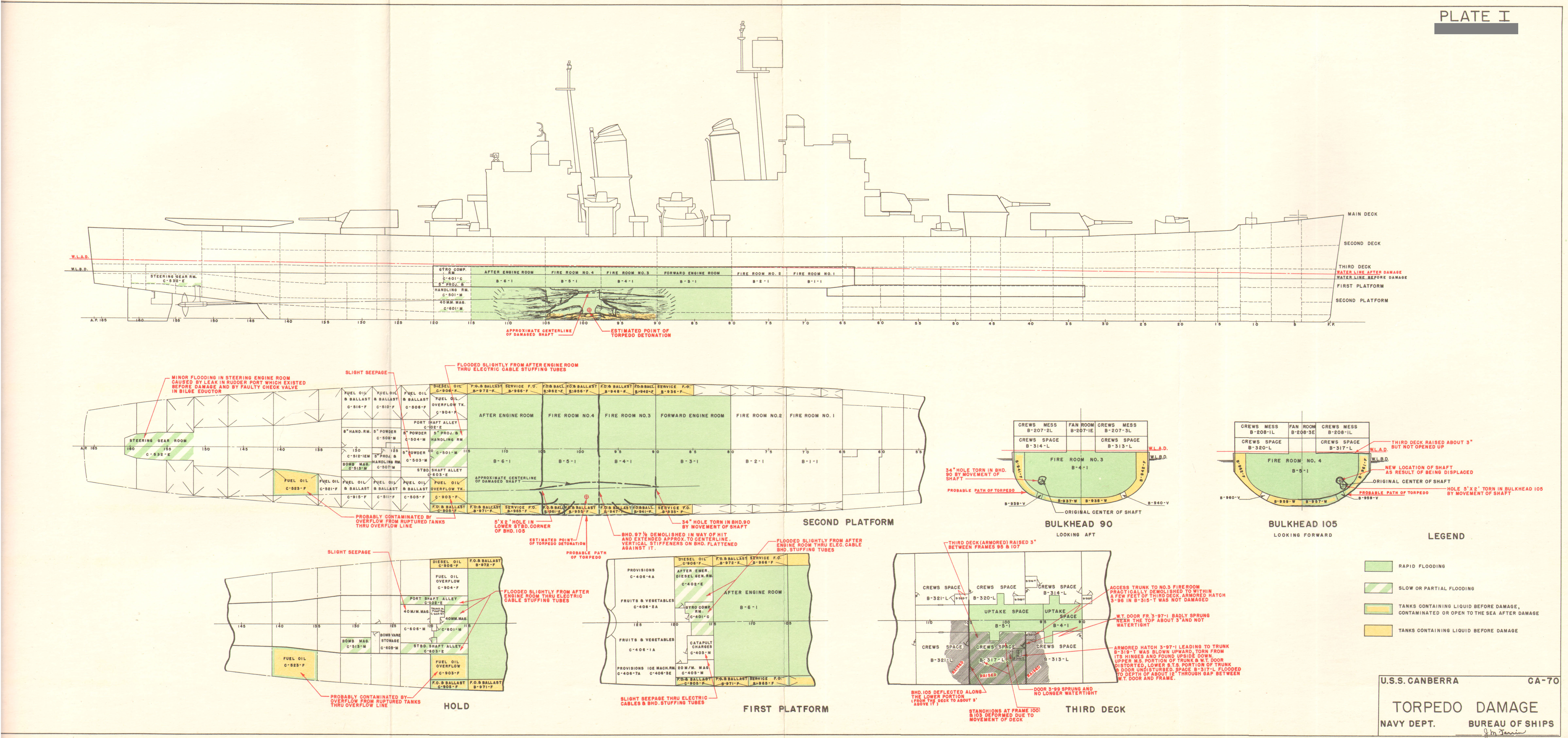
Damage chart from her torpedo strike. Much larger version here. 

Believed to be a Type 91, Mod. 3 torpedo, it hit below her armor belt at the engineering spaces and blew a jagged hole in her side, killing 23 men outright. Due to the location of the wound, a whopping 4,500 tons of water flooded her after fireroom and both engine rooms, leaving the cruiser dead in the water. (Read the extensive damage report, here)

Saved by heroic DC efforts, Canberra, along with the likewise torpedoed light cruiser USS Houston (CL-81), was towed to safety over the next several days under a CAP flown by the aircraft of the carriers Cabot and Cowpens. Nonetheless, during the initial retirement to Ulithi, the crippled cruisers were subjected to repeated Japanese air attacks, with Houston suffering another torpedo hit before it was over.

USS Canberra (CA-70) under tow toward Ulithi Atoll after she was torpedoed while operating off Okinawa. USS Houston (CL-81), also torpedoed and under tow, is in the right background. Canberra was hit amidships on 13 October 1944. Houston was torpedoed twice, amidships on 14 October and aft on 16 October. The tugs may be the USS Munsee (ATF-107), which towed Canberra, and the USS Pawnee (ATF-74). NH 98343

USS Canberra dry-dock ABSD-2 at Manus after the Japanese torpedo attack.

In the end, Canberra would remain under repair in forward bases and then at Boston Naval Yard until after VJ Day. Ordered back to the post-war Pacific Fleet, a refreshed Canberra arrived at San Francisco on 9 January 1946 then was placed out of commission at Bremerton on 7 March 1947 and mothballed.

She earned seven battle stars for her WWII service. Captain Early, her wartime skipper, would earn a Naval Cross and retire as a rear admiral in 1949, a veteran of both world wars in big-gunned ships. 

USS Canberra (CA-70), a chart of the ship’s operations in the Pacific Ocean with the Fifth and Third Fleet, from 14 February to 19 November 1944. Drawn by Quartermaster J.L. Whitmeyer, USNR. NH 78680

The Missile Age

The Baltimore class cost Uncle Sam an estimated $39.3 million per hull in 1940s War Bond-backed dollars. It made sense in the 1950s to try and get some more use out of these all-gun cruisers in an increasingly Atomic world. With that, Canberra and her sister ship USS Boston (CA-69) were tapped in 1951 to become the U.S. Navy’s first guided-missile warships in fleet service, dubbed CAG-1 (Boston) and CAG-2, respectively.

The conversion radically changed the aft of the vessels, deleting their 143-ton No. 3 8-inch turret and after twin 5-inch DP mount. Also stripped off were all the 40mm and 20mm AAA guns, replaced by six (later reduced to four) of the new 3″/50 twin Mk. 22s. Also deleted were the seaplane provisions and accompanying hangar, catapults, and crane.

Aerial photographs of USS Canberra in 1943, top, and 1967, bottom. Note her helicopter platform, angled to the starboard to provide for boat storage space. Immediate CAG sistership Boston did not have such an arrangement.

The superstructure was modified with their twin funnel arrangement morphed into a single stack and their pole mast was replaced with a radar mast topped with a powerful air search radar.

Two giant Terrier missile systems–capable of firing two missiles every 30 seconds– were installed over the stern along with two giant AN/SPQ5 radar directors for them. Below deck, a massive rotating magazine/workroom, capable of holding 144 missiles, was created. Keep in mind that the VLS-equipped Ticonderoga-class cruisers of today only have 122 cells.

USS Canberra (CAG-2) fires a Terrier guided missile during First Fleet demonstrations for Secretary of the Navy Paul H. Nitze, off the U.S. West Coast in December 1963. KN-8743

USS Canberra fires a Terrier guided missile, in February 1957. Photo NH 98398

Official period caption: “Super radars (AN/SPQ5) for guidance on terrier missiles installed onboard USS Canberra (CAG-2). The radars have massive, turret-like antennae and resemble giant searchlights. Developed for the U.S. Navy by the Sperry Gyroscope Company, the long-range, high-altitude missile guidance systems are a part of the U.S. Navy’s program directed toward the fleet with highly reliable missiles to combat supersonic jet aircraft. The super radar is giving an exceptionally high performance for tenacious stable guidance of supersonic missiles whether fired singly or in salvoes at individual or multiple enemy attackers. The systems combine many automatic radar functions in each unit and either system can control the missiles from a single launcher or battery, which fires the terrier missile or both radars can track different target groups simultaneously. It also includes flexible modes of scanning the air space many miles beyond the horizon, providing the advantage of early warning. Thus, individual targets can be selected from close flying groups and tracked with great distances while the missiles are launched and guided with extreme accuracy.” USN Photograph 670326 was released May 3, 1957.

The two-stage missile weighed 1.5 tons and was 27 feet long over the booster but had a speed of Mach 3 and a range of over 17 miles. Besides the 218-pound warhead, it could carry a W45 tactical nuke in the 1KT range. Not bad for just a decade off WWII.

Terriers were huge!

Seen here aboard the USS Providence (CLG-6) in 1962.

The conversions cost $15 million per hull or about half their original cost. Canberra was re-commissioned on 15 June 1956 at Philadelphia and looked quite different from when she was last with the fleet.

USS CANBERRA (CAG-2) entering Hampton Roads, Virginia, 1950s. K-20598.

The Kangaroo opened her pouch for the brass as needed, hosting Ike for his 1957 Bermuda conference with British Prime Minister Harold Macmillan.

President Dwight D. Eisenhower with his Naval Aide, Captain Evan P. Aurand, USN, onboard a launch taking them to USS Canberra (CAG-2), 12 March 1957. NH 68550

USS Canberra CAG-2 carrying President Eisenhower on a trip to Bermuda – March 1957 LIFE Magazine – Hank Walker Photographer

President Dwight D. Eisenhower practicing his golf game, while onboard USS Canberra (CAG 2) en route to Bermuda for a conference, 14 March 1957. The driving target and protective netting have been rigged on the main deck, just to starboard the ship’s Number Two eight-inch gun turret. NH 68555.

After a mid-cruise in the Caribbean and an extended deployment to the Mediterranean, she served as the ceremonial flagship for the selection of the Unknown Serviceman of World War II and Korea in 1958.

USS Boston sailors render honors as the casket is transferred to USS Canberra before ceremonies on board Canberra to select the Unknown Serviceman of World War II. Virginia Capes on 26 May 1958. NH 54117

Hospitalman William R. Charette selects the Unknown Serviceman of World War II, during ceremonies on board USS Canberra, 26 May 1958

Then came another mid-cruise, and stints in the Med, where she was often used as a flagship. A 1960 circumnavigation saw her visit her “home” in Australia for the first time and the next year she was on the line off Cuba, where she hosted RADM John W. Ailes, head of the blockade err quarantine task force.

A beautiful Kodachrome of USS Canberra (CAG-2) was underway on 9 January 1961. KN-1526

Then came her second shooting war, and she did lots of shooting.

Southeast Asia

Off Vietnam in February 1965 screening carriers of TF77, Canberra became the first U.S. Navy vessel to relay an operational message via communication satellite via the Syncom 3 system and prototype Hughes Aircraft terminals to reach the Naval Communications Station in Honolulu, 4,000 miles away. She followed it up with a confirmed xmit to USS Midway (CVA-43), which at the time was some 6,000 miles away.

By March 1965, she shifted away from Yankee Station to take up a spot on the evolving gun line just off the coast of Vietnam during Operation Market Time. This included providing overwatch for air raids into the country and Sea Dragon naval gunfire support, a mission the Navy had thought for sure was dead.

As noted by DANFS, “While supporting these operations Canberra carried out six fire support missions making her the first U.S. Navy cruiser to use her guns in warfare since the Korean War.”

In this role, the old WWII bruiser and others of her kind and vintage found steady employment. Between February 1965 and December 1968, Canberra shipped out for Vietnam’s littoral waters on five deployments, with her guns heavily in demand.

Off the coast of North Vietnam, the eight-inch guns of the USS CANBERRA (CAG-2) frame the “Terrier” missile launchers of the USS LONG BEACH (CGN-9). Photographed by Chief Journalist R.D. Moeser, USN. USN 1121640

USS Canberra (CAG-2) Eight-inch guns of Turret # 2 firing, during a Vietnam War gunfire support mission, March 1967. Note the two outgoing projectiles in the upper right corner. Photographed by Chief Journalist R.D. Moeser, USN. USN 1142159

USS Canberra (CAG-2) crewmen sponge out an 8/55 gun of Turret # 2, following Vietnam War bombardment operations, March 1967. USN 1122618

USS Canberra (CAG-2): A ball of fire lights up USS Canberra (CAG-2) as a three-gun salvo is fired toward North Vietnamese targets, in March 1967. Accession #: L45-42

The POW Savant

One of Canberra’s bluejackets had the misfortune of falling into the hands of the North Vietnamese through a freak accident and became a POW in the Hanoi Hilton.

Seaman Apprentice Douglas Hegdahl spent two years in a hell hole but was released earlier than a lot of other prisoners– as he wasn’t seen as being much of a threat and was one of the few conscripts in NVA hands–and carried irreplaceable intel back home. You see, as an EM in a prison camp full of 256 officers, he was given nearly free rein of the place and could interact with the other Americans. As such he (amazingly) memorized their names, capture dates, method of capture, and personal information despite feigning illiteracy during his captivity.

As described by Erenow:

Petty Officer Second Class Douglas Hegdahl was quiet and self-effacing. Unlike most American prisoners, who had been shot from the sky, he had been rescued from the sea. Serving aboard the USS Canberra, he had disobeyed orders and crept up on deck to watch a night bombardment. As he stepped past a five-inch gun, it discharged. He lost his footing and fell into the Gulf of Tonkin. The warship steamed away into the darkness.

Vietnamese fishermen picked him up and turned him over to the authorities, who thought him so clueless that his North Vietnamese guards called him “the incredibly stupid one.” But once released, he turned out to be a gold mine of information. To the tune of “Old McDonald Had a Farm,” he had memorized the names of more than two hundred prisoners. Thanks to him, scores of American families would find out for the first time that their sons and husbands and fathers were still alive. Within a few days of the press conference, Hanoi’s treatment of the prisoners began to improve— “a lot less brutality,” one captive remembered, “and larger bowls of rice.”

From Piloten im Pyjama, an East German propaganda film shot in the glorious Democratic Republic of Vietnam:

“Douglas Brent Hegdahl maintaining the cleanliness of the camp. Hegdahl is the only American draftee in custody in the DRV. The sailor fell overboard from a warship where he was serving as a draftee and was fished out of the water a short time later by Vietnamese fishermen. Now Hegdahl is sharing the life of the captured air pirates.”

The End

By July 1969, Canberra had been redesignated as an all-gun cruiser, picking up her old hull number (CA-70) and her Terrier missile systems and related equipment were removed. Although she was found to still be in good condition, she was instead pulled from service as part of a big pull-down by the Navy to liquidate older vessels.

On 2 February 1970, Canberra was decommissioned at San Francisco, was stricken from the Naval Vessel Register on 31 July 1978, and sold for scrap two years later.

Epilogue

Doug Hegdahl is still alive, aged 74. He left the Navy in the 1970s after working as a SERE instructor, a job he had particular knowledge. 

One of the USS Canberra’s screws was saved and is on display at the Los Angeles Maritime Museum in San Pedro.

Her ship’s bell was presented to the Government and Commonwealth of Australia the day before September 11 to mark the 50th anniversary of the ANZUS Treaty Alliance in a ceremony between President George W. Bush and Australian Prime Minister John Howard. It is now on display at the Australian Maritime Museum in Sydney, where Bush visited the bell in 2007.

White House photo by Tina Hager.

Further, in 2000, a plaque commemorating USS Canberra was installed at the Australian War Memorial.

She is also remembered in maritime art.

Painting of USS Canberra (CAG-2) departing San Diego Bay, in 1963 by artist Wayne Scarpaci titled Silvergate Departure

When it comes to such artwork, a 1928 watercolor of HMAS Canberra, which was presented to USS Canberra and carried aboard until she was decommissioned, is now in the custody of the NHHC. 

NH 86171-KN HMAS Canberra (Australian heavy cruiser, 1928) Watercolor by F. Elliott. This painting was received from USS Canberra (CA-70) in 1970.

A vibrant USS Canberra reunion association is set to have its meeting in Pittsburgh this year while the HMAS Canberra association remembers the service of their American cousins fondly.

While the Royal Australian Navy is currently on its third HMAS Canberra, a 28,000-ton LHD, the U.S. Navy is set to soon receive its second. PCS USS Canberra (LCS-30), an Independence-class littoral combat ship, recently took to the water of Mobile Bay and is set to commission in 2023. Her name was announced at a Feb. 2018 meeting between President Donald Trump and Australian Prime Minister Malcolm Turnbull.

Specs:


(1946 Jane’s)

(As-built)
Displacement: 14,500 long tons (14,733 t) standard; 16,000 tons full load
Length: 673 ft. 5 in
Beam: 70 ft. 10 in
Height: 112 ft. 10 in (mast)
Draft: 26 ft. 10 in
Propulsion: 8 Babcock & Wilcox boilers, four GE geared steam turbines with four screws = 120,000 shp
Speed: 33 knots
Fuel: 2,500 tons
Complement: 61 officers and 1,085 sailors
Armor: Belt Armor: 6 in
Deck: 3 in
Turrets: 3–6 inches
Conning Tower: 8 in
Aircraft: 4 floatplanes (Kingfishers) 2 catapults, one crane over the stern, below deck hangar for two aircraft
Armament:
9 × 8″/55 (20.3 cm) Marks 12s (3 x 3)
12 × 5″/38 (12.7 cm) Mark 12s (6 x 2)
48 × 40 mm Bofors guns
28 × 20 mm Oerlikon cannons

(As CAG)
Displacement: 17,500 full load
Length: 673 ft. 5 in
Beam: 70 ft. 10 in
Height: 112 ft. 10 in (mast)
Draft: 26 ft. 10 in
Propulsion: 8 Babcock & Wilcox boilers, four GE geared steam turbines with four screws = 120,000 shp
Speed: 33 knots
Fuel: 2,500 tons
Complement: 73 officers, 1,200 enlisted
Armor: Belt Armor: 6 in
Deck: 3 in
Turrets: 3–6 inches
Conning Tower: 8 in
Aircraft: Deck space for helicopter
Radar: SPS-43 forward, SPS-30 aft pole mast
Armament:
6 × 8″/55 (20.3 cm) Marks 12s (2 x 3)
10 × 5″/38 (12.7 cm) Mark 12 (2 x 2)
8 × 3″/50 (7.62 cm) Mark 22 AAAs (4 x 2)
2 x Terrier twin rail SAM launchers (144 missile magazine)

If you liked this column, please consider joining the International Naval Research Organization (INRO), Publishers of Warship International

They are possibly one of the best sources of naval study, images, and fellowship you can find. http://www.warship.org/membership.htm

The International Naval Research Organization is a non-profit corporation dedicated to the encouragement of the study of naval vessels and their histories, principally in the era of iron and steel warships (about 1860 to date). Its purpose is to provide information and a means of contact for those interested in warships.

With more than 50 years of scholarship, Warship International, the written tome of the INRO has published hundreds of articles, most of which are unique in their sweep and subject.

PRINT still has its place. If you LOVE warships you should belong.

I’m a member, so should you be!

Warship Wednesday, April 21, 2021: Let’s Vote on It

Here at LSOZI, we take off every Wednesday for a look at the old steam/diesel navies of the 1833-1954 time period and will profile a different ship each week. These ships have a life, a tale all their own, which sometimes takes them to the strangest places. – Christopher Eger

Warship Wednesday, April 21, 2021: Let’s Vote on It

Library and Archives Canada 4951041

Here we see a beautiful original color photo of the Improved Fiji-class (alternatively described as Colony-class, Mauritius-class, or Ceylon-class) cruiser HMCS Quebec (31) in Copenhagen, Denmark, on the occasion of Queen Elizabeth II’s birthday, 21 April 1954– some 67 years ago today. She battled the Germans, Italians, and Japanese withstood the divine wind and “Fritz X” only to have her reputation mired in undeserved controversy.

A borderline “treaty” cruiser of interwar design, the Fijis amounted to a class that was one short of a dozen with an 8,500-ton standard displacement. In WWII service, this would balloon to a very top-heavy weight of over 11,000. Some 15 percent of the standard displacement was armor. As described by Richard Worth, in his Fleets of World War II, the design was much better off than the previous Leander-class cruisers, and essentially “the Admiralty resolved to squeeze a Town [the immediately preceding 9,100-ton light cruiser class] into 8,000-tons.”

With a fine transom stern, they were able to achieve over 32 knots on a plant that included four Admiralty 3-drum boilers driving four Parsons steam turbines, their main armament amounted to nine 6″/50 (15.2 cm) BL Mark XXIII guns in three triple Mark XXI mountings in the case of our cruiser and her two immediate full sisters (HMS Ceylon and HMS Newfoundland).

The standard Fiji/Colony-class cruiser had four Mark XXI turrets, as shown in the top layout, while the “Improved Fijis/Ceylon-variants of the class mounted three, as in the bottom layout. Not originally designed to carry torpedo tubes, two triple sets were quickly added, along with more AAA guns, once the treaty gloves came off. (Jane’s 1946)

Ordered from Vickers-Armstrong’s, Walker in March 1939, just six months before Hitler sent his legions into Poland, Quebec, our subject vessel was originally named HMS Uganda (66) after that African protectorate. A war baby, she commissioned 3 January 1943.

HMS Uganda sliding down the slipway at the Walker Naval Yard, 7 August 1941. Tyne & Wear Archives & Museums (TWAM ref. DS.VA/9/PH/12/17).

HMS UGANDA, MAURITIUS CLASS CRUISER. JANUARY 1943, SCAPA FLOW. (A 22963) Broadside view. Copyright: © IWM. Original Source: http://www.iwm.org.uk/collections/item/object/205155098

After workups and interception patrols on the lookout for German blockade runners, in May she escorted the RMS Queen Mary (with Churchill aboard) across the Atlantic for a meeting with President Roosevelt at what later became known to history as the Washington Conference.

Transferred to the Mediterranean for service with the 15th Cruiser Squadron, she helped escort convoy WS31/KMF17 on the way before arriving in Malta with Admiral Cunningham aboard on 4 July. Then came the Husky landings in Sicily, where she was very busy covering the landings of the British 1st Airborne Division near Syracuse, rescuing 36 survivors from the hospital ship Talamba, and delivering naval gunfire support.

Cruisers HMS Orion and HMS Uganda on patrol with Mount Etna towering in the distance, some 40 miles away. Taken from HMS Nubian, 12th July 1943. The ships had bombarded Augusta the previous day.

A pom-pom crew of HMCS Uganda examining Kodak pictures. Note the “tropical kit” to include sun helmets and shorts. NAC, PA 140833

Then came the Avalanche landings at Salerno in September, where she provided NGFS for the British X Corps. Four days after reaching the beachhead, she was hit by a 3,000-pound German Fritz X precision-guided, armor-piercing bomb at 1440 on 13 September. Passing through seven decks and through her keel, it exploded under her hull, crippling but not quite killing the ship. When the smoke cleared, amazingly just 16 men of Uganda’s complement were dead.

The damage was very similar, albeit much less costly in lives, to the hit that the same-sized treaty cruiser USS Savannah (CL-42) suffered off Salerno two days prior. In the Fritz attack on that Brooklyn-class light cruiser, the early smart bomb hit the top of the ship’s number three 6/47-gun turret and penetrated deep into her hull before its 710-pound amatol warhead exploded. The damage was crippling, blowing out the bottom of the ship’s hull, immediately flooding her magazines– which may have ironically saved the ship as it prevented them from detonating– and killed 197 of her crew. In all, she would spend eight months being rebuilt.

As for Uganda, she was moved to Charleston Naval Shipyard in South Carolina for extensive repairs– just in time to become the most capable warship in another navy.

Oh, Canada!

By 1944, the Royal Canadian Navy could rightfully claim to be about the third strongest in the world when it came to warship tonnage. However, it was almost all in small escorts such as sloops, corvettes, frigates, and destroyers as well as armed yachts, trawlers, and torpedo boats. The RCN did have three armed merchant cruisers– the “Prince” class Canadian National Steamships passenger liners, which, at 6,000 tons, carried a dozen 6-, 4- and 3-inch guns, as well as depth charges and assorted Bofors/Oerlikons– but Ottawa had no proper cruisers on its naval list.

To rectify this, the brand-new light cruiser HMS Minotaur (53), transferred to Royal Canadian Navy in July 1944, and became HMCS Ontario (C53), although she did not finish working up in time to contribute much to the war effort. She was soon joined by Uganda, who kept her name when she was recommissioned 21 October 1944– Trafalgar Day– but replaced HMS with HMCS.

Uganda’s new crew, drawn from throughout the Canadian fleet, was assembled in 80-man teams and shipped out on a range of British 6-inch cruisers to train on their vessel while it was being repaired. These included a team that, while on HMS Sheffield, braved the Murmansk run and the Boxing Day 1943 fight against Scharnhorst. Curiously, and a bone of contention with the crew, she carried an RN duster rather than a Canadian ensign.

The Canadian cruiser would be commanded by Capt. Edmond Rollo Mainguy, who had previously served on several large RN warships including the battleship HMS Barham in the Great War.

Dispatched for service with the British Pacific Fleet, which was preparing for the final push against Japan, she stopped in the UK for sensor upgrades on the way, swapping Type 284 and 272 radars for newer Type 274 for fire control and Types 277 and 293 for surface warning and height finding. Nonetheless, the choice of the ship for tropical service, as it at the time lacked both onboard exhaust fans for air circulation and a water distillation plant capable of supporting the crew, was questionable. Belowdecks, when not on duty, many men simply wore “a towel and a pair of shoes.”

Regardless, she was a beautiful ship and her crew, most of whom were Battle of the Atlantic vets, were ready to fight.

A great shot of HMCS Uganda with a bone in her teeth. H.F. Pullen Nova Scotia Archives 1984-573 Box 1 F/24

British light cruiser HMS UGANDA underway. 14 October 1944. IWM FL 17797

HMS UGANDA, BRITISH CRUISER. 1944, AT SEA. (A 27728) Copyright: © IWM. Original Source: http://www.iwm.org.uk/collections/item/object/205159166

HMCS Uganda in 1945 while in the British Pacific Fleet. IWM ABS 698

She joined the BPF on 9 March, arriving that day in Sydney via the Suez and the Indian Ocean. Joining British TF 57 as part of the U.S. 5th Fleet, Uganda soon became a close escort for the fleet’s carriers, particularly HMS Formidable and HMS Indomitable. This included fighting off kamikaze raids, delivering NGFS, and acting as a lifeguard for downed aviators as the fleet pushed past Formosa, through the Philippines, and on to Okinawa.

Task Force 57 at anchor, HMS Formidable (foreground) and HMS Indomitable w 4th Cruiser Squadron- (L to R) Gambia, Uganda, and Euryalus-San Pedro Bay, Leyte April 1945

Japanese aircraft attacking H.M.C.S. UGANDA. Ryukyu Islands, Japan, 4 April 1945. LAC 3191649

Bombardment by H.M.C.S. UGANDA of Sukuma Airfield on Miyoko Jima, 4 May 1945, the ship’s QF 4 in (102 mm) Mark XVI guns in action. LAC 3191651

Decks of HMCS Uganda after her bombardment of the Sakishima Island airstrip of Sukama, south of Okinawa, 12 May 1945, with her 6-inch guns swamped with powder tubes. The ship in the distance is her Kiwi-flagged sistership, HMNZS Gambia (48). (Photo: CFB Esquimalt Naval and Military Museum, VR2014.1.1)

Ratings sleep amidst 4-inch shells on HMCS Uganda, 1945 (Photo: CFB Esquimalt Naval and Military Museum, VR2014.1.26)

HMCS UGANDA and HMS FORMIDABLE, the latter burning after a Kamikaze airstrike, May 9, 1945, Royal Canadian Naval photograph. (CFB Esquimalt Naval and Military Museum /Photo Catalogue VR2014. 1.24 from the museum collection.)

Life aboard the ship continued to decline for the crew. Compounding the uncomfortable heat aboard– which led to rounds of tropical bacteria, viruses, and fungus infections among the crew– the BPF had logistical issues trying to supply its ships. This led to mechanical issues as spare parts were not available and poor food.

As noted by Bill Rawling’s A Lonely Ambassador: HMCS Uganda and the War in the Pacific, a 25-page article in The Northern Mariner/Le Marin du nord, VIII, No. 1 (January 1998), 39-63, one firsthand report of the time detailed:

In the tropics everything multiplied — of a crew of 900, two men were detailed for spraying cockroach powder through the mess decks to at least try to control them. It was not out of the ordinary to be munching on your de-hydrated peas and carrots to feel a sharp “crunch.” That was another roach being broken up. Flour deteriorated into a life form — a tiny worm with a white body and a little black head. It would be found in the bread which was baked aboard ship. At first, we would pick the worms out, but as we were told, and came to realize, they would not hurt us, we just ate them with the bread and called it our meat ration for the day.

This set the stage for what became known as the “Uganda Episode.”

As explained by the Naval and Marine Museum at CFB Esquimalt:

Prime Minister Mackenzie King announced on 4 April 1945 that the Canadian Government no longer intended to deploy personnel, other than volunteers, to the Pacific Theatre. The “Volunteers Only” policy, as it was called, required that all naval personnel specifically re-volunteer for service in the Pacific Theatre before they would be dispatched to participate in hostilities.

On the eve of the vote, in which it seemed many of Uganda’s crew were on the fence about going home, Capt. Mainguy reportedly gave a tone-deaf speech that went as high as a lead balloon with one crew member’s recalling that he, “Called us four flushers and quitters. Those who were in doubt soon made up their minds at a statement like that.”

The June 22 crew vote found that 556 of Uganda’s men preferred to head home, while just 344 re-volunteered to stay in the Pacific despite the daunting risk of kamikaze attack and a war that, at the time, was expected to drag out at least another year. With the prospect of swapping out so many of the cruiser’s complement while still deployed a non-starter, the plan was to send her back to Esquimalt, update her for continued service, and sail back to the war with a reformed crew in time to join Operation Olympic, the invasion of Kyūshū which was slated for November.

Relieved on station by the British cruiser HMS Argonaut on 27 July, ironically the Japanese signaled they were ready to quit the war just two weeks later, making the Uganda vote– which left a bitter pill with the RN– almost a moot subject. Uganda arrived at Esquimalt on 10 August, the day the Japanese officially threw in the towel.

While labels of mutiny and cowardice were unjustly lobbed at her crew by historians, her skipper would go on to become a Vice Admiral.

Better years

Postwar, Uganda would spend the next two years in a training role.

Cruiser HMCS Uganda photographed on 31 November 1945.

A color shot of HMCS-Uganda (C66) as seen from the Canadian aircraft carrier HMCS Warrior circa 1946, note the Fairey Firefly and Maple Leaf insignias. LAC-MIKAN-No 4821077

Transferred to the reserves in August 1947, her slumber was brief.

Recommissioned as a result of the Korean War on 14 January 1952 as HMCS Quebec (C31), she soon sailed for Halifax to continue her service, notably under a Canadian flag and with belowdecks habitability improvements.

Guard of Honor and Band at the recommissioning of H.M.C.S. QUEBEC, Esquimalt, British Columbia, 14 January 1952 LAC 3524549

For the next four years, she was a global traveler, heavily involved in NATO exercises.

HMCS QUEBEC coming alongside for a ship-to-ship transfer receiving supplies from HMCS Magnificent, during  Exercise Mainbrace in 1952. LAC 4951392

A closer view, from HMCS Magnificent. Note the carrier’s 40mm mount and the folded wing of a fighter, likely a Hawker Sea Fury judging from the pair of wing-root 20mm cannons. LAC 4951382

H.M.C.S. QUEBEC heeling in rough seas during exercises. 18 Sept 1952 LAC 3524551

HMCS Quebec (C-31) leads HMCS Magnificent (CVL-21), HMAS Sydney (R-17), and multiple destroyers as they return from the Queen’s coronation, July 1953

Sperry radar scan of Gaspé Bay anchorage, HMCS Quebec 12 July 1953 LAC 3206158

HMCS QUEBEC Parading the White Ensign in Rio-South America cruise, 1954. Note the Enfield rifles, with the rating to the right complete with a chromed bayonet. Also, note the local boy to the left giving a salute to the RCN duster. LAC 4950735

Port broadside view of H.M.C.S. QUEBEC after having been freshly painted by ships’ company, Freetown, Sierra Leone, 29 June 1955 LAC 3524552

She also became the first Canadian naval ship to circumnavigate Africa, during her 1955 cruise. In 1946, she had claimed the first such Canadian warship to “Round the Horn” of South America.  

King Neptune and the pollywogs! Original color photo of HMCS QUEBEC’s crossing the line equator ceremony during her fall cruise to South America, 1956. LAC 4950734

HMCS Quebec (C-31) and USS Newport News (CA-148) at Villefranche.

With all-gun cruisers that required a 900-man crew increasingly obsolete in the Atomic era, Quebec was paid off 13 June 1956 and laid up in Nova Scotia. Four years later, she was sold for her value in scrap metal to a Japanese concern.

She is remembered in period maritime art, specifically in a piece by official war artist Harold Beament, who was on the RCNVR list and later president of the Royal Canadian Academy of Arts.

HMCS Uganda in Drydock, Esquimalt, during a post-war refit. Beaverbrook Collection of War Art CWM 19710261-1030

Today, the RCN remembers Quebec fondly. Narrated by R.H. Thomson, the script in the below tribute video is based on a memoir by LCDR Roland Leduc, RCN (Ret’d) who served on the post-war cruiser. 

An exceptional veterans’ site is also online, with numerous photos and remembrances. 

For a great deep dive into HMS Uganda, especially her 1945 service, check out Bill Rawling’s A Lonely Ambassador: HMCS Uganda and the War in the Pacific, a 25-page article in The Northern Mariner/Le Marin du Nord, VIII, No. 1 (January 1998), 39-63.

If you liked this column, please consider joining the International Naval Research Organization (INRO), Publishers of Warship International

They are possibly one of the best sources of naval study, images, and fellowship you can find. http://www.warship.org/membership.htm

The International Naval Research Organization is a non-profit corporation dedicated to the encouragement of the study of naval vessels and their histories, principally in the era of iron and steel warships (about 1860 to date). Its purpose is to provide information and a means of contact for those interested in warships.

With more than 50 years of scholarship, Warship International, the written tome of the INRO has published hundreds of articles, most of which are unique in their sweep and subject.

PRINT still has its place. If you LOVE warships you should belong.

I’m a member, so should you be!

Warship Wednesday, April 14, 2021: Just a Little DASH

Here at LSOZI, we take off every Wednesday for a look at the old steam/diesel navies of the 1833-1954 time period and will profile a different ship each week. These ships have a life, a tale all their own, which sometimes takes them to the strangest places.- Christopher Eger.

Warship Wednesday, April 14, 2021: Just a Little DASH

NARA KN-1814

Here we see a great original color photo of the Fletcher-class destroyer USS Hazelwood (DD-531) with an early torpedo-armed Gyrodyne-equipped Drone Anti-Submarine Helicopter hovering over her newly installed flight deck, 22 March 1961. Hazelwood was an important bridge in tin can history moving from WWII kamikaze-busters into the modern destroyers we know today.

Speaking of modern destroyers, the Fletchers were the WWII equivalent of the Burke-class, constructed in a massive 175-strong class from 11 builders that proved the backbone of the fleet for generations. Coming after the interwar “treaty” destroyers such as the Benson- and Gleaves-classes, they were good-sized (376-feet oal, 2,500 tons full load, 5×5″ guns, 10 torpedo tubes) and could have passed as unprotected cruisers in 1914. Powered by a quartet of oil-fired Babcock & Wilcox boilers and two Westinghouse or GE steam turbines, they had 60,000 shp on tap– half of what today’s Burkes have on a hull 25 percent as heavy– enabling them to reach 38 knots, a speed that is still fast for destroyers today.

USS John Rodgers (DD 574) at Charleston, 28 April 1943. A great example of the Fletcher class in their wartime configuration. Note the five 5″/38 mounts and twin sets of 5-pack torpedo tubes.

LCDR Fred Edwards, Destroyer Type Desk, Bureau of Ships, famously said of the class, “I always felt it was the Fletcher class that won the war . . .they were the heart and soul of the small-ship Navy.”

Named in honor of Continental/Pennsylvania Navy Commodore John Hazelwood, famous for defending Philadelphia and the Delaware River against British man-o-wars in 1777 with a rag-tag assortment of gunboats and galleys, the first USS Hazelwood (Destroyer No. 107) was a Wickes-class greyhound commissioned too late for the Great War and scrapped just 11 years later to comply with naval treaty obligations.

Portrait of Commodore John Hazelwood by Charles Willson Peale 1779 NH 77362-KN

The subject of our tale was laid down by Bethlehem Steel, San Francisco on 11 April 1942– some 79 years ago this week and just four months after Pearl Harbor. She was one of 18 built there, all with square bridges, as opposed to other yards that typically built a combination of both square and round bridge designs. Commissioned 18 June 1943, she was rushed to the pitched battles in the Western Pacific.

Aft plan view of the USS Hazelwood (DD 531) in San Francisco on 3 Sep 1943. Note her three aft 5″/38 mounts, depth charge racks, and torpedo tubes.

Forward pan view of the USS Hazelwood (DD 531) in San Francisco on 3 Sep 1943. A good view of her forward two 5″ mounts.

By October 1943, she was in a fast carrier task force raiding Wake Island.

Switching between TF 52 and TF 53, she took part in the invasion of the Gilbert Islands, Kwajalein, and Majuro Atolls in the Marshall Islands, then came the Palaus. Next came the Philippines, where she accounted for at least two kamikazes during Leyte Gulf.

Hazelwood in Measure 32, Design 6d during WWII

In early 1945, she joined TF 38, “Slew” McCain’s fast carrier strike force for his epic Godzilla bash through the South China Sea, followed up by strikes against the Japanese home islands.

Then came Okinawa.

While clocking in on the dangerous radar picket line through intense Japanese air attacks, she became the center of a blast of divine wind.

From H-Gram 045 by RADM Samuel J. Cox, Director, NHHC:

As destroyer Hazelwood was steaming to assist Haggard (DD-555) on 29 April, three Zekes dropped out of the overcast. Hazelwood shot down one, which crashed close aboard, and the other Zeke missed. The third Zeke came in from astern. Although hit multiple times, it clipped the port side of the aft stack and then crashed into the bridge from behind, toppling the mainmast, knocking out the forward guns, and spraying flaming gasoline all over the forward superstructure. Its bomb exploded, killing the commanding officer, Commander Volkert P. Douw, and many others, including Douw’s prospective relief, Lieutenant Commander Walter Hering, and the executive officer and ship’s doctor.

The engineering officer, Lieutenant (j.g.) Chester M. Locke, took command of Hazelwood and directed the crew in firefighting and care of the wounded. Twenty-five wounded men had been gathered on the forecastle when ammunition began cooking off. Because of the danger of imminent explosion, the destroyer McGowan (DD-678) could not come alongside close aboard. The wounded were put in life jackets, lowered to the water, and able-bodied men dove in and swam them to McGowan. Only one of the wounded men died in the process. Hazelwood’s crew got the fires out in about two hours and McGowan took her in tow until the next morning, when Hazelwood was able to proceed to Kerama Retto under her own power and, from there, to the West Coast for repairs. Although Morison gives a casualty count as 42 killed and 26 wounded, multiple other sources state 10 officers and 67 enlisted men were killed and 36 were wounded. Locke was awarded a Navy Cross.

“USS Hazelwood survives two suicide plane attacks. US Navy Photo 126-15.” Okinawa, Japan. April 1945

USS Hazelwood (DD-531) after being hit by a kamikaze off Okinawa, 29 April 1945. Accession #: 80-G Catalog #: 80-G-187592

USS Hazelwood (DD-531), June 16, 1945. Damaged by kamikaze on April 29, 1945. Official U.S. Navy photograph, now in the collections of the National Archives. 80-G-323986

Notably, two of her sisterships– USS Pringle (DD-477) and USS Bush (DD-529)— had been sunk by kamikaze aircraft off Okinawa less than two weeks before the attack on Hazelwood and three more– USS Luce (DD-522), USS Little (DD-803), and USS Morrison (DD-560)— would suffer a similar fate within the week afterward. Life was not easy for Fletchers working the picket line in the Spring of 1945.

Sent to Mare Island for repairs, Hazelwood was decommissioned on 18 January 1946 and entered the Pacific Reserve Fleet at San Diego, her war over.

The heavily damaged Fletcher-Class Destroyer USS Hazelwood DD-531 passes under the Golden Gate Bridge on her way to Mare Island Naval Shipyard for repairs – June 1945. LIFE Magazine Archives – Thomas Mcavoy Photographer

The heavily damaged Fletcher-Class Destroyer USS Hazelwood DD-531 passes under the Golden Gate Bridge on her way to Mare Island Naval Shipyard for repairs – June 1945. LIFE Magazine Archives – Thomas Mcavoy Photographer

The heavily damaged Fletcher-Class Destroyer USS Hazelwood DD-531 passes under the Golden Gate Bridge on her way to Mare Island Naval Shipyard for repairs – June 1945. LIFE Magazine Archives – Thomas Mcavoy Photographer

The heavily damaged Fletcher-Class Destroyer USS Hazelwood DD-531 passes under the Golden Gate Bridge on her way to Mare Island Naval Shipyard for repairs – June 1945. LIFE Magazine Archives – Thomas Mcavoy Photographer

The heavily damaged Fletcher-Class Destroyer USS Hazelwood DD-531 passes under the Golden Gate Bridge on her way to Mare Island Naval Shipyard for repairs – June 1945. LIFE Magazine Archives – Thomas Mcavoy Photographer

Note the total lack of superstructure and the temporary open bridge rigged.  LIFE Magazine Archives – Thomas Mcavoy Photographer

She received 10 very hard-earned battle stars for her World War II service.

She was luckier than 19 of her sisters who were sunk during the conflict, along with five others who, like her, suffered extreme damage and somehow remained afloat but were beyond economic repair once the nation came looking for a peace dividend. This works out to a loss rate of about 14 percent for the class.

DASH

By the time the Korean War kicked off, and the Soviets were quickly achieving parity on the high seas due to a rapidly-expanding snorkel-equipped submarine arm, 39 improved square-bridge Fletchers were taken out of mothballs and, through the project SCB 74A upgrade, a sort forerunner of the 1960s FRAM program, given new ASW weapons such as Hedgehog and Weapon Alpha in place of anti-ship torpedo tubes, deleted a 5-inch mount (earning the nickname of “4-Gun Fletchers) and swapped WWII-era optically-trained 40mm and 20mm AAA guns for three twin radar-guided 3-in mounts.

The Navy had something else in mind for Hazelwood.

Recommissioned at San Diego on 12 September 1951, she was sent to the Atlantic for the first time to work up with anti-submarine hunter-killer groups while still in roughly her WWII configuration.

USS Hazelwood (DD-531) in the 1950s, still with 40mm Bofors, at least one set of torpedo tubes, and all 5 big guns. USN 1045624

By 1954, she was back in the Pacific, cruising the tense waters off Korea, which had just settled into an uneasy truce that has so far held out. Then came a series of cruises in the Med with the 6th Fleet.

Ordered to Narragansett Bay in 1958, she was placed at the disposal of the Naval Ordnance Laboratory to help develop the Navy’s planned anti-submarine drone. Produced by Gyrodyne Co. of America, Inc., of Long Island, New York, it was at first designated DSN-1.

It made the world’s first free flight of a completely unmanned drone helicopter, long before the term “UAV” was minted, at the Naval Air Test Center, Patuxent River in August 1960, and Hazelwood provided onboard testing facilities, with her stern modified for flight operations with the removal of her torpedo tubes and two 5-inch mounts and the addition of a flight deck and hangar– the first time a Fletcher carried an aircraft since the brief run of a trio of catapult-equipped variants.

QH-50 prototype over Hazelwood, 1960, NARA 80-KN 1814

“U.S. Navy’s First Helicopter Destroyer Conducts Exercises. USS Hazelwood is the Navy’s first anti-submarine helicopter destroyer, steams off the Atlantic coast near Newport, Rhode Island. Attached to Destroyer Development Group Two, Hazelwood is undergoing extensive training exercises to acquaint her crew with air operations. Her flight deck is designed to accommodate the DSN-1 Drone Helicopter (QH-50) scheduled for delivery from Gyrodyne Company of America, Inc. Soon, an HTK Drone Helicopter with a safety pilot, developed by the Kaman Aircraft Company, is being used for training exercises until the DSN-1 Drone becomes available. Through the use of drone helicopter and homing torpedo, Hazelwood will possess an anti-submarine warfare kill potential at much greater range than conventional destroyers.” The photograph was released on 1 September 1959. 428-GX-USN 710543

According to the Gyrodyne Helicopter Historical Foundation, “the DASH Weapon System consisted of the installation of a flight deck, hangar facility, deck control station, CIC control station, SRW-4 transmitter facility, and fore and aft antenna installation” and could carry a nuclear depth charge or Mk44 torpedo.

Via Gyrodyne Helicopter Historical Foundation

USS HAZELWOOD (DD-531) Photographed during the early 1960s while serving as “DASH” test ship. NH 79114


Anti-Submarine Demonstration during the inter-American Naval conference, 1-3 June 1960. An HS-1 Seabat helicopter uses its sonar while S2F and P2V patrol planes fly over USS DARTER (SS-576), USS CALCATERRA (DER-390), and USS HAZELWOOD (DD-531). The demonstration was witnessed by Naval leaders of 10 American nations. USN 710724

USS HAZELWOOD (DD-531) during the early 1960s. Note her bright, modern-style hull numbers. NH 79115

Hazelwood received two lengthy respites from her DASH work, brought about by pressing naval events of the era. The first of these was the Cuban Missile Crisis in late 1962, serving as Gun Fire Support Ship for Task Force 84 during the naval quarantine of the worker’s paradise.

The second was in April 1963 when the newly built attack boat USS Thresher (SSN-593) failed to surface. Hazelwood was one of the first ships rushed to begin a systematic search for the missing submarine, escorting the Woods Hole Oceanographic Institution’s RV Atlantis II to the site and hosting several of the lab’s scientists and equipment aboard.

After her search for Thresher, Hazelwood returned to her job with the flying robots, completing over 1,000 sorties with DASH drones in 1963 alone and helping develop the Shipboard Landing Assist Device (SLAD). That year, Secretary of Defense Robert McNamara approved budgeting for enough aircraft to provide two plus one backup aircraft for each of the Navy’s 240 FRAM-1 & 2 destroyers in addition to development models.

By 1965, DASH drones were being used for hour-long “Snoopy” missions directing naval gunfire with real-time video in Vietnam at the maximum range of the ship’s 5-inchers.

With the drone, designated QH-50, ready for fleet use, Hazelwood’s work was done. Instead of a gold watch, she got what so many of her class ended up with– disposal.

Epilogue

Hazelwood decommissioned on 19 March 1965, just as the QH-50 program was fully matured and entered the Atlantic Reserve Fleet. Stricken 1 December 1974, she was subsequently sold 14 April 1976 to Union Minerals & Alloy, New York, and broken up for scrap.

Her plans, war diaries, 1950s logbooks, and reports are digitized in the National Archives. She is remembered in maritime art.

Kamikaze attacks on USS Hazelwood (DD 531), shown battered but still afloat, April 29, 1945. Artwork by John Hamilton from his publication, “War at Sea,” pg. 256. Courtesy of the U.S. Navy Art Gallery, accession 88-66-K.

A reunion blog for her crew remained updated until 2019.

The rest of her surviving sisters were likewise widely discarded in this era by the Navy, who had long prior replaced them with Knox-class escorts. Those that had not been sent overseas as military aid was promptly sent to the breakers or disposed of in weapon tests. The class that had faced off with the last blossom of Japan’s wartime aviators helped prove the use of just about every anti-ship/tactical strike weapon used by NATO in the Cold War including Harpoon, Exocet, Sea Skua, Bullpup, Walleye, submarine-launched Tomahawk, and even at least one Sidewinder used in surface attack mode. In 1997, SEALS sank the ex-USS Stoddard (DD-566) via assorted combat-diver delivered ordnance. The final Fletcher in use around the globe, Mexico’s Cuitlahuac, ex-USS John Rodgers (DD 574), was laid up in 2001 and dismantled in 2011.

Today, four Fletchers are on public display, three of which in the U.S– USS The Sullivans (DD-537) at Buffalo, USS Kidd (DD-661) at Baton Rouge, and USS Cassin Young (DD-793) at the Boston Navy Yard. Please try to visit them if possible. Kidd, the best preserved of the trio, was used extensively for the filming of the Tom Hanks film, Greyhound.

As for the DASH, achieving IOC in late 1962, it went on to be unofficially credited as the first UAV to rescue a man in combat, carrying a Marine in Vietnam who reportedly rode its short skids away from danger and back to a destroyer waiting offshore. However, due to a lack of redundant systems, they were often lost. By June 1970, the Navy had lost or written off a staggering 411 of the original 746 QH-50C/D drone helicopters built for DASH. Retired in 1971 due to a mix of unrealized expectations, technological limitations for the era (remember, everything was slide rules and vacuum tubes then), and high-costs, OH-50s remained in military use with the Navy until 1997, soldiering on as targets and target-tows. The last operational DASH, ironically used by the Army’s PEO STRI-TMO, made its final flight on 5 May 2006, at the SHORAD site outside the White Sands Missile Range, outliving the Fletchers in usefulness.

A few are preserved in various conditions around the country, including at the Intrepid Air & Space Museum.

Ever since USS Bronstein (DE/FF-1037) was commissioned in 1963, the U.S. Navy has more often than not specifically designed their escorts to operate helicopters, be they unmanned or manned.

Specs:
Displacement 2,924 Tons (Full),
Length: 376′ 5″(oa)
Beam: 39′ 7″
Draft: 13′ 9″ (Max)
Machinery, 60,000 SHP; Westinghouse Turbines, 2 screws
Speed, 38 Knots
Range 6500 NM@ 15 Knots
Crew 273.
Armament:
5 x 5″/38 AA,
6 x 40mm Bofors
10/11 x 20mm AA
10 x 21″ tt.(2×5)

If you liked this column, please consider joining the International Naval Research Organization (INRO), Publishers of Warship International

They are possibly one of the best sources of naval study, images, and fellowship you can find. http://www.warship.org/membership.htm

The International Naval Research Organization is a non-profit corporation dedicated to the encouragement of the study of naval vessels and their histories, principally in the era of iron and steel warships (about 1860 to date). Its purpose is to provide information and a means of contact for those interested in warships.

With more than 50 years of scholarship, Warship International, the written tome of the INRO has published hundreds of articles, most of which are unique in their sweep and subject.

PRINT still has its place. If you LOVE warships you should belong.

I’m a member, so should you be!

Warship Wednesday, April 7, 2021: The Curious Confederate of Barcelona

Here at LSOZI, we take off every Wednesday for a look at the old steam/diesel navies of the 1833-1954 time period and will profile a different ship each week. These ships have a life, a tale all their own, which sometimes takes them to the strangest places. – Christopher Eger

Warship Wednesday, April 7, 2021: The Curious Confederate of Barcelona

Here we see the Spanish bark-rigged screw steam corvette (corbeta) Tornado as she sits high in the water late in her career in the port of Barcelona, circa the 1900s. You wouldn’t know it to look at her, but she had one of the most (in)famous sisterships in 19th Century naval history and would dip her hand in a bit of infamy of her own.

In 1862, as the Confederate Navy was scrambling for warships of any kind, Lt. George T. Sinclair, CSN, was dispatched to Britain to work with CDR James Dunwoody Bulloch, the Confederacy’s chief foreign agent in Liverpool, to acquire a humdinger of a commerce raider. Coupled with a scheme to trade bulk cotton carried by blockade-runners out of Rebel ports for English credit and pounds sterling, Bulloch during the war had paid for the covert construction and purchase of the commerce raiders CSS Alabama and CSS Shenandoah as well as the less well-known CSS Florida.

CSS Alabama enters Table Bay at 10:00 AM August 5, 1863. She is increasing speed to capture the Sea Bride before she can escape to within one league of S.African territorial waters. This painting was commissioned by Ken Sheppard of South Africa. Via the CSS Alabama Assoc

Many consider the vessel that Sinclair and Bulloch ordered, which was drawn to a variant of the plans for the CSS Alabama, to be sort of a “Super Alabama.” Whereas the ‘Bama ran 220-feet overall and light with a 17-foot depth of hold and 1,050-ton displacement, her successor would be 231-feet and run 1,600 tons with larger engines and a battery of three 8-inch pivot guns (Alabama only had a single 8-inch pivot) and a 5-gun broadside.

When completed and armed, the Super Alabama was to take on the identity of the CSS Texas. However, to keep the construction secret, Bulloch arranged with the Clydebank firm of James and George Thomson of Glasgow to build her as a clipper under the name of Canton, then later Pampero, ostensibly for the Turkish Government, with an expected delivery date of October 1863.

Launched but lacking a crew, the English government was pressured after Thomas H. Dudley, United States Consul in Liverpool, discovered a near twin of the CSS Alabama was in the final stages of construction, and by late November a British man-o-war was anchored alongside the “Pampero.” On 10 December 1863, the yard’s owners and the ship’s agents were charged with violations of the Foreign Enlistment Act, wrapping the vessel up in legal proceedings for the rest of the war.

Drawing of the ‘Pampero’ published in The Illustrated London News 1864

In October 1865, six months after Lee surrendered at Appomattox but while the CSS Shenandoah was still raiding Yankee whalers in the Pacific, the Canton/Pampero/Texas was awarded to the bearers of the cotton bonds issued by Bulloch and company that had been used to finance the vessel then sold to the shipping firm of Galbraith & Denny.

The thing is, all the fast ships in European ports that could mount a hastily installed armament were at that time being bought up by the Empire of Spain or the Republic of Chile, who were engaged in a war in the Pacific. The Chilean agents, led by an interesting fellow by the name of Benjamín Vicuña Mackenna, beat the Spanish to the punch and bought Pampero for £75,000 in February 1866, with the vessel soon entered on the Chilean naval list as the corvette Tornado, subsequently sailing for Hamburg.

Over the next several months, the Spanish played a cat-and-mouse game as the Tornado and a second ship with a similar backstory, the corvette Abtao (former CSS Cyclone) attempted to be armed and outfitted, moving around European ports just one step ahead of their pursuers.

By the evening of 22 August, the Spanish 1st class steam frigate Gerona (48 guns), caught up with the unarmed Tornado at Madeira off the Portuguese coast and, after a short pursuit and four warning shots, the Chilean vessel, helmed by retired RN officer Edward Montgomery Collier, struck its flag.

Ángel Cortellini Sánchez ‘s “Captura de la corbeta de hélice Tornado por la fragata de hélice Gerona”, 1881, via Museo Naval de Madrid 

With the Armada Española

The next day, Tornado sailed for Cadiz with a prize crew and soon joined the Spanish fleet. After taking part in the September 1868 naval revolt, the vessel was dispatched to service in Havana in 1870. There, she was involved in the so-called Virginius affair in 1873.

For those not aware, Virginius had an interesting Confederate connection to Tornado, being built originally in Glasgow as a blockade runner then surviving the war and being used briefly by the Revenue Cutter Service.

VIRGINIUS (Merchant steamer, 1864-1873) Built in Glasgow, Scotland, in 1864 as a blockade runner. 1864-1867: SS VIRGIN; 1867-1870: U.S. revenue cutter VIRGIN; 1870-1873: SS VIRGINIUS. For more data, see Erik Heyl, Early American Steamers, vol. I. Watercolor by Erik Heyl, 1951. NH 63845

For three years starting in 1870, Virginius was used to run rebels under Cuban insurgent Gen. Manuel Quesada from the U.S. to the Spanish colony, with the somewhat tacit blind-eye and occasional support of the U.S. Navy. In October 1873, the steamer, skippered by Captain Joseph Fry, (USNA 1846, ex-USN, ex-CSN) and with a mixed British and American crew, was carrying 103 armed Cuban rebels when Tornado encountered her six miles off the Cuban coast.

Pursuit of Virginius by the Spanish gunboat Tornado, October 30, 1873.

Spanish man-of-war Tornado chasing the American steamer Virginius nypl.digitalcollections

1873 el Virginius, pirata estadounidense, es abordado por la corbeta española Tornado

The resulting chase and one-sided battle were short, with Fry striking his flag and Virginius sailed to Santiago de Cuba under armed guard.

There, the Spanish treated the crew and the insurgents as outlaws and pirates, executing 53 against the wall at the Santiago slaughterhouse, including Fry and the teenage son of Quesada, the lurid details of which were well-publicized by the press in the states, souring the relations between Washington and Madrid and pouring the foundation for the Spanish-American War.

Moving past Virginius

As for Tornado, she continued to serve the Spanish fleet for generations.

In 1878, she and the cruiser Jorge Juan stalked the pirate ship Montezuma, a mail steamer that had been taken by mutineers and Cuban rebels who turned to privateer against the Spanish. After a pursuit that spanned the Caribbean, Tornado found the Montezuma burned in Nicaragua.

Returning to Spain in 1879, Tornado was used as a training ship taking part in several lengthy summer cruises around the Med for the next few years, including escorting King Alphonso XII. By 1886, the aging bark was disarmed and used at Cartagena as a torpedo school for the rest of the century.

Home for boys

In 1900, Tornado was moved to Barcelona and assigned a new task– that of being a floating schoolship and barracks for orphan lads whose fathers had been lost at Manila Bay, Manzanillo, San Juan, and Santiago against the Americans. Remember, while U.S. naval historian largely covers these engagements as a tactical walkover and highlights Dewey, Sampson, and Schley as heroes, they left thousands of homes back in Spain missing a father.

Museu Maritim de Barcelona: The Tornado’s orphan cadets

Tornado would remain in Barcelona, moving past the education of the sons of 1898 to taking in general orphans and those of lost mariners and fishermen. Enduring well into the Spanish Civil War, she was sent to the bottom on 28 November 1938 by an air raid from Nationalist forces. Her wreck was scrapped in 1940.

Today, the Museu Maritim de Barcelona has her name board, recovered from the harbor in 1940, on display.

Via Museu Maritim de Barcelona

She is also remembered in a variety of maritime art.

Via Museu Maritim de Barcelona

For more on the Tornado, please read, “The Capture of Tornado: The History of a Diplomatic Dispute,” by Alejandro Anca Alamillo, Warship International, Vol. 45, No. 1 (2008), pp. 65-77. Keep in mind that old issues of WI are available on JSTOR to which access is open to INRO members.

Specs:
Displacement: 2,100 tons
Length: 231 ft
Beam: 33 ft
Draft: 16 ft
Machinery: Four boilers, 328 hp steam engine, one prop
Speed: 14 knots
Range: 1,700 miles
Complement: 202 men
Armament: (Spanish 1870)
1 × 7.8 in Parrott gun
2 × 160/15 cal gun
2 × 5 in bronze gun
2 × 3″/24 cal Hontoria breechloading guns

If you liked this column, please consider joining the International Naval Research Organization (INRO), Publishers of Warship International

They are possibly one of the best sources of naval study, images, and fellowship you can find. http://www.warship.org/membership.htm

The International Naval Research Organization is a non-profit corporation dedicated to the encouragement of the study of naval vessels and their histories, principally in the era of iron and steel warships (about 1860 to date). Its purpose is to provide information and a means of contact for those interested in warships.

With more than 50 years of scholarship, Warship International, the written tome of the INRO has published hundreds of articles, most of which are unique in their sweep and subject.

PRINT still has its place. If you LOVE warships you should belong.

I’m a member, so should you be!

Warship Wednesday, March 31, 2021: NOLA by way of Brazil

Here at LSOZI, we take off every Wednesday for a look at the old steam/diesel navies of the 1833-1954 time period and will profile a different ship each week. These ships have a life, a tale all their own, which sometimes takes them to the strangest places. – Christopher Eger

Warship Wednesday, March 31, 2021: NOLA by way of Brazil

Published by Detroit Publishing Company, 1890-1912. Courtesy of the Library of Congress.

Here we see the Elswick-built Chacabucu-class protected cruiser USS New Orleans (later CL-22) at Brooklyn Navy Yard in the 1900s. Prominently displayed is the cruiser’s elaborate stern decoration, which looks a lot like the Brazilian national emblem, and for good reason.

As part of a general Latin American naval build-up, Brazil ordered four cruisers in 1894 from Armstrong, Whitworth & Co from a design by British naval architect Philip Watts at ₤265,000 a pop. These ships, with a 3,800-ton displacement on a 354-foot hull, were smaller than a frigate by today’s standards but in the late 19th century, with a battery of a half-dozen 6″/50 (15.2 cm) BL Marks IX guns and Harvey armor that ranged between 0.75 inches on their hull to 4.5-inches on their towers, were deemed protected cruisers.

For batting away smaller vessels, they had four 4.7-inch (120mm) Armstrongs, 14 assorted 57 mm and 37mm quick-firing pieces, and three early Nordenfelt 7mm machine guns. To prove their worth in a battle line, they had three torpedo tubes and a brace of Whitehead 18-inch fish with guncotton warheads. They would be the first ships in the Brazilian fleet to have radiotelegraphs and were thoroughly modern for their time.

However, their four Vosper Thornycroft boilers and turbines, augmented by an auxiliary sailing rig, could only just make 20 knots with everything lit on a clean hull.

The lead ship of the class, laid down as Chacabucu (Elswick Yard Number 629) for the Brazilian government in March 1895, was sold to the Chileans just six months later with her name duly switched to Ministro Zenteno after a hero of the latter country. The second vessel, Almirante Barroso (Yard No. 630), was ordered in November 1894 and commissioned on 29 April 1897. Yard Nos. 631 and 676 were to be Amazonas and Almirante Abreu.

Amazonas in British waters on builder’s trials with no flags. Photo via Vickers Archives.

When things got squirrelly between the U.S. and Spain in early 1898 over Cuban independence and the lost battleship USS Maine, American purchasing agents were active in Europe both to A) expand Uncle Sam’s fleet, and B) prevent the Spaniards from doing the same.

This led to an agreement to buy from Brazil the old dynamite cruiser Nictheroy, though without her guns, and the two nearly complete cruisers outfitting on the Tyne. Lt. John C. Colwell, the naval attaché in London, personally took delivery of both British-built cruisers at Gravesend, England on 18 March, just a month after the loss of Maine and still a month before the American declaration of war.

With that, Nictheroy became USS Buffalo, Amazonas very quickly became USS New Orleans –the first time the name was carried by an active warship on the Navy List– and Almirante Abreu would eventually join the fleet as USS Albany. New Orleans, ready to go, would be sailed across the Atlantic by scratch crews from the cruiser USS San Francisco while English engineers handled the machinery, recording her Brazilian name in her logbook for the crossing.

USS New Orleans arrives off the New York Navy Yard, April 1898, after crossing the Atlantic. Note oversize commissioning pennant flying from her mainmast, and Brazilian Navy paint scheme. She had been purchased from Brazil on 16 March 1898, while still under construction in England. Sailing on her inaugural Atlantic crossing was a 15-man Marine det commanded by 1LT George Barnett, a future 12th Commandant of the Corps. NH 45114

She proved a popular subject with photographers, after all, she was a brand-new cruiser that descended seemingly from Mars himself, on the eve of the nation’s first conflict with a European power since 1815.

USS New Orleans (1898-1929) Docked at the New York Navy Yard, April 1898, immediately after her maiden voyage from England. The receiving ship USS Vermont is at the left. Note New Orleans’ extra-long commissioning pennant. NH 75495

U.S. Navy protected cruiser, USS New Orleans. The photo is listed as an “8-inch gun crew” although it is a 6″/50 (15.2 cm) Mark 5 Armstrong gun. Perhaps the caption was propaganda. Note the Marine in marching order and the bosun to the left with his pipe in his pocket. Detroit Publishing Company, 1890-1912.

US Navy protected cruiser USS New Orleans, six-inch gun. Note the small guns in the mast. Also, the man photobombing to the right of the frame, likely the photographer (Edward H. Hart) due to his bespoke hat. Published by Detroit Publishing Company, possibly 1898.

USS New Orleans (1898-1929) Photographed during the Spanish-American War, 1898. Note the change in her scheme from the Brazilian pattern. NH 45115

US Navy protected cruiser USS New Orleans (1898-1930, later PG-34, CL-22) leaving Brooklyn Navy Yard during the Spanish-American War. Photographed by Edward H. Hart, published by Detroit Publishing Company, 1898. Courtesy of the Library of Congress. LC-DIG-DET-4A13959

Her Span Am War service was significant, shipping out of Norfolk three weeks after the declaration and meeting the Flying Squadron off Santiago de Cuba on 30 May. The next day, our new cruiser, along with USS Massachusetts (Coast Battleship No.2) and USS Iowa (Coast Battleship No.4) reconnoitered the harbor, exchanging heavy fire with both Spanish ships and shore batteries.

Attack on Santiago, 31 May 1898 by USS MASSACHUSETTS (BB-2), USS IOWA (BB-4), and USS NEW ORLEANS (CL-22) by W.B. Shearer. USN 903384

New Orleans went on to spend the rest of her war on blockade duty, shuffling between Guantanamo Bay and San Juan. On 17 July 1898, she captured the French blockade runner Olinde Rodrigues trying to sneak into the latter and sent her, under a prize crew, to Charleston, South Carolina. The steamship was owned and claimed by La Compagnie Generale Transatlantique out of Harve, which later became the subject of a lengthy court case that, in the end, left the New Orleans’s crew without prize money.

USS New Orleans (1898-1929) Halftone photograph, taken during the Spanish-American War and published in the book War in Cuba, 1898. Courtesy of Alfred Cellier, 1977. NH 85648

Immediately after the conclusion of hostilities, she took part in the Peace Jubilee in New York, visited her namesake “hometown” in the Crescent City, then sailed for the Philippines via the Suez, arriving just before Christmas 1899, where she would remain on station for four years.

U.S. Navy protected cruiser, USS New Orleans on Asiatic Station, 1902. Shown is CPT (later RADM) Charles Stillman Sperry (USNA 1866), skipper, and his XO, LCDR James T. Smith. Note the ornate triple ship’s wheels in the background. Donation of Walter J. Krussel, 1949. Courtesy of the Library of Congress.

Laid up from 1905 to 1909, she recommissioned in 1910 with a new suite of American-pattern guns and headed to the Far East once again, with a gleaming new scheme worthy of TR’s Great White Fleet.

LOC LC-D4-5521

USS NEW ORLEANS (CL-22) Photographed before World War I in her white scheme. Note signalman atop the bridge. Description: Courtesy of Thomas P. Naughton, 1973.NH 92171

U.S. Navy protected cruiser, USS New Orleans, quarter-deck over the stern. Note her searchlights and torpedo-busting guns in the tower. Detroit Publishing Company, 1890-1912

Officers, crew, and mascot of USS New Orleans at Yokohama (CL-22), Japan, 1910. Note the flat caps and cracker jacks of the sailors; fringed epauletted body coats and cocked hats of the officers; outfits that were much more 19th Century than 20th. Via the Yangtze River Patrol Association.

USS NEW ORLEANS (CL-22) Flying a “Homeward Bound” pennant, circa 1912. Halftoned photo original view was courtesy of “Our Navy” magazine. NH 45118

By 1914, she was back in North American waters, spending time– along with most of the other surface assets of the fleet– in Mexican waters, patrolling that country’s Pacific coast in a haze gray scheme. This was a mission she would continue for three years, alternating with trips back up to Puget Sound where she would serve as a training vessel for the Washington State Naval Militia.

USS New Orleans CL-22. March 1916 crew photo taken during an overhaul at PSNS. Note the difference in uniforms from the China photo taken just six years prior. Via Puget Sound Navy Museum.

When the U.S. entered the Great War, she was transferred to the Atlantic, arriving at Hampton Roads on 27 August 1917. From there, she escorted a convoy carrying Doughboys and materiel to Europe. However, with plenty of ships on tap in the British Isles, the funky third-class cruiser received orders once more for the Pacific, reaching Yokohama from Honolulu on 13 March 1918.

USS NEW ORLEANS (CL-22) En route to the Asiatic Station, early in 1918, note her dark gray scheme. NH 45120

It was about this time that the Western Allies decided to intervene in the affairs of civil war-torn Russia, landing troops in Vladivostok in the Pacific as well as Archangel and Murmansk in the White/Barents Seas.

U.S. Soldiers parade in Vladivostok, Aug. 1918, a mission that would span four years and involve New Orleans for most of that. 

New Orleans would remain off and on as a station ship in Vladivostok until 17 August 1922, as the city’s population had quadrupled from 90,000 to more than 400,000 as refugees from the anti-Bolshevik White Russian forces and the Czechoslovak Legion, the latter formed from Austro-Hungarian Army POWs in Siberia, swelled the port, seeking to escape the oncoming Reds. Sheltered under the guns of American, British, French, and Japanese ships, the city remained the last large holdout from Moscow’s control, only being secured by the Red Army in October 1922 with the withdrawal of the hated “Interventionists.”

Czech Maj. Gen Radola Gajda and Captain E. B. Larimer on the deck of USS NEW ORLEANS, Vladivostok, 1919. A former Austrian and Montenegrin army field officer, Gajda helped the Russians raise the Czech legions in 1916 and would later become a high-level commander in the White Army in Siberia– even leading a coup to get rid of its overall leader, Russian Adm. Alexander Kolchak. Gajda would escape Vladivostok for Europe and briefly become the Chief of the General Staff for the Czech Army in the mid-1920s. Note his Russian cossack-style shashka saber with a knot as well as a mix of Russian, Austrian and Montenegrin medals. NH 1097.

Her last mission completed, and her tonnage held against the fleet in future naval treaties, New Orleans returned to Mare Island on 23 September, after calls en route at Yokohama and Honolulu, and was decommissioned on 16 November 1922. Stricken from the Navy List on 13 November 1929, she was sold for scrapping on 4 February 1930 to D. C. Seagraves of San Francisco, California.

As for her sisters, Chacabucu/Ministro Zenteno remained in Chilean service until 1930 and was scrapped while about the same time the Brazilian Barroso was disarmed and turned into a floating barracks, ultimately being written off sometime later, date unknown.

Zenteno and Barroso, Jane’s 1914 listing.

Albany missed the Span Am War, being commissioned in the River Tyne, England, on 29 May 1900. Sailing for the Far East from there where she would serve, alternating cruises back to Europe, until 1913 she only went to the U.S. for the first time for her mid-life refit. Recommissioned in 1914, Albany served off Mexico, gave convoy duty in WWI, and ended up with sister New Orleans briefly in Russia. With the post-war drawdown, she was placed out of commission on 10 October 1922 at Mare Island and sold for scrap in 1930.

Epilogue

Our cruiser is remembered in period maritime art.

U.S. Navy protected cruiser, USS New Orleans (later PG 34 and CL 22), port bow. Reproduction of a painting by Koerner & Hayes, circa 1897-98.

Her plans are in the National Archives.

A single 4.7-inch Elswick Armstrong gun from each of these English-made Brazilian cruisers in U.S. service is installed at the Kane County, Illinois Soldier and Sailor Monument at the former courthouse in Geneva, Illinois.

SECNAV has done a good job of keeping a “NO Boat” or “NOLA boat” on the Naval List for roughly 103 of the past 122 years.

The second completed USS New Orleans would also be a cruiser, CA-32, leader of her seven-hull class of 10,000-ton “Treaty Cruisers” built in the early-to-mid 1930s. The class would give very hard service in WWII, with three sunk at the horrific Battle of Savo Island. However, USS New Orleans (CA-32) was luckier, earning a remarkable 17 battlestars, going on to be laid up in 1947 and stricken/scrapped in 1959.

USS New Orleans (CA-32) In English waters, about June 1934. Photographed by Wright & Logan, Southsea, England. Donation of Captain Joseph Finnegan, USN (Retired), 1970. NH 71787

The third USS New Orleans was an Iwo Jima-class amphibious assault ship, LPH-11, commissioned in 1968. After a 30-year career, she was decommissioned and later disposed of in a SINKEX in 2020.

A vertical view of the amphibious assault ship USS NEW ORLEANS (LPH-11) underway. CH-53 Sea Stallion and CH-46 Sea Knight helicopters line the flight deck, 6/16/1988. PH2 Weideman/DNST8807549.

The fourth New Orleans is a Pascagoula-built San Antonio-class amphibious transport dock, LPD-18, that has been in the fleet since 2007.

PHILIPPINE SEA (Aug. 21, 2020) A rigid-hull inflatable boat, right, transits the Philippine Sea from the amphibious transport dock ship USS New Orleans (LPD 18). New Orleans, part of America Expeditionary Strike Group, 31st Marine Expeditionary Unit team is operating in the 7th Fleet area of operations to enhance interoperability with allies and partners and serves as a ready response force to defend peace and stability in the Indo-Pacific region. (U.S. Navy photo by Mass Communication Specialist 2nd Class Taylor DiMartino)

Specs:

Jane’s 1914 listing for Albany and New Orleans.

If you liked this column, please consider joining the International Naval Research Organization (INRO), Publishers of Warship International.

They are possibly one of the best sources of naval study, images, and fellowship you can find. http://www.warship.org/membership.htm

The International Naval Research Organization is a non-profit corporation dedicated to the encouragement of the study of naval vessels and their histories, principally in the era of iron and steel warships (about 1860 to date). Its purpose is to provide information and a means of contact for those interested in warships.

With more than 50 years of scholarship, Warship International, the written tome of the INRO has published hundreds of articles, most of which are unique in their sweep and subject.

PRINT still has its place. If you LOVE warships you should belong.

I am a member, so should you be!

Warship Wednesday, March 24, 2021: Nicky’s Dangerous Dolphin

Here at LSOZI, we take off every Wednesday for a look at the old steam/diesel navies of the 1833-1954 time period and will profile a different ship each week. These ships have a life, a tale all their own, which sometimes takes them to the strangest places. – Christopher Eger

Warship Wednesday, March 24, 2021: Nicky’s Dangerous Dolphin

Here we see the primitive one-of-a-kind submarine, Delfin of the Imperial Russian Navy cruising around the Krondstadt roadstead in August 1903, proudly flying the St. Andrew’s ensign. A sometimes-cranky little boat in perhaps the world’s most unlucky fleet, she would nonetheless leave a huge mark on naval history.

On 19 December 1900, Lt. Gen Nikolai Kuteinikov, head of shipbuilding for the Russian Admiralty, authorized a commission to begin work towards a submersible torpednyy kater, or torpedo cutter. While negotiations with Irish engineer John Philip Holland’s concern in American to purchase one of his submarine boats proved fruitless as Holland wanted a 10-unit package deal for a whopping $1.9 million, the Russians decided to roll their own. After all, how hard could it be?

Assigned this task was a team under promising young naval architect Ivan Bubnov. Bubnov, just 28 at the time, was fresh from the construction of the new battleship Poltava. As it would turn out, he would end up as Tsarist Russia’s Simon Lake.

Laid down on 5 July 1901 at the Baltic Shipbuilding & Mechanical Plant on Vasilevskiy Island– today’s historic 165-year-old OJSC Baltic Shipyard– the subject of our story was at first dubbed Torpednyy Kater No. 113, then later switching her pennant to Minonosets (destroyer) No. 150 before leaving the slipways.

The design was simple. Made in two symmetrical halves of rounded 8mm nickel steel then riveted and forge welded together over an internal framework, the submersible was just 64 feet long– the same size as USS Holland (SS-1).

Using flat iron plating on the vessel’s top decks for added strength, her fixed periscope-equipped conning tower/wheelhouse doubled as a hatch. Just 113 tons, she had ballast tanks on each end and could take on nine tons of seawater (in 15 minutes) to submerge to a maximum depth of about 150 feet. Obukhov was contracted for the blow system, which included a small electric air compressor that took four hours to refill completely empty air tanks.

Longitudinal section of submarine “Dolphin” via Ivan Grigorievich Bubnov’s Russian submarines: The history of creation and use of, 1834-1923.

He (Russian warships are never referred to as being female) used a French-made Soter-Garle electric motor and 64 Fullmen lead-acid batteries to achieve 7.5-knots submerged for short periods, and a German-made 300hp Daimler gasoline engine to reach 8.5 knots on the surface. Control was through a series of six rudders.

In short, he has been described as “like the USS Holland (SS-1) but worse.”

By September 1902, he was launched, and the following Spring was undergoing trials under the command of Capt. (3rd Rank) Mikhail Beklemishev, a 44-year-old torpedo tactics instructor on the submarine commission who had learned his trade on destroyers in the 1890s. During the construction of the Russian submarine under his command, he had traveled to the U.S. and met with Mr. Holland ostensibly on a shopping trip, and both observed and went to sea on Holland’s early Type 7 submarines at Electric Boat in Groton. Ironic considering Delfin’s description.

All the plankowners were volunteers recruited by Beklemishev.

Accommodations for the 13-member crew were cramped– remember the boat was shorter than a mobile home today and most of the spaces were taken up by machinery. Berthing was via hammocks and seabags strung over the wooden deck in the bow covering the batteries. A small stove for heating canned food and a novel electric samovar provided tea made up the galley. Fresh water amounted to about 40 gallons and the head consisted of a sand-lined closet. Officers’ quarters in the middle of the boat for the skipper and XO amounted to two stuffed sofas and a small dining table, all bolted to the deck around their own O-club cistern. Workstations had wooden stools similarly affixed to the deck.

He was armed with a pair of 1898 pattern 15-inch Whitehead torpedoes held outside of the submarine in a trapeze arrangement designed by Polish engineer Dr. Stefan Drzewiecki. Termed a “drop collar,” Drzewiecki’s girder launching system would become standard on Tsarist submarines through 1918 as well as a few French classes.

French submarine Espadon is seen at Cherbourg, France. Note the 17.7-inch torpedo in the Drzewiecki drop collar external launching system on her deck. Also, note her very Delfin-like main hatch with a periscope on top.

They could launch their steel fish with the submarine either submerged or surfaced and were operated via a hellbox inside the sub. The total price of the new submersible was 388,000 gold rubles.

In two rounds of sea trials in the Gulf of Finland during the summer of 1903, Beklemishev and crew were able to spend several days in a row on the ocean and found the craft to perform satisfactorily, both on the surface and submerged.

The occasion of her launch for sea trials. Note the two Whitehead torpedoes in Drzewiecki drop collars at her stern. Also, Beklemishev is the goateed officer on deck.

The same day, with a better view of the Whiteheads. 

On 16 August, Tsar Nicholas II, aboard his yacht Alexander and with the battleship Slava in escort, reviewed the little submersible torpedo boat and received the details of his trials directly from Beklemishev.

The well-known image of the Tsar (second from center, hands on sword) receiving the report from Beklemishev (far left) aboard Minonosets No. 150 on 16 Aug 1903. Bubnov stands behind the emperor and looks like he is waiting for Beklemishev to say something crazy.

Laid up during the annual Baltic Sea freeze-over, Minonosets No. 150 was given several modifications to correct errors observed during her sea trials to include a second periscope as well as redesigned rudders and diving planes.

Lessons learned in her construction and operation were used by Bubnov to create a larger, 100-foot submarine from the Minonosets No. 150 design– the six-boat kerosene/electric Kasatka (killer whale) class– which had four drop collared torpedoes. To compare with foreign types, the Admiralty purchased six 137-ton boats with bottoming wheels from Simon Lake (Osetr-class), three 209-ton subs from Krupp in Germany (Karp, Karas, and Kambala), a gifted midget sub from Krupp (the trailerable 40-foot Forel) and seven 105-ton boats from Mr. Holland (Som-class). Beklemishev was pulled from command and placed in charge of what was effectively the first Russian submarine school. Whereas the Russians only had their sole domestic-made boat in 1903, within a year they had more than two dozen soon on the way from multiple sources.

On May 31, 1904, all Russian destroyer submarines were given names by order of the Tsar, and “Minonosets No. 150” was christened Delfin.

When the ice melted, Delfin was ready for fleet operations but looked slightly different.

Note the second periscope

During regular operations in a rapidly expanding specialty branch, Delfin was used increasingly as a training boat, and on a practice dive while at the shipyard in June 1904, she went to the bottom under the command of LT. Anatoly Cherkasov along with 37 men and, tragically, remained there due to an issue with an improperly closed hatch, filling the sub’s interior with seawater except for a two-foot air bubble at the top of the boat. When finally rescued, Cherkasov and 23 of his crew had perished with the young officer voluntarily giving up his place to allow others to survive on the increasingly fetid air.

The first Russian submariners to be buried as heroes, they would not be the last. Amazingly, the survivors all elected to remain in the branch.

The grievous loss led the Russians to develop some of the world’s first submarine rescue tactics and vessels, including the rescue ship Volkhov, ordered in 1911 (which still, amazingly, endures as the Kommuna in Black Sea Fleet today.)

Raised and repaired, Delfin fired test torpedoes at a target hulk in October and, along with seven other small submarines, were hauled out of the water, fitted to railcars, and shipped via the single track Trans-Siberian Railway some 4,060 miles to the Siberian Flotilla’s base in Vladivostok as a pitched war was on with the Japanese in the Pacific.

Russian submarines on railcars to Vladivostok, 1904. The closest to the photo is Nalim/Burbot, a Kasatka-class boat. Four Kasatkas, notably just larger refinements to the Delfin’s design, were sent to the Pacific along with Delfin and two Holland-produced Som-class boats. 

The trip included a break at Lake Baikal where, as the spur around the world’s deepest freshwater body of water was not complete, they had to be transferred to a ferry to cross to the other side. The sight of submarines on a ferry crossing a lake in Siberia must have been a sight.

By 23 December 1904, Delfin arrived at Vladivostok and, once put in the water through a hole chopped in the iced-in harbor, made a test dive in the Pacific on 12 February. Two days later, along with the Holland-produced Som, he made a cautious combat patrol under the ice to the sea and soon was venturing further out to as far as 120 miles offshore, later operating with Kasatka as well.

Imperial Russian Submarines Delfin and Kasatka prepared to go out to sea for a patrol against the Japanese.

In all, by May, he spent 17 days at sea including eight on patrol. Together, Delfin, Som, and Kasatka reportedly came across two blockading Japanese destroyers 70 miles out and, attempted to get close enough to fire a torpedo volley– the Whiteheads only had a range of 1,500 yards– but were unable to due to the disparity in speed.

Speaking of the first submarine war in the Pacific, the Japanese ordered five of Mr. Holland’s boats in the summer of 1904, and quietly– so as not to flout American neutrality too much– they were constructed, dismantled, shipped from Connecticut to Seattle by rail and then, under the supervision of Arthur Leopold Busch, shipped to Japan for reassembly at the Yokosuka Naval Arsenal. However, the Japanese Holland boats weren’t ready for combat until after the end of the war.

Holland-built No 1 Class Submarine No.2 pictured at Yokosuka Naval Arsenal on May 1,1905

Japanese submarine tender Toyohashi mothering two Holland-class boats, Yokusuka, Sept. 25, 1905

Delfin’s war was cut short when, on 5 May, he suffered a gasoline explosion in port that singed crewmembers and popped 29 rivets. The smokey submariners were able to escape before he sank (for the second time in two years). Raised, he needed three months of repairs ashore before she was able to take to the water again.

Imperial Russian Submarine Delfin raised after sinking On May the 5th 1905,

The next Spring, on 11 March 1906, acting on behalf of the Tsar, the Minister of the Sea, Admiral Alexei Birilev decreed that Russia’s submersible “destroyers” were actually submarines and finally listed on the naval rolls as such.

Delfin would spend the next decade in the Far East, becoming the granddaddy of the Pacific Submarine Division. There she underwent a regular cycle of summertime cruises followed by winter lay-ups sans batteries and to keep the hull out of the ice. Each spring, she would receive additional equipment and improvements, making her much less spartan and much more survivable. Notably, she would suffer at least two other fires in her service they were quickly contained. In 1910, he performed a role of a torpedo testing craft, firing no less than 43 fish that summer while submerged.

Russian Siberian Military Flotilla, Ulysses Bay 1908, submarine Delfin (far left) along with submarines Kasatka, Skat, Nalim, Sheremetev, Osyotr, Kefal, Paltus, Bychok or Plotva, with the destroyer Grozovoy offshore. 

In August 1914, with the Great War upon the world, Delfin would take on war shot torpedoes and, along with the other subs of the Siberian Flotilla, would undertake fruitless combat patrols with a weather eye peeled for German and Austrian vessels.

Deflin’s 1914 Jane’s listing as part of the Russian Siberian Flotilla. Note the “Bubnoff” reference. The Russians entered the Great War with over 40 submarines, one of the world’s largest users

In March 1916, with the Kaiser’s wolves long cleared from the Far East except for the occasional surface raider, it was decided to ship Delfin from frozen Vladivostok to equally frigid Archangel in the White Sea, to be used in the defense of Kola Bay. Packed on railcars as far as Kotlas, he was transferred to barges on the Dvina River in June to take up to Archangel. Damaged in transport, he was not repaired and successfully placed in the water at her new homeport until September.

Badly damaged in a storm in April 1917, the commander of the Northern Fleet sidelined Delfin in favor of a new American-built Amerikanskiy Golland (Holland)-class submarine that was soon to arrive in port. Used briefly for training, Delfin was stricken from the fleet’s list in August 1917.

Later transferred to the local White Sea merchant fleet, he would be repurposed to a shift-lifting pontoon for salvage work, and then, on 16 March 1932, it was ordered by the Council of Labor and Defense Commissars that she be scrapped.

Epilogue

Delfin today is remembered in several pieces of maritime art.

Relics of the boat as well as a monument to the first Russian submariners are in Vladivostok.

Cap Ribbon and model of Russian submarine Дельфин Delphin at Vladivostok

Monument to Delphin and the first Rusian submariners. Vladivostok

As for his fathers, submarine designer Bubnov would design no less than 32 subs for the Tsar including the successful Akula and Bars classes, with the latter seeing service in both world wars. He would also lend his expertise to the Gangut-class battleships, which would cover themselves in glory and endure into the 1950s.

I.G. Bubnov near to submarine Akula on the dock of the Baltic factory

Made a Major General, Bubnov was ushered out of the design bureau with the fall of the Tsar but never left St. Petersburg, dying in the city’s Typhus epidemic in 1919 during the Civil War at the ripe old age of 47. The Soviets later named two merchant ships after him in the 1970s and 80s.

Beklemishev, Delfin’s first and most successful skipper, remained with the fleet until 1910, retiring as a Major General in charge of diving and submarine training. After teaching at various universities in the capital, he was appointed to the shipbuilding commission during the Great War, a position he was surprisingly able to keep for a while even after the Reds took over, even though he was arrested several times. Comrade Beklemishev retired for good in 1931 and passed away five years later in St. Petersburg, err Leningrad, and his grave was lost during the siege of the city in WWII. Both his son and grandson would go on to be Soviet merchant officers of some renowned, with the latter having a rescue tug named in his honor.

Speaking of honors and rescues, the grave of Delfin’s lost 24 submariners remain at Smolensk Orthodox Cemetery on Vasilevskiy Island in St. Petersburg, not too far away from that of Bubnov, who is celebrated today and has his likeness on several stamps and institutions.

Since 1996, a new holiday, the “Day of the Submariner” has been a national occasion. Implemented by order No. 253 of Admiral of the Fleet Felix Nikolayevich Gromov the “Day of the Submariner” is celebrated annually on 19 March, citing the 1906 order given by Adm. Birilev adding the term to the fleet and changing the submersible “destroyers” into official submarines, of which the Russians have had several hundred since then.

Last week, on the 115th anniversary of Birilev’s order, the Russian Navy, submarine vets, and their families held services across the country, including at the graves of the Delfin’s crew and the monument for the lost submariners of the Kursk, a more recent disaster.

Specs:

Via ‘“Submarines of the Tsarist Navy” (Spassky, I. D., Semyonov, V. P., Polmar, Norman), an excellent English primer to early Russian subs. 

Displacement: 113 tons surfaced; 126 tons submerged
Length: 64 ft
Beam: 11 ft
Draught: 9 ft 6 in
Propulsion: 1 shaft petrol / electric, 300 hp/120 hp
Speed:
10 knots surfaced; 6 knots submerged after 1910.
Complement: 22 officers and men after 1910
Armament:
2 external 15 in torpedoes in Drzewiecki drop collars.

If you liked this column, please consider joining the International Naval Research Organization (INRO), Publishers of Warship International

They are possibly one of the best sources of naval study, images, and fellowship you can find. http://www.warship.org/membership.htm

The International Naval Research Organization is a non-profit corporation dedicated to the encouragement of the study of naval vessels and their histories, principally in the era of iron and steel warships (about 1860 to date). Its purpose is to provide information and a means of contact for those interested in warships.

With more than 50 years of scholarship, Warship International, the written tome of the INRO has published hundreds of articles, most of which are unique in their sweep and subject.

PRINT still has its place. If you LOVE warships you should belong.

I’m a member, so should you be!

« Older Entries Recent Entries »